
It is amazing how much Android software development has changed over the past 15 years. To help you keep up with all the changes to Android OS, we have created a brief history of Android software development.
By understanding the history of Android, you will know how to create successful mobile apps for the Android OS.
Android Name History
As it often happens in our lives, we get named after someone or something. Well, the Android name history started the same way back in 1989. It came from the nickname of one of the founders — Andy Rubin.
At the time when he worked at Apple, Rubin had a strong passion for Android robots. Henceforth, it was no surprise that Andy’s co-workers and mates began to call him Android — the name that eventually became official for the company and operating system.
Original Company
As with all histories, we start from the beginning. In 2003 Rich Miner, Nick Sears, Chris White, and Andy Rubin founded a company called, as we’ve already mentioned, Android Inc.
Rubin started Android so they could develop “smarter mobile devices that are more aware of its owner’s location and preferences”.
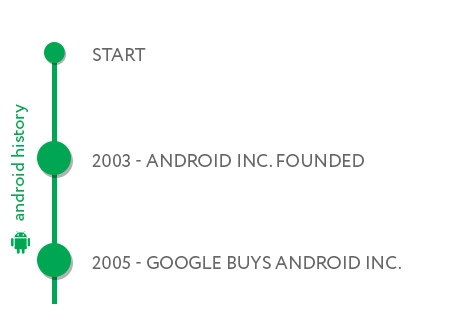
For the next two years the company struggled to gain a foothold in the smartphone industry. That was until Google purchased the company in 2005.
Rubin and his co-founders stayed on with full access to Google’s entire lineup of products.
One of the biggest decisions made at the time of the acquisition was to use Linux as the foundation for the Android operating system.
Launching and Open Source
Steve Jobs launched the modern smartphone era with his announcement of the iPhone on January 9, 2007. By June of that year, the first batch of iPhones was live in stores. The phone had become an instant sensation.
iPhone had become an instant sensation in June 2007
However, Google was not far behind. Then Google Chairman and CEO Eric Schmidt admitted in November 2007 to an ambitious new Google phone and an open source OS.
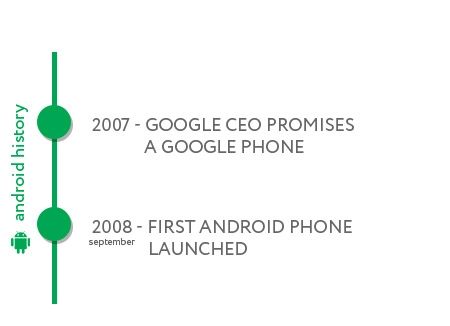
Google then joined the Open Handset Alliance with HTC, Motorola, Qualcomm, T-Mobile, and Texas Instruments. Later on, in September 2008, the first in the history of the Android device, HTC Dream, was launched onto the market and became commercially available.
Google’s Android OS became the de facto software for numerous smartphone manufacturing companies including HTC, Motorola, and Samsung.
The first Android phone was launched in September 2008.
The first Android-based smartphones were not as aesthetically pleasing as the iPhone. Still, many of them combined the new touchscreen technology with a physical QWERTY keyboard.
The first Android phone used several Google products such as Google Maps, YouTube, and Google search among others.

The Google Play store had not launched yet. Instead, they added the Android Marketplace where developers displayed their mobile apps.
Android Versions Evolution
Since that first phone in 2008, Google has launched 12 versions of their OS that is installed on over 3 billion of different devices.
They have also released five major Pixel phone models, which did not make a splash on the market despite an aggressive marketing campaign.
Here is the usage of multiple Android OS versions.
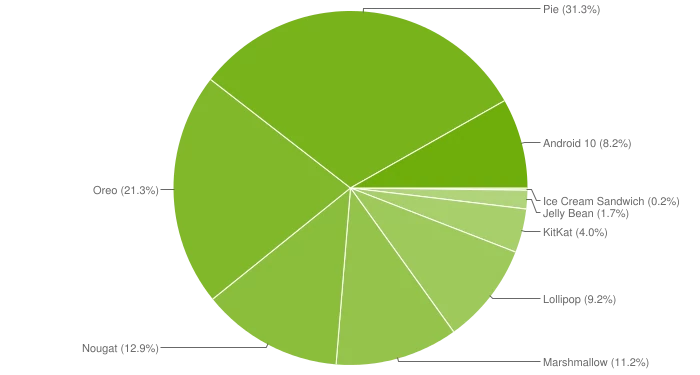
Source: Ausdroid
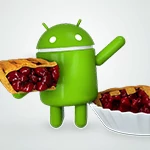
To some point, every version of OS was always named after sweet treats or desserts in alphabetical order. Google once explained: “Since these devices make our lives so sweet, each Android version is named after a dessert.”
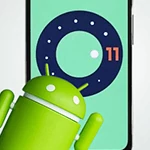
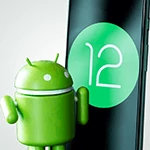
However, starting from Android 10, iconic names went away, being replaced with simple numbers. In fact, it became hard to find an easy-recognizable dessert while you get towards the end of the alphabet.
So now let’s move to the Android versions list and take a look at each to explore how the operating system has actually evolved throughout the timeline.