“Education is the key that unlocks the golden door to freedom.” That’s how George Washington described its importance. But the path to finding that key isn’t always easy.
Many students give up on education because the materials feel too difficult or the learning process seems boring. Today’s educational software and academic courses are designed with these challenges in mind.
And really, it’s hard to disagree that education has become more engaging, interactive, and personalized than ever before.
But here’s the thing: these tangible, positive changes in this sector wouldn’t be possible without big data. In this publication, we’re going to explore how this innovation redefines education and the possibilities it could unlock in the years to come.
Key Highlights
- Data analytics provide a comprehensive overview of a student’s overall educational history and academic performance, leading to more personalized learning plans.
- Though creating a custom solution for managing educational data may require a higher initial investment, it’s the only way to handle variables accurately and meet your business’s unique needs.
- In some cases, educational data analytics can be a double-edged sword, as low-performing students may be labeled and treated unequally.
- Soon, it will be possible to create a digital twin of a student that reflects their skills and performance to test new courses and adjust them before sharing with real learners.
Core Types of Data to Drive Educational Insights
When it comes to processing big data, you understand that you are going to deal with a huge number of variables. To save time and simplify analytics, it’s crucial to focus on the core data that truly drives value for your educational system. Below is a shortlist of key ones to consider:
Personal Data
The same is true for education. When it comes to eLearning platforms, they often collect data such as users’ age, gender, location, and email address. But educational institutions go even deeper. Typically, they keep information about a student’s overall learning history, from entrance exam scores to previous courses and academic performance.
This provides a comprehensive overview of each person’s profile, leading to more personalized learning plans.
Activity Data
Schools and institutions utilize slightly more variables for big data analysis in this regard. Typically, they also collect data on attendance, participation in class activities, assignment submissions, and so on.
Learning Score

Financial Data

You may also leverage financial data to track students’ payment history. As such, you can send relevant reminders to reduce the risk of revenue loss. From this perspective, big data analytics in higher education can also prevent students from being kicked out of the university because of missed payments.
Learn more about the power of Data Analytics in Education
Labor Market

Rates and Feedback

Consider, you offer a course on blockchain technologies, and notice that many users stop watching halfway through or frequently pause and rewatch certain sections. It may mean that your material is either boring or too tough to understand, or maybe both. So, solicit direct feedback to understand what’s going wrong.
From Insight to Impact: Turning Data into Real Value
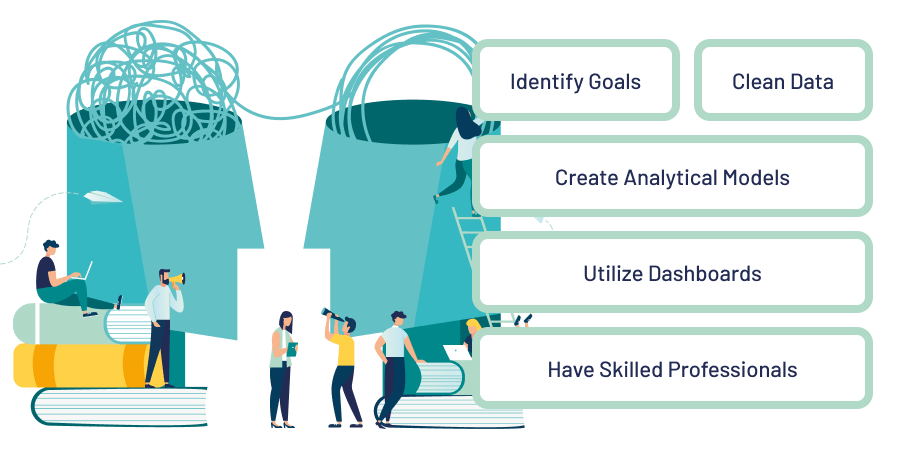
Imagine you want to make your favorite veggie salad. What is your routine? You probably wash the vegetables first, then cut them, mix, and finally season everything. Obviously, you wouldn’t start by cutting and seasoning before washing. Well, technically you could, but you’d end up with a messy dish instead of a delicious salad.
Think of big data analytics the same way. Here, you should also follow some basic steps to do it right. Specifically, consider the following ones:
Step 1: Identify Goals
You might think everything should start by collecting a massive dataset into your data lake. Then, depending on your needs, you can process only the relevant variables. But the truth is, it all starts with clearly identifying your key goals.
Start with setting core KPIs, like students’ performance, engagement levels, or dropout rates, and collect only the data that supports them. This way, you may avoid getting lost in a sea of irrelevant information and save time by focusing on what truly matters.
Check our publication to Discover More About Data Lakes
Step 2: Clean Data
Getting accurate insight means processing clean variables for analytics. This includes removing inconsistencies, irrelevancies, and duplicates, and, of course, bringing all data into a consistent format to process it smoothly.
Step 3: Create Analytical Models
After cleaning your data, consider building analytical models. They help identify possible risks, and make reliable predictions. For example, you can use clustering to assess student performance. You might break down the data into three groups:
- Green – high-performing
- Blue – mid-performing
- Red – low-performing
As such, you will identify the group of students who need additional support not to drop out.
Step 4: Utilize Dashboards
The next step is making your insights understandable for users. Here, business intelligence solutions may serve best. Typically, BI tools offer a wide range of customized features like interactive dashboards and visual charts, which make big data understandable for non-professional users.

BI for Business
Step 5: Have Skilled Professionals
All the above-mentioned steps will be incomplete without an experienced team on board. Needless to say, you need skilled data analysts to smoothly process insights.
Additionally, it’s worth investing in training for your staff, such as professors or methodologists, to help them work with data more confidently.
Best Tools for Analyzing Big Data in Education
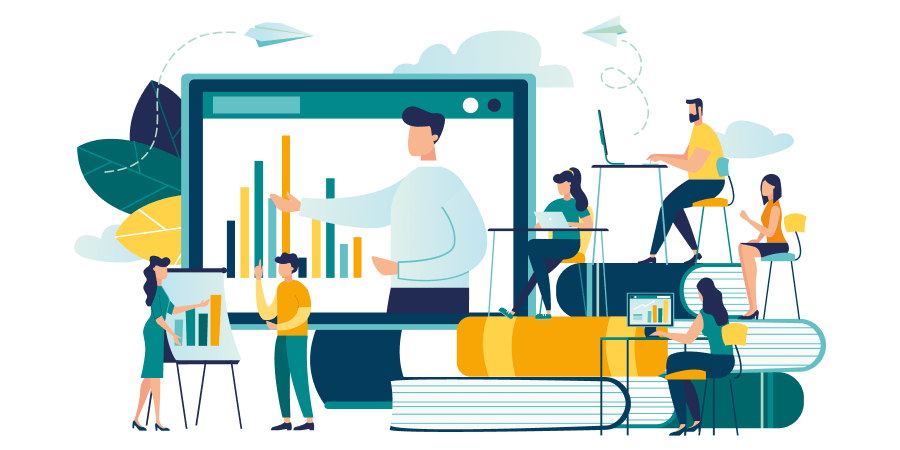
You may come across various tools to manage big data in education. Today, platforms like Microsoft Fabric and Google Cloud are among the most effective options to leverage in this regard.
Plus, if you use learning management systems, you can enjoy the built-in analytics models they come with. Simply put, effortlessly process your data. And though everything seems pretty perfect at first glance, here’s where the shoe pinches: off-the-shelf tools may fall short when it comes to meeting your business’s unique needs.
So, instead of giving you a list of top tools to smoothly handley your educational data, let’s be honest — nothing beats a custom solution. Of course, crafting your own bespoke solution from scratch may seem like a costly endeavor, but the outcome it will bring in the future is definitely worth the investment.
Find out more intriguing Reasons to Leverage Custom-Built Apps
Why Can Big Data Be a Double-Edged Sword for Education?
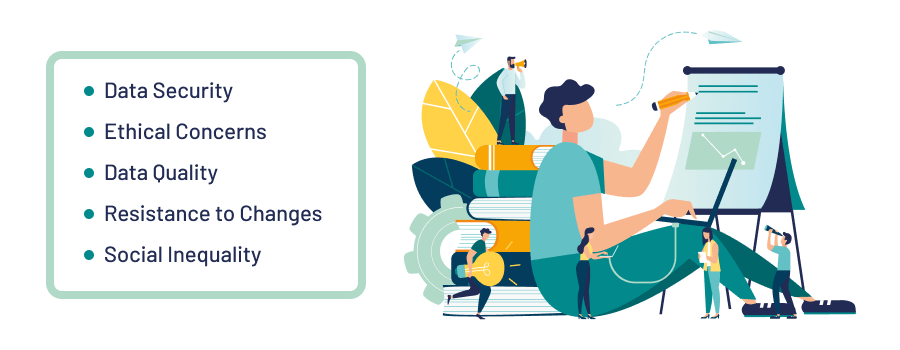
Processing your educational big data to gain valuable insight is like threading a needle. Hidden pitfalls are everywhere, from silos data to privacy concerns. So, before diving into this venture, be prepared to navigate these potential issues along the way.
Data Security
The eLearning market is expected to reach US$75.52 billion by 2029. Given the massive number of users on these platforms, just imagine how much personal data is being collected.
Big data and higher education also go hand in hand. University systems often collect and store sensitive student data, thus they can become prime targets for hackers. Protecting such systems isn’t simple, but it’s non-negotiable. This requires strict compliance with local regulations, robust implementation methods, strong encryption, and the adoption of modern technologies (e.g., blockchain, MFA, cloud security tools, and AI) to enhance data security.
Read on how we helped our client Elevate Cybersecurity with the Blockchain-Based Intrusion Detection System
Ethical Concerns
Having access to a student’s performance score can be both a blessing and a curse. As we’ve already mentioned, data analytics helps identify students with low performance or those at risk of dropping out of university. Ideally, this information should be used to take preventive actions and improve learning outcomes.
However, in some cases, this may cause more harm than good. Specifically, this data can unintentionally lead to students in the “at-risk” group being treated unequally or with bias.
Data Quality
As you collect data from different sources, you risk dealing with silos and unstructured variables. However, there’s no alternative — you need to gather all this information for comprehensive and accurate data analytics.
Of course, you understand that cleaning this data is going to be tough. You should standardize formats, remove duplicates and inconsistencies, use validation rules, and the like. These steps also take time, but they’re the only way to effectively process your educational data.
Resistance to Change
Understanding the importance of data literacy to empower your staff to smoothly interact with data, you may feel inclined to provide them with the necessary support. Meanwhile, the older generation is not always ready to utilize new technologies. Oftentimes, they are resistant to change and prefer to stick with what they’re familiar with.
For example, they may choose to log student attendance in a paper logbook rather than using an online attendance tracker. Needless to say, if this is the chosen method, you won’t be able to collect the necessary data to track crucial insights on student activity and performance.
Social Inequality
We’ve discussed how education has evolved over the past decades. And the main role in this change is big data analytics. But unfortunately, not everyone has access to the necessary technologies, and not all institutions can afford to leverage smart systems for collecting and analyzing data. This creates unequal conditions among learners.
Why Education Can’t Go on Without Big Data Anymore?
If you are still not sure whether it’s time to employ big data to improve your educational materials and overall learning outcomes, the answer is — this is long overdue. This statistic proves it best: the big data analytics market in education worldwide will reach $57.14 billion by 2030.
Hence, whether it’s an academic institution or an eLearning platform, many have already realized they can’t move forward without robust big data analytics.
We’ve already covered the top reasons making big data irreplaceable for education. Before wrapping up, let’s skim through some key takeaways and discover a couple of coming-soon options:
More Personalized Learning

Discover why Artificial Intelligence Plays a Key Role in Education
Predictive Models

Digital Twins
Super Adaptive Micro Course

Make Big Data Your Edge in Smarter Education
With all of the insights we’ve covered, you can see the immense role of big data in education. Only by collecting and properly analyzing crucial data can you make your materials engaging and useful and gain a competitive edge.
That is to say, big data can work wonders for your learning program. However, to reap its full advantages, you need robust data analytics in place. At Velvetech, we’ve got years of experience under our belt, helping companies across different industries to turn their variables into measurable insights.
Why not become our next success story? Feel free to contact us for more details.
About the author