
Remember your school or university days. The learning process back then compared to now is worlds apart — from the methods used to the tools available to students and teachers.
Dozens of years ago when the Internet or even computers were not common, students had to burn the midnight oil in libraries to find the needed materials. Teachers had no other choice than to burden tons of different responsibilities that went far beyond the learning process upon themselves and didn’t have access to any support tools.
What’s now? Students may just ask ChatGPT, and voila, they have answers generated just in seconds. For their convenience, they all use laptops and tablets and gradually abandon paper carriers. Teachers, in their turn, gained the advanced opportunities to quickly and comprehensively analyze students’ performance and adjust their learning process to boost the wards’ academic results.
Seemingly, there’s nothing bad in it: times change, and we have to keep pace and make use of the capabilities technologies are willing to offer. However, unsupervised usage of such tools may do more harm than good in the long run.
Today, let’s discuss how the usage of AI-powered educational solutions affects the learning process in general. How they gradually transform the educational process, making it more interactive and efficient, and if there is a chance to draw up a universal AI-powered knowledge base used in all parts of the world.
What’s Good about AI. How Its Capabilities Are Used in Academic and Corporate Education
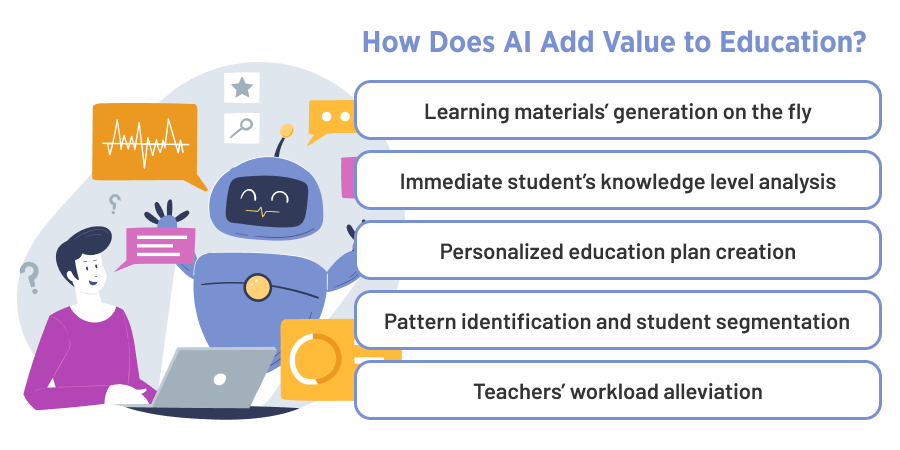
Let’s start our discussion with the major notes and examples of Artificial Intelligence in education. The technology significantly alleviates the lives of both parties — students and teachers; we’re already used to it. Below, we answer how is AI used in education and go over some aspects where the technology unquestionably yields invaluable benefits.
Automated Creation of Educational Content
With your hand on your heart, answer: did you use only the textbooks provided by your educational institution by default? Most likely, they weren’t enough, and you had to pester libraries to find the materials you needed to prepare a report or an essay.
In other words, the search for necessary information represented a fascinating adventure by itself. That’s what you had to spend the lion’s share of your time and energy on while your effort could have been redirected to studying.
With the advent of Artificial Intelligence, gaining access to necessary materials is way easier, and it’s one of the biggest benefits of AI in education. All you need is to correctly create the request to the generative network — and here you are, the answer is ready in several seconds. However, the key word here is “correctly”, we’ll touch upon this point when we switch to risks posed by AI.
Students’ Knowledge Assessment and Personalized Educational Plan Creation
Let’s review these two intertwined points as a whole and refer to one simple example. Say, you already have basic knowledge of the Spanish language and desire to enhance your skills but have no idea where to start.
Generative AI applications in education can provide you with a fulcrum. You create a prompt, and the network offers tests to determine your level of Spanish. After you pass them, it conducts an assessment to detect your blind spots and generates learning materials that correlate with your knowledge at the moment.
Obviously, it applies not only to language learning. You are empowered to study any subject the network is trained for. If it’s not, Generative AI tools can be additionally trained on specialized content, or at least there is a possibility to provide it with the context, so they could generate the curriculum on its basis.
Check out how we created a Mobile Learning Framework for Offline Educational Apps
Corporate Training
To fully assess the value of Artificial Intelligence in corporate education, let’s refer to the example of such a global company as McDonald’s. The turnover rate of kitchen staff and cashiers is huge without exaggeration. Obviously, they have their internal Learning Management System (LMS) where they store all learning materials and documents.
Newbies log in to the software and read all the instructions to be prepared for further work. But how to control how a new employee has absorbed the knowledge? Of course, it can be done via various control tests, but is this method of monitoring effective?
How would you like it if we use an AI-enabled chatbot trained on the learning materials from the corporate knowledge base for an interactive studying process? The technology can flexibly adapt to the learner’s knowledge level and provide a truly personalized experience. Judge for yourself, which educational method is more effective: multi-page knowledge base self-studying or interactive and tailored training?
GenAI for Business
Pattern Identification and Student Segmentation
Artificial Intelligence perfectly works on big data. With huge volumes of various information, both historical and current, it can identify patterns and make predictions. Here are several examples from the educational sphere.
Prediction of Student’s Learning Outcomes Based on Historical Data
For example, through the analysis of previous student’s tests, the network can predict their learning outcomes and offer special materials or even elaborate tailored educational programs, based on their particular weak points.
Intersection with Healthcare: Early Identification of Student’s Impairments
The AI application in education may suspect that something is wrong even before a teacher smells a rat. How? Through the advanced analytical capabilities, of course! Guided by the results of completed tests, the software can detect non-typical patterns and make teachers aware of potential children’s health problems.
Sure thing, we can’t fully shift the diagnosis to the system, nor do we need it to be responsible for that. However, it can help teachers and parents pay attention to possible health issues and take timely measures for their further progression.
Discover Generative AI for Healthcare: Facilitating Science and Workflows
Enabling Parents to Have Better Control Over Their Children’s Academic Performance
However, nowadays this can be done even without any intervention of an educator: the necessity to schedule a call with parents and select material suitable for students is disappearing by itself, and it’s also a big benefit of artificial intelligence in education.
Currently, our team is working on the development of an educational solution. For our client, we elaborate a module that analyzes student’s academic performance and automatically generates an email to their parents. In the body, there is a detailed description of the problem, while the attachments contain links to related content or educational videos. Therefore, the possibility that a student would neglect the problem and it would affect the educational process as a whole is very unlikely.
Shortage of High-Qualified Teachers Can Be Replenished by AI-Enabled Virtual Tutors
Teachers, like doctors, are a precious asset for each country, and its shortage is an acute problem requiring instantaneous responses. The problem is exacerbated by the fact that not each educator is erudite and competent enough to impart knowledge to students effectively.
This gap can be filled by AI in online education. Let’s combine voice synthesis, speech recognition, and animated avatar — and here we go! We have a virtual tutor that may hardly be distinguished from a real human at first sight. However, differences exist: a living person is unable to analyze huge flows of information and generate content on the fly, in comparison with AI applications used in education.
What the Future Holds for AI in Education. Is There a Chance It Becomes a Universal Encyclopedia?
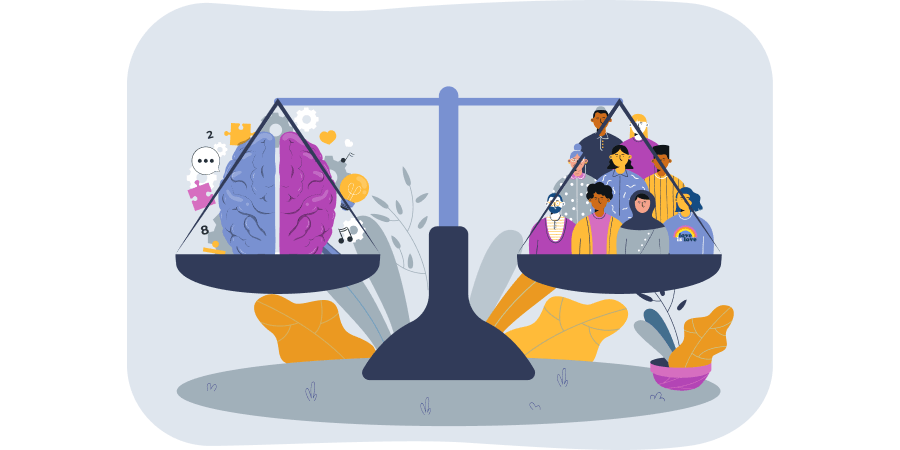
Seemingly, what prevents us from turning a conditional ChatGPT into a universal knowledge base that can be used by teachers and students from all parts of the world? There are minor, but very important things to keep in mind — different languages and cultural specifics.
Did you know that major chatbots have been trained on approximately 100 languages, while our world counts 2,700 or even 7,000 if we include dialects in the list? Another thing worth mentioning is that the vast majority of accessible online higher education materials were produced by only two regions — the European Union and North America.
The asymmetry is impressive, isn’t it? And now imagine how educational approaches vary from one region to another due to sociocultural specifics. We must reckon with it and try not to standardize them, and here are our points in favor of this.
Putting the Identity of a Particular Culture at Risk
And now think carefully, will you travel to a place absolutely identical to yours? Imagine, nature, landscapes, weather, and architecture are absolutely similar. Most likely, it will not make much sense to do so.
The same goes for education. If everyone is raised on standardized content and follows an identical curriculum created by machines, will there anything unique be left in them? Probably not. We may end up with a generation of individuals who share the same background and experiences.
Cultural Specifics in One Country Might Be Unacceptable for Another
However, this approach poses certain risks, and no, we don’t mean the quality of the deliverables, which often leaves much to be desired. We speak about some cultural differences and educational approaches that might be totally inadmissible, say, in North America, but are common for the country you outsource your tasks.
A quick example: you hire engineers from Malaysia to train an ML model for your educational solution that you are going to implement in the US. But when selecting a team, did you take notice of the fact that corporal punishments in Malaysian schools are common and don’t shock anybody?
We are sure, there are a lot of customs inherent to cultures that drastically differ from European or American ones. That’s why entrusting educational ML model training to foreign teams, be prepared that their cultural specifics would inevitably affect the final result. But what should be done to mitigate such risks, you may ask?
First, you may hire teams from a more or less understandable and close culture. Second, perform better control over the content your model is trained on. Rigorous filtering and validation — this is your area of responsibility to forestall cultural shifts. But be prepared that such an approach may cost you even more than hiring local engineers right away.
Read about Outsourcing Software Development: A Company’s Strategic Blueprint
Global Issues Are Clear. What about Corporate Education?

And here you face the necessity to use pre-trained open-source models to dilute and supplement your existing educational content. Why is it risky? Because they may include details that are not acceptable in your particular corporate culture. What you can do here to offset the risk is to select validated sources and filter the content you train your model on rigorously.
Explore Generative AI Risks and Regulatory Issues
Interim Conclusions
AI in education sector gives a powerful impetus to the adjustment of the learning process, making it more engaging and effective. Teachers gain chances to shift some of their tedious manual tasks to technology while students access expanded learning opportunities.
However, to turn the technology into a truly helpful and, which is more essential, safe tool, it’s important to take into account various aspects, such as the cultural specifics of humans the system is designed for.
In this blog post, we’ve highlighted some of the risks associated with the careless use of AI for education, but the list is just the beginning. In our next article, we’ll speak about the negative AI impact on education and explore more potential dangers the technology poses — so stay tuned!
P.S. With a strong track record in education software development and extensive AI implementation experience, our team is well-equipped to navigate the complexities and risks involved. Reach out to us for expert guidance on harnessing AI responsibly!