
The healthcare industry, known for its conservative approach to adopting new technologies, stands on the brink of a shift with the advent of Generative AI. It promises to enhance patient care, empower medical research, and overhaul traditional practices by taking advantage of synthetic data generation, quick text retrieval, and much more.
No doubt that the integration of GenAI in healthcare signifies a monumental leap toward addressing the limitations of conventional approaches. Especially, in complex medical conditions that have long evaded straightforward solutions. Such as by producing text, audio, or even code, Generative AI makes administrative work easier and patient services more efficient; it also fuels medical software and naturally drives innovation.
Reports from Boston Consulting Group and McKinsey highlight GenAI’s transformative potential in healthcare, underscoring its ability to expedite progress and reimagine patient care and treatment methodologies. In the article, we’ll review the best-known GenAI use cases in healthcare that already changed the industry.
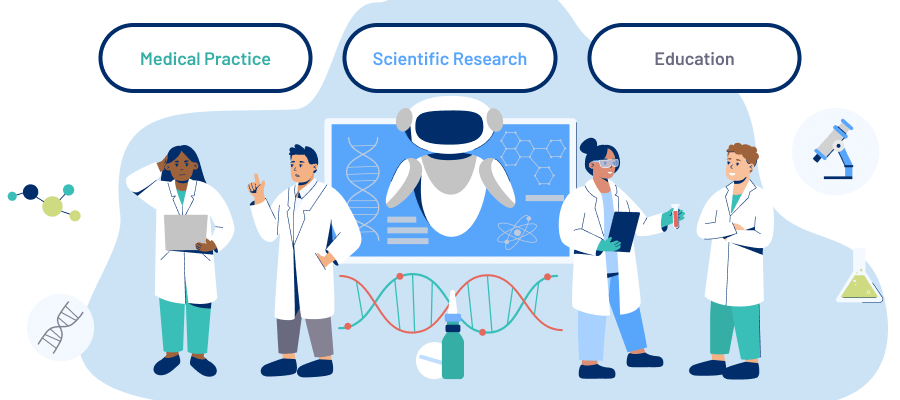
How Healthcare Specialists Use Generative AI in Applied Medicine
The use of GenAI in applied medicine is diverse, just like the field itself. Think of diagnosing, treating, and preventing diseases and health conditions, for example. In this section, we’ll take a close look at the hands-on applications of GenAI that make the lives of patients and care providers easier.
Reducing Administrative Burden

Uncover how we implemented an Appointment Scheduling System
There’s no lack of operations that GenAI already makes easier. Among them are:
- Insurance and benefits verification
- Billing and payments
- Accounts receivables
- Front-desk communications
- Employee and patient scheduling
- Taking and verifying clinical notes
- Procedure coding
- Calculating co-pay and co-insurance
- Providing post-visit patient service
- Provider network credentialing
- Reports and document generation
- Hiring process
Having become quite popular now, self-service chatbots can give the assistance needed to support patient requests. However, to preserve the human touch and data security in patient request processing, chatbots are primarily used by healthcare workers for quicker information retrieval on past treatments, best practices, and scientific advancements.
Personalized Medicine & Service

Discover all about Data Analytics in Healthcare
Enhanced Electronic Health Records, or EHR management, supported by GenAI, ensures faster extraction and analysis of patient data and improves the delivery of personalized patient care and content. Basic therapeutic assistance is now also possible with fast adjustment of unstructured data and providing highlights of the most important information to drive better decisions.
Telemedicine

The advanced AI algorithms analyze patient data and health records to identify trends and patterns that may not be immediately apparent to human practitioners. With this technology at hand, healthcare providers can offer more personalized, affordable, and proactive care, even from a distance.
Find out the Advantages of Telemedicine Technology
Let’s see how it works. During a virtual consultation, GenAI integrated into the telehealth solution takes clinical notes, capturing all patient data and filling any gaps in real time. Based on that generated data, it can then take it a step further and quickly provide prompts and suggestions for recommendations and treatment.
Similarly, in remote patient monitoring, GenAI performs analysis of data from medical wearable devices and home monitoring equipment. It can rapidly detect deviations from normal health parameters and timely alert healthcare providers to potential issues before they become serious. GenAI’s ability to predict health outcomes can also guide recommendations and medication adjustments, tailored to the individual’s unique health profile.
Read about the development of an RPM Solution for Urology
On top of that, Generative AI enhances telehealth through the development of AI-driven diagnostic tools and decision-support systems. In essence, it can assist healthcare professionals by providing instant access to relevant medical literature, patient history, and predictive analytics.
Diagnosis

Specifically, the power of deep-learning algorithms to create new content can help providers come up with treatment plans and recommendations while avoiding human bias and ensuring more accurate diagnoses. Of course, this is rather about collaboration, not replacing doctors who are the ones to provide the essential clinical judgment.
A prime example of GenAI’s impact on diagnosis is Paige.AI, which has leveraged the technology to significantly improve the accuracy of prostate cancer detection through digital pathology. Fundamentally, it has marked a historic achievement with the first FDA approval for such technology. This is a true milestone in digital pathology that underscores the broader potential of GenAI in changing how medical professionals perform disease diagnosis.
Medical Imaging

For instance, technologies developed by Siemens Healthineers have demonstrated how GenAI can improve image quality, aiding in the detection and segmentation of radiological data, thus facilitating more accurate diagnoses and treatment plans.
Startups like Subtle Medical also get recognition for their achievements in developing generative AI models that deliver better image data and optimize radiology workflows, indicating a significant leap toward the future of medical imaging.
Robotic Surgery

The integration of GenAI supports the training of medical robots, too, preparing them for complex surgical procedures. Insights MulticoreWare highlights the evolving role of GenAI in the medical device industry, where it not only improves the precision of robotic surgery but also contributes to the development of new surgical techniques and procedures.
Of course, the healthcare industry is not limited to what happens in hospitals. All of the institutions are powered by extensive research aggregated from different times and locations. To manage the information thoroughly and timely, a range of research settings already use GenAI. And here we’re moving to the next part.
Generative AI in Healthcare Research and Education
In healthcare, to make even slight progress, you need to conduct voluminous research. In fact, health workers worldwide are constantly putting their effort into developing new treatment methods, drugs, and solutions that foster patient-centeric care. And generative AI can help with it. Let’s see how.
Drug Discovery & Development

Insilico Medicine, a pioneer in applying AI for drug development, has demonstrated the capacity of Generative AI to expedite the creation of treatments for complex diseases like cancer and fibrosis. They managed to accelerate the development of a novel treatment for idiopathic pulmonary fibrosis, dramatically cutting down both time and costs associated with drug discovery.
Beyond speeding up drug design, Generative AI plays a crucial role in predicting drug-drug interactions, thus testing the safety and efficacy of new medications before they reach patients. This capability is vital for identifying potential adverse reactions and optimizing drug formulas for better patient outcomes.
Recursion Pharmaceuticals, for instance, utilizes GenAI to decode biological and chemical data and enable the prediction of how different drug compounds might interact with each other. This is a big step toward the greater precision of pharmaceutical research.
Generative AI’s potential is further exemplified in its ability to facilitate the exploration of vast datasets for specific research questions, such as investigating the effects of certain drugs on patient health. This is achieved through advanced algorithms capable of generating FHIR queries from natural language questions, thus bridging the gap between data retrieval and clinical insights.
Moreover, companies like Merck have leveraged AWS‘s Generative AI services to address common pharmaceutical manufacturing challenges, such as reducing false rejects in production lines by over 50%. This not only optimizes manufacturing processes but also underscores the broader applicability of Generative AI in enhancing operational efficiency across the pharmaceutical industry.
Clinical Trials

For example, Bayer Pharmaceuticals is exploring Generative AI solutions like Google Cloud’s Vertex AI and Med-PaLM 2 to streamline the drug go-to-market process. These technologies enable researchers to more efficiently access, identify, and correlate data to facilitate the discovery of potential treatments and automate time-intensive tasks associated with clinical trials.
Pandemic Risk Assessment

Healthcare Education

So, we see that Generative AI can significantly enrich healthcare education and create realistic training scenarios to simulate patient interactions. This technology supports the development of clinical decision-making skills by providing a dynamic and interactive learning environment that adapts in real time.
For instance, the University of Michigan already utilizes GenAI scenarios for sepsis treatment simulations and offers a deeply immersive educational experience that prepares healthcare professionals for real-world challenges.
Above, we’ve detailed the profound impact Generative AI is having across the spectrum of healthcare, from research and drug development to education and pandemic preparedness. As the technology continues to evolve, its potential to enhance and transform this sector grows, promising significant advancements in patient care, medical research, and healthcare delivery.
However, it’s not surprising that the healthcare industry stands among the most ethically challenged fields due to the constant need to tackle sensitive issues and data.
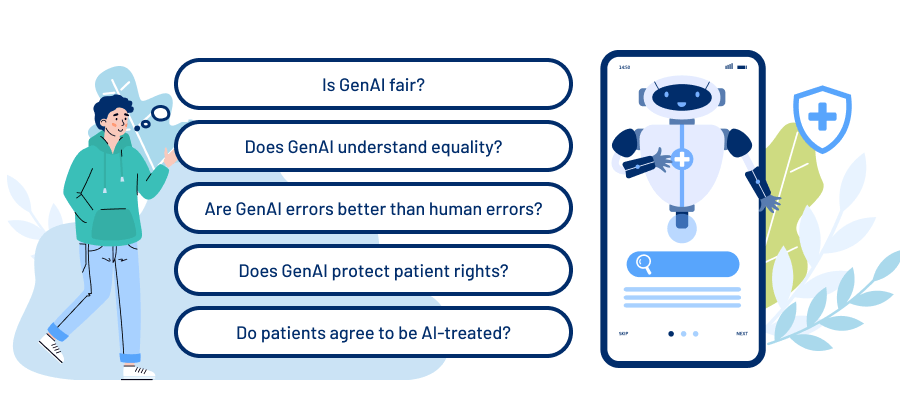
Ethical Considerations in the Use of Generative AI in Healthcare
The integration of Generative AI in healthcare brings forth a range of ethical considerations that must be addressed to ensure the technology’s benefits are realized without compromising fairness, equity, or patient rights
A critical challenge in deploying AI within healthcare is the potential for inherent biases in the algorithms, which can lead to unequal treatment outcomes for different demographic groups. To avoid this, you need to ensure that AI models are trained on diverse datasets that accurately reflect the broader patient population, thus mitigating bias and promoting equity in healthcare delivery.
Another question is: Are human errors better than GenAI errors? Well, there’s no simple answer as the debate between human errors and GenAI errors is complex. While human errors can be attributed to a variety of factors, including fatigue and oversight, GenAI errors often stem from issues within the data or algorithmic biases.
It’s essential to recognize that while GenAI can significantly reduce the frequency of errors, the impact of those errors that do occur must be carefully managed through rigorous testing, validation, and continuous monitoring of AI systems.
The use of AI to support or make clinical decisions also raises questions about the ethical implications for patient autonomy. So, it’s crucial to keep patients informed about how AI is actually used in their care and emphasize that AI recommendations do not override the clinical judgment of healthcare professionals.
GenAI for Business
Regulatory Landscape for AI in Healthcare
Eventually, we’ve made it to the last part of our article, where we want to talk about the regulatory side of Generative AI. Though there’s still a lot to elaborate on, we can’t skip mentioning some critical considerations for now.
In the United States, the FDA has begun to establish guidelines for the approval and use of AI-based medical devices, focusing on safety, efficacy, and transparency. As usual, compliance with HIPAA is also essential for ensuring patient data security and privacy in AI applications.
Explore the insights on HIPAA-Compliant App Development
In Europe, the EMA, along with GDPR, sets standards for the ethical use of AI in healthcare, emphasizing patient safety, data protection, and transparency.
As the capabilities and applications of Generative AI in healthcare continue to grow, regulatory bodies are tasked with updating and evolving guidelines to keep pace with technological advancements and make sure that AI is safely and effectively integrated into healthcare practices.
Read about How Medical Organizations Use AI
Most likely, we’ll see much effort put into harmonizing AI regulations globally as we need to create consistent standards for GenAI. Regulatory oversight must be flexible enough to allow for the rapid development and deployment of AI solutions, while also being stringent enough to ensure that these technologies do not pose undue risk to patients.
Innovate but Regulate
At the end of the day, leveraging Generative AI development is a great idea if you want to keep up with the health tech world and benefit from what it can offer. However, as we’ve just mentioned, addressing ethical considerations and navigating complex regulations is paramount. The difficulty here is that these regulations are still far from being comprehensive.
For now, to take advantage of the technology, you need to balance its implementation with prioritizing fairness, equity, data security, and patient autonomy. To achieve that, foster collaboration between tech and healthcare professionals, regulators, and patients so that Generative AI can serve as a truly powerful tool for you.
If you’ve decided to automate administrative tasks, enhance patient diagnosis, or even be at the forefront of advancing medical imaging, you’ll need a skilled team to guide you. It’s no surprise that this team should have hands-on experience in both Generative Artificial Intelligence and healthcare software development. This way, you can rest assured that your solution will be reliable, efficient, and trusted by its users. Velvetech has it all, so don’t hesitate to reach out if you need any assistance.