
Every day, exponential amounts of data are created in our world. All thanks to digitalization and the boom of the Internet. A large chunk of this data comes from the healthcare industry.
In fact, by 2025, the compound annual growth rate of data for healthcare will reach 36%. More than for the other top industries like manufacturing, financial services, or media and entertainment.
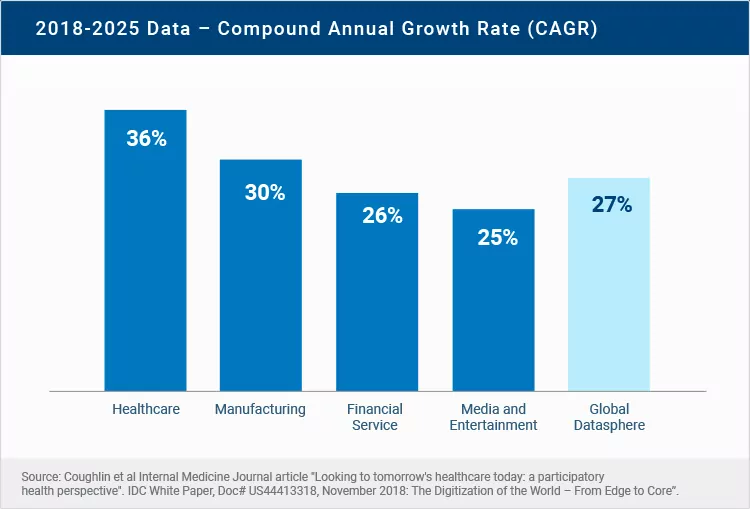
Looking at the CAGR, it’s easy to see why the healthcare analytics market is expected to reach $50.5 billion by 2025. After all, there’s a lot of value hidden in this digital information.
Yet, not all businesses are leveraging data to its highest potential. If you think you might be one of them and don’t know enough about the ways software solutions can help your medical organization — keep reading.
In today’s post, we’ll dive into the subject of data analytics in healthcare and talk about its role, types, and key uses that are worth paying attention to.
The Role of Big Data Analytics in Healthcare
In the healthcare context, big data refers to enormous amounts of digital information that is created by technologies that collect patient records, help manage medical facilities, and optimize existing processes.
Solutions like medical websites, electronic health records, customer relationship management platforms, medical billing software, practice management systems, and the like, all generate big data in healthcare.
Discover more Healthcare Software Solutions Disrupting The Industry
So, what is big data analytics in healthcare? Essentially, it’s the process of quickly analyzing digital information to forecast upcoming events and trends, improve service delivery, and better contain disease outbreaks.
Of course, data analytics can be useful in other industries, but its value in improving patient care quality, diagnosis processes, and clinic management makes it highly lucrative for medical organizations.
Types of Data Analytics
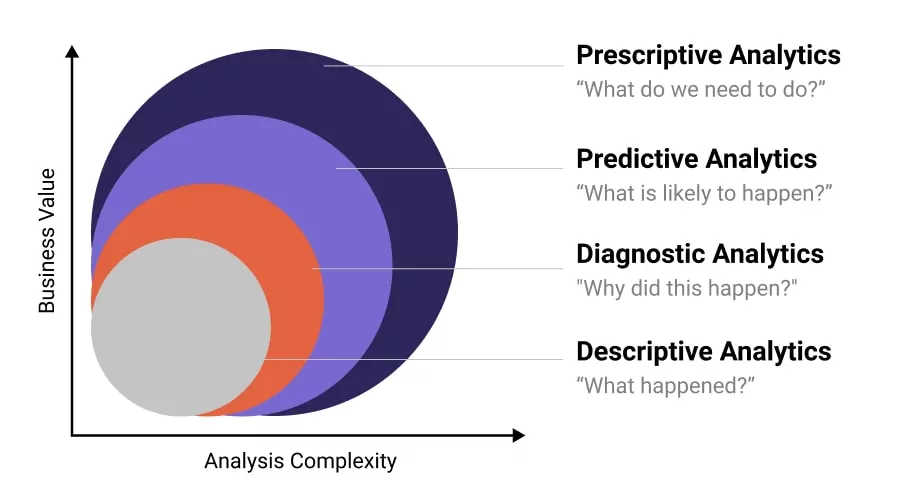
In total, there are four types of medical data analytics that all serve to achieve a slightly different goal. Or, rather, to answer a somewhat different question. Let’s dive deeper into each of them.
Descriptive
Descriptive analytics is all about describing what has already happened. It can be used to identify how contagious a disease is. For example, by analyzing the number of infections within a population over a certain period.
Diagnostic
Diagnostic analytics answer the “why did it happen” question. Thus, attempting to understand what caused an event.
Diagnostic analytics can help quickly detect what is wrong with the patient based on the symptoms they might be experiencing. Thereby, increasing the speed with which treatment can be administered.
Predictive
Predictive analytics explore historical data and trends to forecast the future. It helps answer the “what is likely to happen” question.
For example, predictive analytics can project the spread of a seasonal illness, like the flu, by analyzing data from previous years.
Learn more about the Main Types of Data Analysis
Prescriptive
Lastly, prescriptive analytics serve to suggest what can be done next. Hence, it can identify the actions needed for the desired outcome to be achieved.
Specifically, prescriptive analytics can come up with preventative treatment plans by assessing pre-existing conditions and risk factors of a patient.
Key Uses of Data Analytics For Healthcare
Now that you understand the role of healthcare data analysis and the four main types of analytics, it’s time to cover its five major uses within the industry.
Since data is generated constantly, there are endless ways to leverage digital information within the medical sphere. However, the below key uses are the ones that healthcare organizations may find the most value in.
Patient Engagement

Health tracking tools that monitor sleeping patterns, heart rate, exercise levels, and the like, are all excellent examples of patient-engagement solutions. As you may imagine, these connected devices leverage IoMT technologies and gather quite a lot of health-related intelligence.
Hence, this is where data analytics comes into play. By automatically scrutinizing the generated information, it can extract valuable insights, identify health risks, and provide recommendations for wellness improvement.
As a result, patients can get important information about their current health state and become directly involved in managing their well-being.
Moreover, physicians can monitor the data that wearable devices generate and be able to study how certain conditions gradually evolve. For instance, evaluate how a person’s heart rate improves after regular exercise and consistent sleeping patterns.
Learn more about Patient Engagement Software
Preventative Care

“An ounce of prevention is worth a pound of cure”.
— Benjamin Franklin
If we take smokers as an example, we know that they have a higher risk of developing lung diseases. In this case, data-empowered software can merge insights from smart devices, electronic health records, and other systems, analyze information, and identify dangers early on to recommend preventative measures before it’s too late.
Additionally, analytics can play a major role in post-acute care that places a high value on maximizing patient wellness and preventing rehospitalization. Often, this can be achieved at a much better rate with the help of data analytics that can not only forecast the potential post-surgery complications but also suggest what to do to prevent them.
Find out how Velvetech built a Post-Acute Care Management System
Strategic Planning

By gathering and examining information from CRM platforms, PMS tools, and other solutions that accumulate customer data, analytical systems can provide you with insights regarding patient behavior.
Why do people tend to stop treatments after a certain point? Which services get the most complaints? By answering these questions with the help of analysis tools, you’ll be able to adjust your strategies and improve service delivery.
Additionally, AI-powered call analytics platforms can feed conversational data and deliver immediate, actionable intelligence to your dashboards. Thus, helping you monitor the requests patients make via the phone.
Personnel Management

With predictive data analytics, you can minimize personnel management errors. Instead, algorithms will forecast how many people are likely to arrive on any given day and time based on historical data. Thus, arming you with highly accurate information to plan your staffing.
Discover how Velvetech improved Appointment Scheduling For a Dental Marketplace
As a result, your employees will be less overwhelmed when a lot of unscheduled patients show up, and your customer services will significantly improve.
BI for Business
Should Your Medical Company Start With Data Analytics?
Data remains largely underutilized due to companies not seeing its full potential. However, we hope today you’ve learned that it is definitely where the future of healthcare lies.
Whether you want to improve patient engagement, preventative care services, product development initiatives, your strategy, or staff management — professional data analytics services can help.
At Velvetech, we always do our best to help clients stay ahead of the curve and make the most of all the information they have within their systems. So, if you’re looking for a company that can assist you in leveraging analytics and developing top-notch healthcare software solutions, don’t hesitate to reach out.