While medical providers are looking for ways to accommodate healthcare consumerization, the market of digital solutions for this sector keeps growing incessantly. In fact, it’s anticipated to cost $ 766.06 billion by 2033.
Since many companies invest in technologies to address patient needs and stay ahead of competitors, they should be aware of the rules and regulations their software has to follow. No doubt that HIPAA is one of the most important requirements to meet when developing a health app.
So what does mobile app HIPAA compliance mean? What does it take to achieve it, and how much do its violations cost? Let’s find out the basics and explore the considerations to take into account while initiating HIPAA-compliant app development.
What Is HIPAA?
Health Insurance Portability and Accountability Act, or HIPAA, is a US statute introduced in 1996 that regulates the flow of healthcare data. Part of this act specifies how personal information processed by healthcare and insurance companies should be protected from fraud and theft.
Among all the rules incorporated in HIPAA, you should pay close attention to five of them. They are:
- Privacy Rule: Protects patients’ personal medical records by identifying who can access them and how they can be shared.
- Security Rule: Defines clear security measures needed to protect sensitive data.
- Enforcement Rule: Provides guidelines for compliance, investigations, and penalties for violations.
- Omnibus Rule: Ensures that individuals can seamlessly access their health records and makes it transparent how providers will use their personal information.
- Breach Notification Rule: Requires providers to notify patients about data breaches.
The need for your healthcare software to be HIPAA-compliant is defined by the type of entity that uses the app and the type of data covered by it. To give you more details, we’ll take a look at each of these criteria.
Data
While thinking about health application development, you need to distinguish two types of data in order for your solution to be HIPAA-compliant. They are Consumer Health Information, or CHI, and Protected Health Information, or PHI. Let’s take a look at their core differences.
|
Attributes
|
Protected Health Information
|
Consumer Health Information
|
|---|---|---|
| Information | Personal information, medical records, and payment details | General health-related data for public use |
| Accessibility | Shared with a covered entity and secured by a service provider | Can be accessed by government and NGOs |
| Purpose | Employed for personalized treatment plans, billing, and other healthcare operations | Applied in awareness programs, healthcare planning, and statistics creation |
| Regulation | HIPAA applicable | Doesn’t have to be HIPAA-compliant |
As you can see, when an app handles personal and medical data, it falls under HIPAA regulation. Let’s take a look at an example to better understand when your product should follow HIPAA and when it shouldn’t.
If you have an application that monitors images containing sensitive data like names, addresses, phone numbers, etc. — HIPAA comes into force. However, if the same app helps study skin diseases by analyzing anonymous images, it doesn’t have to be HIPAA compliant.
Entities
HIPAA regulations apply to all entities that access, produce, process, and store PHI. According to the Privacy Rule, there are two types of entities subjected to it: covered entities and business associates.
Covered entities refer to all healthcare organizations, providers, clearinghouses, and private practices. This type of entity also incorporates pharmacies, nursing homes, and insurers.
Business associates are organizations that collect, store, and handle PHI on behalf of the covered entities. They can include software and cloud service providers, lawyers, or accountants.
Why Is HIPAA Important?
HIPAA plays a vital role for both patients and healthcare organizations. It was enacted to help protect sensitive data and ensure that its processing and sharing are strictly regulated. The act provides important rules related to confidentiality and privacy, defines what parties can share information, to whom and how it can be disclosed.
Therefore, any company considering design and development of an app that deals with health data, whether it is a web application or mobile solution, should clearly comprehend if it has to be HIPAA compliant.

Source: Someecards
HIPAA Benefits for Patients and Healthcare Providers
When it comes to developing a HIPAA-compliant and secure app, you may put in a lot of effort. Yes, it’s truly not an easy walk in the park. However, only by following HIPAA-compliant software requirements can you craft a product that offers plenty of benefits for both patients and healthcare providers. Let’s skim through the core advantages to consider.
|
Benefits
|
For Patients
|
Consumer Health Information
|
|---|---|---|
| Privacy protection | Patient’s data can’t be shared without their approval | Ensuring the confidentiality of patients’ health records reduces the risk of legal liability |
| Data security | HIPAA provides peace of mind on individual healthcare information safety | HIPAA sets clear rules and standards on how to protect client’s data |
| Transparency | People may request records to see how their PHI is being handled and used | By being transparent about patient data management, providers become more trustworthy |
| Accessibility | Individuals may seamlessly obtain their medical records and request adjustments to ensure accuracy | Up-to-date patient well-being information empowers providers to deliver more personalized treatment plans |
| Breach notification | Patients receive notifications about breaches | By notifying users about data breaches, providers may avoid hefty fines for non-compliance |
Risks and Penalties
Where there is a rule, there can be a violation; and where there is a violation, there can be a penalty. It’s hard to underestimate HIPAA compliance software requirements and the importance of an app to follow them, so it’s better to be prepared and know what to expect in case of non-compliance.
Examples of major violations of HIPAA rules include the loss of data, accessing confidential information, or sharing PHI without authorization. The size of fines levied on entities varies from $100 to $50,000 per violation and can reach an annual maximum of $1.5 million.
With that in mind, let’s go further and explore the key tips to build a healthcare mobile app compliant with HIPAA regulations.
Key Features of HIPAA-Compliant Applications
Every healthcare software development project is definitely unique and requires a tailored approach. Here are the core features to incorporate for the robust HIPAA-compliant application development.
1. Secure User Authentication

As a result, you may significantly enhance your app’s security and prevent unauthorized access.
2. Automatic Logout

The main goal of this feature is to prevent unauthorized access in case of device loss. Obviously, automatic logout will be a valuable addition to your HIPAA-compliant healthcare application.
3. Access Control

That is to say, grant role-based access to users’ health records. As such, you can significantly reduce the risk of internal data breaches.
Learn how the Implementation of Two-User Roles Restricted Access to Mobile Medical Surveillance App
4. Audit Tracking

This way, you can promptly detect any suspicious activities and take proactive steps to safeguard patient data.
5. Secure APIs

You can definitely picture the kind of sensitive data these platforms and devices handle, and without a secure API in place, you can’t protect patients’ personal information.
Learn more about How Wearables Shape Healthcare
6. Data Backup

However, there is no guarantee of being completely immune to breaches. Hence, it’s worth considering how you’re going to protect users’ private information in such cases. One of the most effective choices is data backups. By having copies of your parent’s health files, you may minimize data loss and reduce downtime.
Find out interesting tips on Cloud Disaster Recovery
7. Incident Response Plan

In your plan, you should define:
- How to monitor your system to ensure its security
- How to minimize the damage in case of breaches
- How are you going to recover the system
- What lessons you’ve learned to improve your app’s security and prevent future hacks
Tips to Build a HIPAA-Compliant App
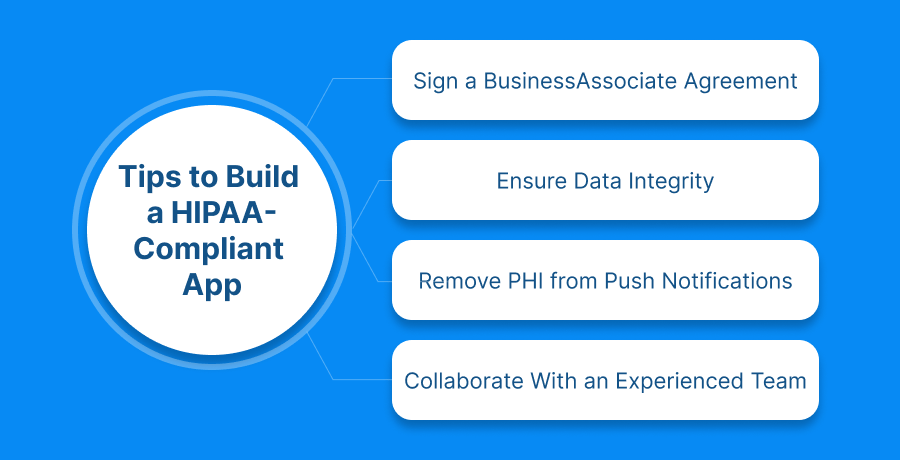
Having discussed the key features that make your software development HIPAA-compliant, you’ve likely grasped a basic understanding of how to secure your app. However, before wrapping up, let’s skim through some tips to help you elevate your healthcare solution security even further.
1. Sign a Business Associate Agreement
Crafting HIPAA-compliant products from scratch can cost a pretty penny. To cut the development budget, it’s worth leveraging infrastructures or platforms that adhere to HIPAA regulations. Take TrueVault, for example. It meets strict data privacy laws, ensuring your patient’s information is not compromised and remains securely stored.
While it seems like a real hidden gem, before implementing such platforms, sign a Business Associate Agreement (BAA). This will safeguard you from unforeseen issues and give you a clear understanding of how users’ data will be handled and managed.
On top of that, a BAA clearly defines responsibilities in case of any breaches, thus minimizing legal risks and boosting your solution’s reliability.
2. Ensure Data Integrity
Data integrity is extremely important for building HIPAA-compliant mobile apps and other software solutions. The use of encryption technologies and secure communication channels allows health apps to protect sensitive data. They ensure that, even if a breach occurs, confidential information is safe because it can’t be decoded and read.
In addition to applying secure HTTPS connections and SSL/TLS protocols, it’s vital to transfer PHI following Healthcare Messaging Standards like HL7, FHIR, CDA, DICOM, etc. Keep in mind that data should be protected during both storage and transfer.
3. Remove PHI from Push Notifications
As one of the features of your healthcare app, you may want to incorporate push notifications. In this case, consider excluding PHI from them. Even when the phone is locked, the data may appear on the screen and be visible publicly.
Similarly, don’t mention any sensitive data in messages or emails unless consent is given by a user. It might happen that not all communication channels are encrypted, thus medical and other personal information can be easily compromised.
4. Collaborate With an Experienced Team
Regardless of the app you are developing, having a skilled team on board is like a safety net, which ensures your investment won’t fall short. Here partnering with companies that have proven expertise in HIPAA-compliant mobile app development services will be a wise move.
With the right team in place, you can craft a product that meets industry standards and is highly secure. As a result, you may both minimize legal risks and enhance your app’s reliability. If you want to learn how to collaborate with experienced professionals, check out our guide on hiring the right development partner.
What Budget to Consider for HIPPA-Compliant App Development?
When it comes to developing an application, one question always arises — how much will it cost? Well, you hear that a lot but it all depends on the complexity of your solution. So, no matter how much we’d love to give you an exact price tag for HIPAA-compliant mobile app development, it’s tough. Yet, we highlight the key factors with their overage cost to help you gain an approximate understanding of the overall budget.
- Product complexity: Simple apps may cost around $10,000, while implementing software with advanced features could require up to $100,000.
- Development team: Freelancers may charge up to $15,000, while collaborating with companies that specialize in healthcare app development may cost up to $150,000.
- Security measures: Employing strong security measures like encryption, authentication, and regular security audits may run anywhere from $10,000 to $50,000.
- Compliance consulting: Engaging experts for risk assessments and ensuring adherence to HIPAA regulations may require an investment of $5,000 to $30,000.
- Testing and quality assurance: The budget for these components typically ranges from $10,000 to $50,000, again depending on the app’s complexity.
- Maintenance and support: Basically, these activities take up approximately 15% to 20% of the initial development cost.
Reach HIPAA Compliance with the Right Expertise
Besides having an idea and a development strategy for your healthcare solution, it’s fundamental to ensure you meet the requirements of mobile app HIPAA compliance. Primarily, focus on the security measures to protect PHI and provide data integrity.
HIPAA regulations often pose a challenge for software developers and require some effort to understand and follow them to the letter. However, misreading or ignoring them has significant risks and penalties. Thus, when you request custom software development services, choose a team of developers that already knows what HIPAA compliance means and can help you build an application in accordance with these rules and your goals.
Velvetech has rich experience in healthcare app delivery that’s reinforced with profound knowledge of the field. The company’s technology expertise will support you in the development of robust eHealth software, compliant with all essential aspects of HIPAA. Reach out to us today.
About the author