We are surrounded by data, they are anywhere and everywhere. Now, just recollect how many datasets your educational institution has. And try to gauge the percentage you actually use and take advantage of.
If you realize that the share of actively used data is negligibly small, we have bad news for you. Perhaps, you do so for a variety of reasons: piles of heterogeneous information that is hard to structure, absence of appropriate data management tools, visualization complexities, and so on.
The truth of the matter is that you miss plenty of opportunities that could have significantly alleviated your teachers’ workload, streamlined administrative operations, and meanwhile boosted student outcomes.
In this article, we’d like to showcase the chances you voluntarily lose when not using the full potential of data. Let’s discuss why analytics must be an integral part of any educational software and which specifics of data management exist.
Starting From a Broader Perspective. Why Data Analysis in Education Is on the Rise
First, let’s refer to the statistics provided by KBV Reseaarch, which says “The Global Big data analytics in education market size is expected to reach $47.82 billion by 2027, rising at a market growth of 20.79% CAGR during the forecast period.”
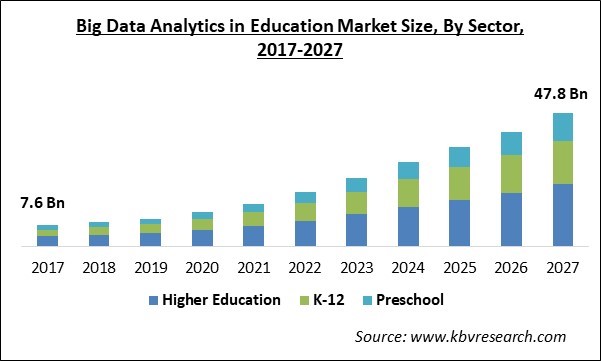
That’s impressive, right? As we can see from the graph, there was a pronounced impact on market growth during the pandemic when everybody went digital, including educational institutions. Moreover, during this period, the demand for online courses on such platforms as Udemy and Coursera increased dramatically, and the trend is not fading but still gaining momentum.
This fact clearly revealed that the return to traditional educational methods is truly improbable, and the entire system craved for transformations quite a long time ago. Thankfully, the majority of schools and colleges have gradually acknowledged this plain truth and started to reconsider their processes and approaches.
Data analytics in education is one of the most essential pieces of the puzzle. Using appropriate tools and adapting them to your needs, there appear a plenty of opportunities you may offer to students and teachers.
More personalized approach to learners, precise identification and elimination of knowledge gaps, motivation stimulation, and help in career guidance — these are major fortes of data analytics for schools and other educational institutions that we are going to consider in the following paragraphs in detail.
Specifics of Data Analytics in Education. Why the Approach Has Little In Common with Other Industries

Before we switch to use cases that highlight the substantial benefits of data analytics in education, first, let’s figure out how it differs from other industries. To do that, let’s take a company that produces and sells something, say, electronic devices.
Why do they need analytics and which metrics do they use? Financial performance, marketing campaign results, and employees’ KPIs. Agree, that the metrics will hardly vary from company to company, although businesses may be different, data they are curious about will be more or less similar and there’s no need to reinvent the wheel.
Discover 6 Types of Data Analysis that Help Decision-Makers
Education radically differs from other businesses, where financial information prevails. Mainly because it has completely different aims, not related to making a profit. And here there are multiple metrics that are equally important and must be considered, and sometimes, they are non-obvious.
Sure thing, there are data lying on the surface, such as class attendance, average scores on academic performance, and more. Meanwhile, to obtain maximum benefits from analytics, we need to look deeper. And here’s where the shoe pinches: sometimes it’s not an easy task to highlight the needed metrics and drill them down. However, specific tools, especially in conjunction with artificial intelligence, can make a difference here.
For example, we want to help a student with career guidance. Estimate, will these superficial metrics mentioned above be enough to help them select the direction? Apparently not. Here, we need to consider additional indicators, such as participation in extracurricular activities, blind spots in these or that subject, greater propensity to humanitarian or exact sciences, and even a psycho personality. We’ve mentioned just several ones, however, the list can go on.
Use Cases. How Data Analytics Brings Use to All Parties of the Learning Process
Steps Towards Personalization
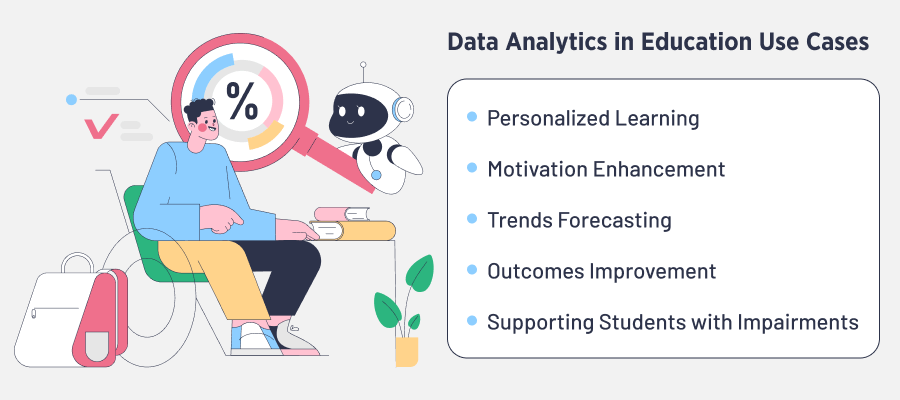
All students are different. Some don’t have problems with prolonged concentration and can watch a 2-hour training video without interruptions; some do. There are students who perceive information by hearing, but there are also such learners with excellent visual memory. Let alone the fact that each person has their own learning pace, and if it’s slower than others’, it doesn’t mean that this person is a bad learner.
As you see the amount of nuances that must be taken into account is literally immense, and each student requires a unique approach to reach the best academic results. But how can this be done without data analytics in education? The question is rhetorical.
Check out how we created a Mobile Learning Framework for Offline Educational Apps
Motivation Enhancement
We also have another thing to consider closely related to personalization — student motivation. Imagine, you have a class of 20 learners, and some of them have problems with mathematics. To your point of view, how motivated will they be if a teacher doesn’t pay any attention to the gaps they have and continues presenting educational material at a tempo of the majority of the class?
If a learner sees that they lag behind and are not able to keep the given pace, the enthusiasm may be short-lived. Of course, at school, a pupil doesn’t have an opportunity just to give up. But if we speak about a university or online courses where a student can just turn around and leave in an instant? Agree, both options are so-so; in the first case, a learner will study through the power, and in the second, they will not study at all.
Trends Forecasting
Say, you launched an online course, and you are interested in having the enrolled students finish it and obtain certificates. With advanced analytics, you may notice when a learner loses motivation and intends to give up.
By identifying such patterns with data analysis in education, you are enabled to take preventive measures to avert such a scenario. For example, if a student wants to leave because doesn’t handle the offered load, you can offer an adaptive program. Or suggest some other directions that intersect with the previously selected one.
There are a lot of strategies to follow; however, having noticed some triggers, you are empowered to act proactively, and it’s you who chooses how.
Academic Results Improvement
If you check one test submitted by a student, the result can hardly be illustrative. It can be written well or poorly, but it’s impossible to judge the student’s abilities by only one verification work. Let alone the identification of weak points and working them out to improve the results.
Comprehensive big data analytics in education can help you capture the full picture. On the basis of both historical and current data, you can have a better visibility of a student’s performance and identify the blind spots promptly. Knowing them, you can select a strategy to follow: offer additional educational materials, videos, or extra lessons with a teacher.
Moreover, if you notice that not only one single learner has similar problems, but even a group of them, there is a possibility to reconsider the educational program accordingly.
Supporting Students with Impairments
Here we have tight interception with the healthcare sphere. Not all students are perfectly healthy and may have some deviations, such as dyslexia or ADHD. Obviously, it’s impossible just to bail on such students and continue presenting the material in the usual way.
This is where comprehensive big data analytics in education combined with AI can make a difference. By analyzing test results and other data, AI-powered tools can identify unusual patterns and alert teachers to potential issues before they become noticeable. Here, you can elaborate on a specific program suitable for children with impairments and create a separate group of pupils with similar problems.
Keep in mind that this approach cannot replace professional diagnosis. However, it can assist teachers and parents by flagging potential health concerns and prompting timely intervention to prevent further complications.
Read about the Role of AI in Education and If It’s an Invaluable Tool or a Phantom Menace
Despite the Good. Why Educational Institutions Are Still Reluctant to Take Advantage of Data Analytics
Too Costly Story

Gathering a seasoned team of developers and data analysts, whom you’ll have to pay every month, purchasing expensive tools and their introduction, arranging training for teaching staff and other side expenses — such potential splurge may frighten anyone. That’s why you need to think through all the pros data analytics may yield in K-12 and higher education, correlate them with the costs you have to incur, and select what outweighs particularly for you.
Long Integration Period

Sure thing, the acknowledgment of the fact that you have to invest a huge amount of money in data analytics for education and not be able to take advantage of it right away, can be demotivating. But that’s what you just have to be prepared for.
Reluctance from the Teaching Staff’s Side

What can you do with it? First, it’s better to conduct thorough preparatory work and arrange comprehensive training to help your field staff master a new tool. Second, pay particular attention to data visualization. Carefully select the metrics for dashboards your teachers will use in their work and try to strike a balance between their number and ease of perception.
We’re in Play! Essential Steps to Take for Data Analytics Introduction
Follow the Path of Full Digitalization
The first thing you must keep in mind if you want to introduce data analysis in education is the digitalization of the entire learning process. Yes, you’ve read it right — all data, including previous test results, attendance, and extra-curricular activities must be in digital format to bring the use.
We totally understand that you’ve probably accumulated piles of information that you store in papers. Obviously, it’s an immense endeavor to sort out all documentation and digitize it. But look at it from another perspective!
After you transfer your precious data to the digital format, you won’t have to worry that you lose or spoil something and get rid of the necessity to deal with the paperwork. All the info will be stored centrally, let alone the fact that so much physical space will be freed up!
Hire a Professional Engineering Team
Even after data are digitized, we would say that it’s only the beginning of a long and thorny path. To make this journey smooth and successful, you can’t do without a professional team of data analysts and software developers.
Selection of an appropriate toolset, metrics definition, software fine-tuning, and dashboard development — the scope of work is huge, and entrusting it to professionals with the related background is the best solution you can make.
Expanding a Team
Don’t Ignore Teaching Staff Training
We’ve already mentioned the problem of the teaching staff’s reluctance to accept new tools and adapt to a renovated educational process. That’s why, alleviating the transition period and helping educators acknowledge the benefits they gain in return works to your advantage.
It’s essential to let teachers understand that new software will automate their workflows and facilitate pupils’ assessment and reporting. That’s why it’s better to allocate time and resources to arrange comprehensive training.
Find out How to Transform Your Business with an Effective Data Analytics Strategy
Wrapping Up
Data analytics can do a truly great job for education. Improvement of student results, more personalized approach to teaching, prediction of outcomes, and potential blind spots — it’s just a small fraction of the advantages you gain when implementing data analytics for your academic performance solution.
However, as always, easier said than done. Be prepared for complexities related to high costs and a long integration period. To our point of view, in this case, the benefits far outweigh all the related drawbacks, but the right approach is the main condition for it.
Our team has extensive expertise in data analysis, dashboard development, and crafting high-quality educational software. Contact us, we’ll help you make your first steps toward in-depth analytics!
About the author