
Education comes in many forms. Whether it’s school, specialized programs, or driver’s license training, each one is specific in its own way and requires a unique approach.
Education itself can’t be called a simple process, however, some of its subtypes especially stand out from others. The medical one obviously belongs to the category of the most meaningful, and, undoubtedly, complex directions of education.
Technologies significantly facilitate the process, making it more accessible, effective, and engaging. The only caveat is that when developing educational software for the medical sphere, a bunch of industry-specific nuances must be considered. Otherwise, a system might bring more harm than good.
That’s what we’d like to speak about in this blog post — educational solutions in the medical sphere. Let’s discuss why this direction is truly unique and which intricacies must be considered when building such systems.
Why Medical Education Stands Out of Other Branches
Remember how you gained a driving license. The process is clear and simple: you go to a driving school, learn the rules, study to drive, pass the exams, and obtain your license. That’s it. No need to improve qualifications, earn additional certificates, or attend conferences to keep the title of a driver.
If we speak about medical education, it’s the other way around. When doctors obtain their diplomas and graduate from their universities — it’s only the first step of their educational ladder, which is never-ending in reality.
As a rule, medical practitioners belong to medical associations within which they improve their qualifications, earn points, and obtain certificates. Thus, the lion’s share of medical courses are financed by such organizations or pharmacological companies, which require specific software for educational purposes.
Here’s how the process goes. For example, an organization belonging to the association wins a grant to improve cardiologists’ awareness of complications occurring in the case of a specific heart surgery. They gather an expert panel specializing in this area and create educational content, for example, a webinar where all this information is available to interested parties.
Sure thing, the content itself is still not everything. The system must include the knowledge control feature. Say, before a doctor starts the educational program, the system must evaluate their knowledge. After the course is complete, knowledge assessment takes place again, to ensure that a doctor has absorbed information properly.
Obviously, such systems must also incorporate analytical capabilities and a maximally simple and clear structure. Why is it important and why is it easier said than done? We’ll discuss it in the following paragraphs.
Things to Be Factored In When Developing Software for Medical Education
Opportunities to Study On the Go

However, a doctor can’t just bail on it and must allocate some periods to acquire fresh knowledge. Therefore, such educational systems must be aimed at saving doctor’s time and provide opportunities to consume the educational content in combination with other tasks or during breaks. Obviously, a conditional surgeon doesn’t carry around a laptop or a PC heading from one operational room to another.
That’s why the major requirement of projects belonging to medical education we faced was the opportunity to use a mobile device for education. For example, one of our customers requested the option to download podcasts of educational modules to a conditional iPhone, so a doctor could listen to them even offline when had some spare time.
Check out how we created a Mobile Learning Framework for Offline Educational Apps
Medical Education Is a Never-Ending Story

We’ve completed multiple projects for medical associations initiating certifications, and one of the most critical requests was the opportunity to send newsletters and notifications. Why so? Because such organizations have huge databases of doctors that are their members. When launching a new educational program, webinar, or offline conference, associations send invitations to doctors who might be interested in it: depending on specialization and event agenda, of course.
Complex Structure of Educational Content
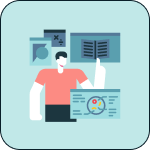
Video lessons, text modules, presentations, tests, progress monitoring, and online webinars — as a rule, medical learning apps must combine all the above-mentioned. Moreover, since knowledge control is especially essential in this area, and if a learner fails a test, they must have a possibility to be quickly redirected to the needed module. It’s much more convenient than scrolling through pages and slides trying to find the necessary information. Another thing worth mentioning is that they can’t get down to another module without satisfactory test results and are able to move further only after knowledge is mastered in full.
Expertise exchange is an important component of medical education. That’s why another common thing in such apps intended for medical students is the availability of forums or community tools, where learners can communicate with each other and also interact with lecturers. Besides virtual webinars, live events take place, and interested specialists should also be able to connect to a meeting if there’s no possibility of attending it physically.
Challenges to Be Aware Of or Why Building Software for Medical Education Is Far from Easy
Content Complexity Combined Exorbitant Degree of Responsibility
It’s a rare case when a developer designing medical education software has a related background. That’s the #1 challenge we’d like to mention. Let’s compare: say, we create a system intended for elementary school students, and when our math question 2+2 gives a result of 5 or the capitals of Canada and the US are mixed up, will a catastrophe happen? Of course not, no one’s life depends on such minor things.
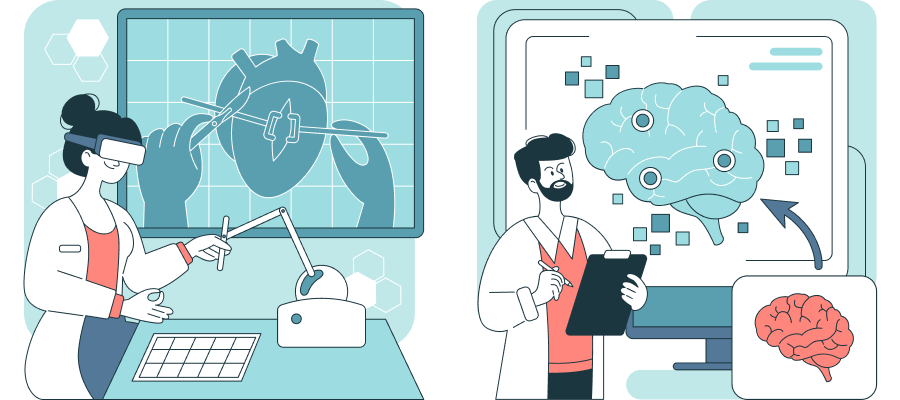
It’s an entirely different matter when we speak about medical content. Huge information volumes, starting from the basics of anatomy and biology and ending up with highly specialized areas, such as cardiology, neurosurgery, etc. Extremely complex scientific concepts and terminology, new research and treatment methods — all content must be precise and up-to-date to ensure that learners study on verified data. Pro tip: Keep this in mind if you train your Machine Learning models on publicly available content.
Discover the Risks and Concerns of Using AI in Education
Just imagine what may happen if a heart surgeon learns to operate incorrectly. Or a hematologist prescribes irrelevant treatment which turns out to be not only useless according to the latest research but even dangerous. Such failures result in multi-million lawsuits as well as pose a threat to health or even cause death. That’s why make sure that you entrust your project to a proficient and reliable team of developers and use verified educational content.
How to Assess Educational Results Correctly?
The entire healthcare system faces the problem of ambiguity in efficiency evaluation. Let’s consider a simple example with a conditional hospital’s KPI. Say, how many surgical interventions they had for the selected period, how many appointments doctors had. Seemingly, the more, the better. But on the other side, we gain a picture that our population is not healthy in general, although hospitals and clinics may boast of outstanding performance results.
Medical education has more or less similar nuances. However, it can’t be denied that the evaluation system is grudgingly changing, and there is an emerging trend towards outcome-based efficiency assessment. Meanwhile, there is a bunch of challenges on the way to building effective medical learning software. Here are several most pressing ones:
- Practical skills evaluation
It’s not an easy task for medical education software to provide an unbiased assessment of a learner’s practical skills. Sure thing, we can leverage the capabilities of Virtual Reality and simulators, but where is a guarantee that a doctor will be able to perform the same actions in real life and in way more stressful conditions? - Clinical thinking assessment
Medical practice requires prompt decisions under conditions of uncertainty. Is a machine able to assess a student’s capabilities to analyze symptoms correctly and prescribe appropriate treatment unerringly? The answer is yes, but to do that, educational systems must include multiple complex scenarios, which requires additional resources, significant computational powers, and jewelry work in terms of fine-tuning.
We are here to help you with a custom-made educational solution.
Want to improve your students’ outcome results and make the learning process more engaging? Let’s get started!
Trend to Create Medical Education Systems Intended for People without Medical Background: Real-Life Example
There are millions of people in different parts of the world who involuntarily have to acquire some specific medical skills. Sure thing, they can’t be called doctors or nurses, they are just people who by the will of fate take care of elderly or severely ill relatives. Such systems help them learn how to perform elementary medical manipulations and ensure proper patient care.
We are currently working on a project designed for both healthcare professionals — doctors and nurses — and the families of individuals with mental illnesses like Alzheimer’s. The system aims to help improve the quality of life for these patients and serve as a lifeline for those in rural or underserved areas with limited access to specialized care facilities. So, this direction also shouldn’t be ignored — people without any medical background may use such a system, and it’s important to make it intuitive and easy to grasp.
Standards and Regulations Applicable to Systems for Medical Education
- HIPAA
Obviously, a medical education system is not a patient management one where tons of personal patient data and anamneses are stored. As a rule, all the content is maximally impersonal, without any details. However, we shouldn’t discount that some learning systems imply interactivity, like chats, forums, and more.Therefore, potentially, patient details may still pop up in such discussions. On the other hand, there are systems accessible by patients themselves or caregivers (like the one we mentioned above), where sensitive info may also exist. Thus, such data must be encrypted and secured, in other words, there’s no escape from HIPAA compliance if we speak about any type of healthcare-related software.
Explore why It’s Time to Double Down on Healthcare Data Security
- SCORM
Although this standard is for education in general, some medical education software must also be SCORM-compatible. It ensures compatibility of learning materials and hassle-free usage across different platforms. Within this standard, it’s possible to exchange not only educational content but also learning outcomes and test results. - Software as a Medical Device (SaMD)
Scalpels, syringes, stethoscopes — all these things are considered to be medical devices, however, none of them requires special licensing and certification. But relatively recently, there appeared such kinds of software a patient’s life directly depends on, which now is called SaMD. For example, a system that manages an artificial heart transplanted into a patient.Agree, that rigorous testing and licensing are a must for such kind of software. Thus, some educational systems might also fall into this category. It depends on various criteria, such as the degree of interaction with patients and which impact it may have on treatment outcomes.
At the End of the Day
Of all the branches and directions of education, medical one is one of the most challenging and complex. Exorbitant degree of responsibility, intricate terminology, dynamically changing environment — all these aspects make the medical software development process a true adventure, immersive but meanwhile quite perilous.
In any case, you can’t do without a professional software development team when embarking on such a journey. Our team has completed a wide range of healthcare projects of varied complexity and is experienced in building comprehensive educational solutions. Drop us a line, our skill combo is at your disposal!