
In today’s dynamic and ever-changing business landscape, data has become a crucial component in every facet. Regardless of the industry you are operating in, you need data for extracting valuable insights, making informed decisions, understanding customer behavior, and uncovering hidden opportunities. Leveraging data is the key to gaining a competitive edge in the marketplace.
Key Highlights
- By providing in-depth insights on target audience behavior and preferences, data analytics significantly elevates personalization.
- Data scientists, data engineers, and data analysts are key professionals that each data analytics team should have on board.
- By employing data governance in your analytics strategy, you can elevate the security of data handling and meet industry regulations.
- AI and ML automate data analytics and increase accuracy by minimizing possible manual errors and significantly speeding up the process.
So how exactly can you harness the power of data? Well, one of the most effective approaches we know today is data analytics.
In this blog post, we’ll go over the benefits of having a robust data analytics strategy and outline the necessary steps to develop a feasible one. So let’s proceed.
Importance of Data Analytics Strategy
“Those companies that view data as a strategic asset are the ones that will survive and thrive.”
— Bernard Marr, The Author of Data Strategy
A data analytics strategy refers to a well-defined plan or approach adopted by an organization to leverage data effectively and gain valuable insights. It involves establishing clear goals, determining the data for collection and analysis, and selecting appropriate analytical techniques and tools. Moreover, it includes defining the processes and resources required to extract meaningful information from the data.
A solid data analytics strategy can help businesses enhance decision-making by harnessing the full potential of data assets. On top of that, it contributes to boosting innovation by providing ground for insights.
Benefits of Having a Data Analytics Strategy
Before we delve deeper into the essential steps you need to take for a powerful data analysis strategy, let’s first establish its benefits.
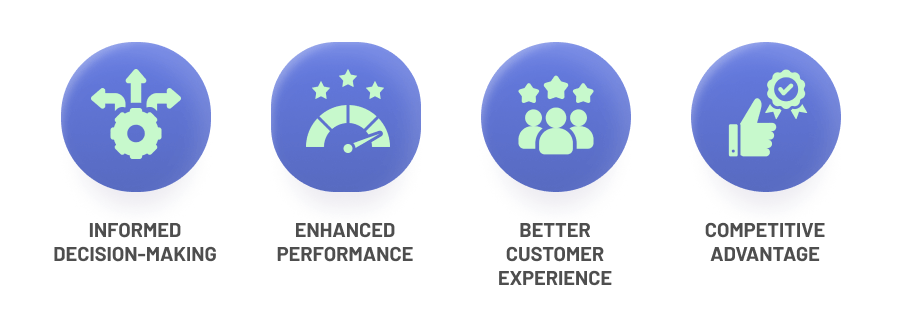
1. Informed Decision-Making
As we’ve already mentioned, solid data analysis provides deep and reliable insights for data-driven decisions. These insights let businesses understand their consumers, markets, company needs, etc.
With a robust data analytics strategy, businesses can rely on more tools to dive deep into the data they collect, extract meaningful insights, and leverage accurate predictions. This is often achieved with the use of AI and ML technologies. They can help process vast amounts of data at remarkable speeds, automate data analysis processes, reduce manual intervention, and, as a result, accelerate decision-making.
Discover Data Analytics Types for Better Decisions
2. Enhanced Performance
Your data analytics strategy can include effective practices to monitor and track key performance metrics. This will enable you to evaluate your businesses performance, detect areas of improvement and work on them effectively.
By employing analytics, businesses can optimize processes, streamline workflows, and achieve increased productivity while reducing costs. All this assists businesses in staying competitive in the market.
3. Better Customer Experience
If you aim to achieve long-term business success, you should act in alignment with your customers’ needs. Data analytics provides deeper insights into customer behavior and better understand the target audience. Additionally, it allows businesses to personalize their offers according to the specific preferences of clients.
By having a strategy that outlines how you can analyze and leverage customer data, you can deliver exceptional customer experiences as well as foster brand loyalty.
Found out the Ways to Improve Customer Experience
4. Competitive Advantage
The last benefit of using a consistent data analytics approach is its ability to help organizations obtain a market advantage. It partly derives from all the previous advantages that we outlined.
As we’ve said before, analyzing data offers valuable insights into customer behavior, company needs, and industry trends. Therefore, businesses that implement a robust strategy can effectively secure a competitive advantage within their sector.
If you want to develop a robust data analytics strategy, be ready to face the following common pitfalls:
- Data inconsistency: Obviously, inaccurate and siloed data won’t lead to business-driven decisions.
- Ignoring data governance: Without proper data governance in place, you may face non-compliance and vulnerabilities in your systems.
- Poor data visualization: Gaining meaningful insights from data without proper visualization is far from simple.
- Algorithm bias: Modern data analytics employs technologies like AI and ML algorithms for better insights, but algorithm bias can lead to unfair decisions.
BI for Business
Key Steps to Create a Data Analytics Strategy
Now let’s talk about the key steps that should be considered when creating an effective strategy to analyze your data in the most efficient way.
1. Understand Your Objectives

On the other hand, your goal may be improving your internal processes. So here, you can establish relevant performance metrics that align with your goals. In any case, defining objectives and including them into your analytics strategy at the start will help you effectively track and measure your progress and accomplishments.
2. Assess Data Requirements
- Define data sources. There are few sources from which you can get the required data. They include internal and external databases, APIs, third-party sources, etc. The point here is to understand the reliability and accessibility of these sources.
- Identify data formats. The choice of data types for data analytics depends on the specific purpose you have in mind. You may need various data formats, such as text, images, audios, etc. that will be aligned with your specific needs.
- Keep up with compliance standards. It’s important to keep your data requirements in adherence with relevant compliance standards.
- Document the data requirements. Ideally, you should create a complete document defining all of the data requirements highlighted above. It will not only guide you but also help communicate with stakeholders.
3. Define Data Analytics Tools

Particularly, you can consider using the following techs:
- Data Warehouse. When it comes to storing and managing large amounts of historical data from various sources, a data warehouse is a perfect option. It stores data in a centralized repository for better business intelligence and accurate analytics.
- ETL (Extract, Transform, Load) Tools. These tools streamline the extraction of data from diverse sources, converting it into a standardized format, and loading it into a system like a data warehouse.
- Data Integration Middleware. Typically, it is used to bridge the gap between applications and disparate systems. Data integration middleware enables real-time synchronization of data.
- Big Data. They are designed to handle and process massive amounts of structured and unstructured data. Big data can extract significant insights from diverse data sources.
- Business Intelligence Tools. In simple terms, Business Intelligence tools enable users to explore and analyze data, create impactful visualizations, and derive actionable insights.
- ML and AI. Machine Learning and Artificial Intelligence can automate the analysis of vast amounts of data, detect hidden patterns, generate accurate forecasts about customers’ behavior or business operations.
- Cloud Computing. Cloud-based platforms and services provide easy access to data sets and advanced capabilities for data processing. They also offer a wide range of tools for data analytics.
4. Identify Your Team

Decentralized. In this case, decision-making authority and operational responsibilities are divided across different entities within an organization. Each performs independently with its own processes and assets. Such decentralization aims to help make quick decisions tailored to specific needs.
Centralized. In a centralized operating model, decision-making authority is consolidated at a central point within the organization. This approach promotes a high level of standardization and coordination across various units or departments.
Hybrid. The hybrid model combines the strengths of both the centralized and decentralized models. It provides flexibility to choose the most suitable approach based on a specific situation. Overall, it seeks to create a balance between standardization and customization, taking advantage of the both.
When it comes to the team composition, there are three key professionals each data analytics team should consider. These are data scientists, data engineers, and, of course, data analysts. They all work collaboratively to leverage massive amounts of data.
- Data engineers design, develop and maintain systems that manage data sets and can be used for data analysis.
- Data scientists, in their turn, use their knowledge of mathematics, statistics, and computer science to collect required data, cleaning and preprocessing it. Additionally, they harness machine learning algorithms to derive predictions, classifications, or recommendations from the available data.
- Data analysts evaluate this information and provide reports and insights that assist in making strategic decisions.
Finding skilled data analysts may not be as easy as expected. To succeed, you may consider outsourcing your efforts. As such, you can collaborate with industry experts worldwide.
Alternatively, if you have staff, offer training to elevate their performance. You can also employ easy-to-use analytics tools so your team feels more confident in using them. Last but not least, ensure your analytics team includes key professionals like data scientists, data engineers, and data analysts.
5. Leverage Data Governance

Generally, whatever sector you operate in, data governance is a good practice to incorporate into your strategy. Especially, if you’re in such a strictly regulated industry as healthcare. For example, data governance can help you stay aligned with HIPAA regulations.
Read more about HIPAA-Compliant App Development
6. Build a Data Analytics Strategy Roadmap

Simply put, it outlines the specific steps and timelines needed to achieve the desired result. On top of that, a roadmap is an effective tool that helps every stakeholder be on the same page.
No business is static. They face changes over time, and their goals and priorities evolve. Consequently, the data analytics strategy roadmap should be updated to align with these changes.
The frequency of updates depends on the specific changes within your business. Ideally, it’s worth reviewing your roadmap regularly (quarterly or every 6 months) to ensure everything is aligned with your current goals.
Transform Your Strategy into a Competitive Edge
As you see, strategic business analytics plays a pivotal role in today’s data-driven world. It is essential for businesses that aim to improve their performance and stay ahead of competition. The right strategy is the key to transform your data into actionable insights.
If you are not sure with what to start and how to implement the right approach for your business, our team of seasoned professionals is ready to help you by providing a range of data analytics services. With our expertise, we can guide you towards developing robust analytics methods tailored specifically to your business needs.