
Regardless of the size of your company, you probably rely on data to fuel the decision-making process. However, dealing with as much digital information as the modern business world currently provides can get rather difficult.
Thus, to stay efficient, an organization should focus on developing and maintaining a comprehensive enterprise data management strategy. Having a coherent approach is just as important for companies that are only starting out with data management (EDM) as it is for those who have already implemented multiple intelligent tools.
That’s why, in today’s post, we’ll discuss what you should consider when creating a good enterprise management strategy and how to do it. For some, it’ll be a good refresher or a way to check if their approach is on track; for others, it will serve as a guideline to rely on when starting their own process. So, let’s get into it.
Types of Enterprise Data
Broadly speaking, enterprise data can be any type of digital information your business works with. It may come from web platforms, mobile apps, CRM systems, and other software the company employs.
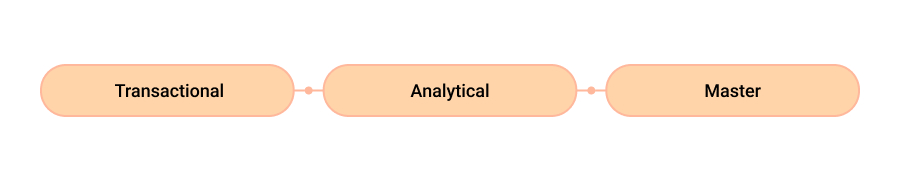
All this data can be categorized in three distinct kinds. In fact, it can probably be split up into more, but we’ll focus on the most popular groups — transactional, analytical, and master.
Transactional
Transactional data facilitates a company’s ongoing operations. It captures information pertaining to transactions like time, place, price, payment method, and use of discounts. In the context of insurance, transactional data may cover insurance claims, while in banking institutions, it might include information on deposits, withdrawals, or credit.
This type of data is typically stored within enterprise systems and helps automate data processing in sales, customer support, purchasing, and other departments that are focused on daily business activities.
Discover how Velvetech Automated Data Processing for a Recruitment Agency
Analytical
Analytical data is all about values and metrics that deliver insightful business intelligence to improve decision-making. Typically, it is stored in enterprise repositories like data lakes or data warehouses, which allow for deployment of machine learning algorithms or for different types of data analysis to be carried out.
Uncover the Difference Between a Data Lake and a Data Warehouse
Master
Finally, master data represents information about business entities and provides context for transactions and daily operations. Concretely, it can include details about products, customers, employees, or suppliers and partners.
Main Components of Enterprise Data Management

Now that you know the different types of data that are out there, let’s move on to how it can all be managed. In simple terms, enterprise data management involves any processes that help define, govern, secure, and maintain the digital information your organization generates and works with.
Working with data can be tricky. Hence, when creating a comprehensive EDM strategy, you’ve got to consider a few key elements that will facilitate success.
Data Governance
Data governance essentially helps ensure that specific data-related activities have the right people responsible for them. It includes policies and processes that help maintain the integrity, quality, and security of a business’s digital information.
These documents should explicitly state an organization’s data guidelines as well as how, when, and by whom they are to be enforced. Overall data governance accomplishes the following:
- Creates internal and external accountability
- Protects user privacy
- Helps adhere to rules and regulations
- Encourages ethical responsibility
During the process of outlining your enterprise data management strategy, you’ll likely need to spend some time on establishing data governance. It’s definitely something that shouldn’t be overlooked.
Data Integration
In order to reap the rewards of enterprise data management solutions, it’s important to think about data integration. In essence, it means you’ve got to consolidate digital information from disparate sources and various formats in a unified repository so that it is accessible and can be leveraged.
Learn about the Integration of VoIP System Metadata with Salesforce CRM
If you haven’t already, you might need to implement a data warehouse or another database in order to efficiently store and transform all of your data. However, this shouldn’t deter you because it is an important component of a successful EDM strategy.
Master Data Management
Master data management (MDM) sort of outpours from the integration component we discussed above. MDM is a process of ensuring that any decision-making within a company is based on the most current, “true” version of the data. It facilitates the uniformity, accuracy, and stewardship of an enterprise’s data.
Naturally, this is only possible when all the digital information is correctly integrated, duplicates are removed, and records are up to date.
Data Quality
Quality is of utmost importance when it comes to data. Incomplete or inaccurate digital information will damage the reliability of analytics and thus negatively affect your business. Moreover, it can slow down the implementation of enterprise data management software and cause project delays which only incur additional costs.
Hence, you ought to make sure any underlying quality problems are addressed when outlining your data management strategy. Concretely, your team might have to perform data cleansing, enrichment, integrity checks, and quality assurance activities.
Data Security
Finally, the last component of EDM we’ll discuss today is data security. With the regulatory landscape constantly changing and consumer demands for safety of personal data increasing, it’s crucial to ensure your systems are safeguarded well. Data must be protected at all points of the life cycle, whether it’s being stored or is in transit.
Hence, you need to consider which measures you will be implementing into your enterprise data management tools to prevent leaks, theft, or destruction. It might be worth starting with the basics like implementing encryption and two-factor authentication.
However, if you want to take it a step further, turning to innovative technologies like blockchain can also be an option. Specifically, as it allows firms to capitalize on its decentralization and cryptography aspects.
Discover how Blockchain Protected a Clinic From Security Breaches
BI for Business
Key Steps of Creating Your Enterprise Data Management Strategy
Now, it’s time to talk about the actual process of developing your EDM strategy. Keep in mind that the following steps will differ depending on how far along you are on your data management journey and the existing tech stack you’ve got. Some steps might have to be done in parallel or in a slightly different order.
However, no matter what your unique situation is, you can definitely use the below process as a guideline and to get a better idea about what awaits you.
1. Assess Current Situation

Of course, assessing your current situation might be quite time-consuming. In particular, if you work with a lot of digital information and are only getting started with systemizing your approach to it. Nonetheless, don’t rush this step, as it will ensure that the final result truly caters to your unique needs and challenges.
2. Define Needs and Objectives

- What are the end goals?
- Are there any pressing issues that should be prioritized?
- What kind of analytics do you want to run?
- Which data is needed and where will it be stored?
- Who will be responsible for ensuring completion of this undertaking?
- Are there challenges you already foresee?
- What are the KPIs which will help measure success?
Of course, for some organizations, the implementation of a company-wide data management strategy may take a lot of time. In that case, stick to the agile approach and define incremental deliverables and goals. In the end, they will all add up and leave you with a success-ensuring plan.
3. Identify the Needed Tools

Perhaps, you already have some of the required solutions, and they need minor tweaking or modernization. Or, you might just be working with a few solutions, like a CRM, ERP, and CMS, and are ready to take it up a notch by centralizing everything with a data warehouse. Whatever the case might be, you need to determine if any solutions are missing from your tech stack and decide how you will acquire them.
Do you want a custom-built tool, or will you go for an out-of-the-box one? If it’s the former, do you prefer outsourcing development to an external vendor or handing the project to your internal IT team, if you have one? These are the questions you’ve got to consider at this stage.
4. Implement Data Management Solutions

After this part of the process is complete, don’t forget that any software needs to be monitored and maintained. Otherwise, it might quickly become outdated and deliver poor results. So, don’t forget to ensure you’ve got a team keeping track of its performance.
5. Establish Data Governance Policies

Essentially, determine the necessary standards, policies, and procedures that will be followed by the entire organization to prevent security breaches, data corruption and loss. Moreover, don’t forget to account for regulatory compliance and include necessary guidelines into your documentation. This is particularly relevant in highly regulated sectors like finance and healthcare.
Of course, your EDM software will likely already be compliant if you’re working with experienced development specialists. However, it’s still crucial for your policies to also incorporate proper data usage procedures. Overall, just focus on outlining how you ensure data quality, security, privacy, and transparency in the processing of digital information.
6. Train Your Employees

Consider setting up a company-wide education program that will train the relevant staff on any new software and explain why certain changes were enacted. Most importantly, equip the team with the knowledge they need to continuously reach your enterprise data management goals.
Lack of Developers
Get Help With Your Data Management Strategy
Today, we’ve covered a lot of ground surrounding enterprise data management strategy and hope you’re now inspired to outline your very own approach and begin implementing it.
Remember, no matter the size of your business — you stand to benefit from taking a data-driven approach to decision-making.
At Velvetech, we know how hard it can be to begin your digital transformation process. For that reason, we offer extensive data management services for companies from all kinds of business sectors. So, don’t hesitate to reach out to our team for help. We’re always happy to work on a new project.