
“We have unlimited timelines and budget, so no rush” — have you ever heard this phrase from a client who turned to you to buy a product? No? Neither have we, so you are definitely not alone.
In today’s environment, this phrase sounds like the realm of fantasy. To remain afloat, keep the pace, or even be a step ahead of the competitors, businesses can’t afford such a luxury. On the contrary, in most cases, product delivery speed is of the highest priority. And don’t forget about budgets, which are usually also not unlimited.
That’s why those who don’t want to bother with custom development, choose in favor of low-code or no-code (LC/NC). Obviously, this is a great option when you want to accelerate time-to-market and create a full-featured product with minimal budgets.
All so, however, it’s better to keep in mind that such platforms have their flexibility boundaries, and sometimes it’s impossible to do with low-code/no-code development alone. In this article, let’s delve deeper into the topic and consider if such an approach can be a perfect match, particularly for you.
What Is Low-Code/No-Code Development? A Brief Digression into the Start of Its Era

No-code app development, as well as low-code, are generally accepted to be relatively new topics. But it’s not a rare case that all new is well-forgotten old. As for LC/NC, it’s no exception, and such approaches were studied and utilized long ago. Another matter is that their peak of development has come in the current time.
The idea of no-code and low-code app development itself lies in creating applications with minimum code lines or without them at all. Until recently, we didn’t know the term;Meanwhile, this approach existed and was called Rapid Application Development (RAD).
Let’s turn back to the 90s and recall the good old Microsoft Visual Studio that appeared at that time and its working principle. Its idea was that visual components of Windows applications could be created with just a click of the mouse. However, its functionality boiled down to the visual part only, and it was impossible to create complex logic without code.
Many agree that writing code only for the backend part is much easier and quicker than both — back and front. But later, another class of systems appeared: Business Process Modeling Notation (BPMN). It allowed the description of complex business processes not in the view of code but in the view of various forms and figures, such as squares, rhombuses, arrows, and so on.
So what do we gain in the end? Both the user interface and backend can be built through banal mouse-clicking, which eliminates the need to write even a single line of code. This is the principle that is taken as the basis for low-code and no-code development, and such platforms are like constructors with a number of elements you can build an app with.
Read why The Time is Ripe for Low-Code Development Adoption
As for custom development, it’s not that simple. To create a full-fledged product, you’ll have to write code manually and test it as well. As you understand, here, you can’t do with a couple of newbies in software development and delegate the support to a vendor of a selected LC/NC platform. Instead, you’ll need a team of seasoned engineers with strong code knowledge.
Below, let’s have a brief comparison of both these approaches in the table:
|
Aspect
|
Low-code/no-code development
|
Custom development
|
|---|---|---|
| Coding Knowledge | Basic knowledge of code-writing principles is required | Strong knowledge of programming languages and frameworks is required |
| Development Speed | High dev speed; you can gain a working product within weeks | Slow dev speed; delivery time is at least several months |
| Customization Level | Limited customization capabilities | No limitations |
| Security | Your vendor’s responsibility | Your engineers’ responsibility |
| Maintenance | Vendor’s responsibility | In-house or outsourced maintenance and updates |
| Integration Flexibility | Limited to vendor-supported integrations | Can be integrated with any other system |
Low-Code/No-Code + Custom Development Combo. Real-Life Examples When You Might Need It
Usually, if we speak about low-code and no-code app development, such platforms claim to be maximally flexible and customizable, and this statement is true, but not entirely. Sometimes, even though you can implement this or that feature without the need to write code, dealing with all configurations may take days. Meanwhile, this can also be done by writing several lines of code, which takes hours.
But this reason is not the only one to resort to custom development. Below, let’s consider several examples from our experience.
Make It Work and Look the Way You Want

Let’s consider an example from our own experience. Our team works closely with the Creatio’s no-code platform. They allow code writing and plugin development that expands application functionality, including the visual part.
Recently, we’ve released a product named Velvetel Pulse, an AI-powered contact center solution for omnichannel customer communications. At the moment, this platform works within the Creatio ecosystem only and extends its functionality with cloud telephony, advanced call analytics, transcripts, and smart call management.
To enable this synergy, our team created a custom connector for Creatio. Just because without it, it wouldn’t be possible to leverage the capabilities of all features at once.

Gaining Control of Customer Engagements
Cost-Saving Reasons

Several months ago, our engineering team got down to a new healthcare project. The company provides human services to families and individuals; they purchased 15 Creatio CRM licenses from us for their internal staff. However, they have an extensive client base, counting hundreds of patients who were initially supposed to have access to the system, too, and they also needed a customer portal. Creatio also offers such an option, but each user still needs to purchase licenses.
Do you get it? Say, one license costs $15 per month, and if you have 15 users, your monthly expenses will be $225. Not that much, right? Another scenario is that you have 1015 users and have to pay $15,335 every month. The tangible difference, isn’t it?
However, it doesn’t mean that the solution doesn’t exist. We suggested our client create a custom patient portal. This means that we are developing a separate platform and integrating it with Creatio CRM. In such a case, the client won’t have to pay for licenses; although, there are other expenditure items related to custom development, such as maintenance and hosting services.
A hybrid approach like the one we described above is quite a typical scenario that helps to bypass the limitations of this or that LC/NC platform and avoid tremendous costs for such things as subscriptions. Meanwhile, it’s better to delve into the specifics of a concrete project to understand if this approach suits you particularly.
Flexibility Boundaries and More. Limitations of Low-Code/No-Code Platforms
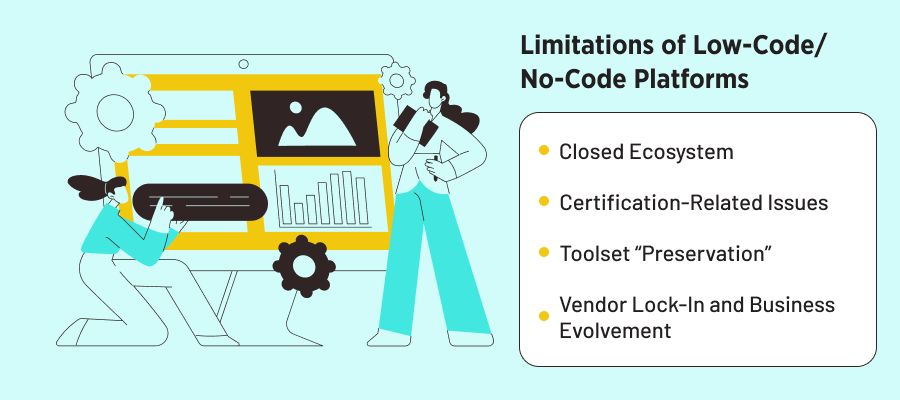
LC/NC Platforms as a Closed Ecosystem
This aspect has a twofold character. Have you come across such specializations as, say, Salesforce developer or Creatio developer? Pretty sure you have, so let’s consider both examples.
First, in both cases, be it a Creatio or SF developer, the engineers are well-versed in their ecosystems: they know how to write working code within these platforms and are fully aware of the limitations. However, these two systems mentioned above follow different paths in terms of the technologies they use.
For instance, as for Creatio, you can write backend code with .NET technology and its common programming language C#. Therefore, an engineer with relevant experience can easily delve into the intricacies of the ecosystem and become a Creatio developer quite soon. In other words, their skills are universal and can be applied wherever .NET is needed.
The same principle doesn’t work if we speak about Salesforce and its ecosystem. They went far beyond and decided not to apply tried and true technologies but to create their own programming language. As a result, to become a Salesforce developer, an engineer not only has to dive into the platform’s environment and its working principles but also to learn a unique technology.
The good news is that since an engineer has a specific skill set, their rate is much higher than the one’s with a universal background. The bad news is that this knowledge can’t be extended over other similar platforms, which significantly restricts the room for maneuvering.
However, there’s an unquestionable upside of closed ecosystems and limited applicability of unique skills. For example, if a company has in-house Salesforce or Creatio developers, they’re more likely to stay satisfied and work long-term, with less chance of being hunted by another company.
Certification-Related Issues
Imagine a situation. You’ve purchased a subscription for a low-code/no-code platform to automate your business processes and gradually start getting the hang of the new ecosystem. Your engineers are trying to fine-tune something and come across things they have no idea how to deal with.
The logical step is to reach out to support. “Are you a certified engineer to deal with low-code development within our ecosystem? Please provide your certification so we can help you.” — This is the most probable answer you’ll receive from them.
That’s why the verdict is: Want to write code within the Salesforce or Creatio environment? Very welcome, but gain your certificate first. This principle applies not only to these mentioned platforms but to other low-code/no-code systems, too.
Toolset “Preservation”
If you look at any of the long-living low-code/no-code platforms, you might notice that the technologies they use haven’t been altered. For example, if a provider selected a combo of jQuery and AngularJS for the frontend part many years ago, most likely, they won’t switch to others sometime later.
The concern is the following: they have clients that actively use the platform. Migration will definitely take time and will most probably affect system performance, which certainly won’t please active users. That’s why vendors are closely linked to technologies they had initially selected.
Therefore, when choosing a low-code/no-code platform, it’s better to pay attention to the stack they use and decide in favor of the vendor using long-living technologies.
Vendor Lock-In + Further Business Evolvement
For example, you own a relatively small business. On the one hand, you need to establish and streamline your inner processes. But on the other, you have no budget for a full-fledged custom solution and decide in favor of a low-code/no-code platform, being sure that it’s the most cost-effective approach in your case.
For some time, it really is, and the system covers all your needs. But over time, your business evolves. The system quickly acquires new users, which means you have to purchase more and more licenses. Moreover, your requirements may evolve as well, and there may come a moment when the existing functionality isn’t enough.
Sure thing, there’s always an option to develop a custom supplement and integrate it with your low-code/no-code platform. However, there still is a chance that it will not work as expected in conjunction with the existing system.
Or there may be a scenario when the selected platform evolves, and alterations don’t align with your needs. Or a provider exits the business, and the system ceases to exist. These are also potential risks you should bear in mind.
What should be done to maximally mitigate these risks? It’s necessary to soberly evaluate your flexibility boundaries and consider all possible ways of development.
At the End of the Day
Low-code and no-code development offers significant advantages, from rapid time-to-market to cost savings. However, there are times when these platforms fall short, and custom development becomes the only viable option. Understanding your flexibility limits and conducting a thorough risk assessment is essential when deciding on the best approach.
Looking to explore LC/NC platforms but unsure where to begin? Reach out to us! Our certified engineers specialize in low-code/no-code development and can guide you through implementing these solutions effectively in your workflows.