
According to HubSpot, lead-generation businesses experienced a 50% increase in revenue. However, in the age of information abundance and high competition, lead generation becomes a complex task, requiring new approaches and incorporating new technologies.
When companies implement CRM software, they usually think of improving customer relationship management, sales process, and marketing efforts. Yet, CRM provides more opportunities than you might think. It can help you from the very beginning and take your lead generation to the next level, enhancing your overall business efficiency.
What Is Lead Generation?
In marketing and sales, lead generation is the process of initiating and capturing an individual’s interest in a company’s service or product. Its purpose is to enable developing a sales pipeline, converting leads into opportunities, and nurturing them until the deal is closed.
Identifying leads is way more intricate than just following up with those who subscribed to your newsletter or downloaded an eBook. A successful lead generation strategy includes such important elements as:
- Lead generation database
- Marketing content
- Communication channels
- Analytics tools
After all, the efforts you put in the beginning will most likely define the efficiency of your entire lead management process and marketing strategy as a whole. That’s why it’s so essential to find the right digital tools for lead generation that will help you maximize your input and streamline all activities and interactions.
How Can CRM Help with Lead Generation and Management?
CRM software is known to help with sales and marketing automation. It provides numerous benefits for businesses of all verticals while managing their customer relationships and boosting profits.
Learn more about the Reasons to Implement a CRM
When it comes to working with leads, whether it’s generation or management, CRM is a real gem. In general, it can add value and support a variety of your activities to capture and convert leads. In the long run, this software helps you retain customers and close more deals.
Companies that embrace CRM solutions for any interactions with their leads usually notice advances in the following areas:
- Sales reps efficiency
- Lead qualification and scoring
- Analytics and reporting
- Lead data cleansing
Do You Need a CRM for Lead Generation Management?
Even with all the advantages CRM software brings for the management of lead generation, it doesn’t necessarily mean that your business really needs one. It might seem obvious, but many companies skip on digging deep into their challenges and rush on investing into a new tool.
Yet, the specifics of business operations, company size, number of leads to work with, and issues that sales or marketing departments face can affect the decision to embrace CRM for help with lead generation.
So, before implementing the solution, identify the core pain points of your team and the business objectives you’re pursuing. For this, you can ask yourself the questions like:
- Do you need centralized storage and easy access to all contact details?
- Does it take too much effort for your team to track customer interactions?
- Are you looking for automation of your sales and marketing activities?
- Do you need better control over your sales process?
- Do you want to enhance the conversion and retention rates?
If you find yourself pondering any of these moments, then it’s time to get help and consider embracing a CRM. Let’s explore the key ways this software can support your company’s marketing and sales initiatives and enhance your lead generation process.
Top 6 Ways CRM Improves Lead Generation
1. Effective Marketing Campaigns

In general, marketing campaigns help businesses promote their brands and increase sales. It’s an effective practice that allows companies to generate new leads and convert them into clients. Companies use various combinations of media such as advertising, tv and radio, emails, and social media to reach their audience.
An effective marketing strategy requires defining clear goals, developing a plan, targeting the audience, testing, measuring, and improving results. It’s important to deliver a message that will resonate with the needs and interests of your audience and turn them into leads.
A CRM platform empowers marketing efforts by facilitating and advancing the whole sales lead generation process. For example, it enables you to segment the target audience based on insights like name, email address, and purchase history to create a personalized email sequence and automate its sending in tandem with communications via other channels.
With lead enrichment for CRM, you can go even further and get more details about each contact (e.g., job title, location, industry, website activity). This gives you a comprehensive overview of your client profiles, leading to more personalized offerings.
Additionally, you can update the data based on customer engagement, automatically change statuses, and assign tasks. On top of that, CRM allows you to analyze major metrics like open rates, CTRs, conversion, or bounce rates and use this information to refine your campaigns.
Learn how CRM Implementation Elevated Marketing Campaigns for an IoT Healthcare Startup
2. Omnichannel Interactions
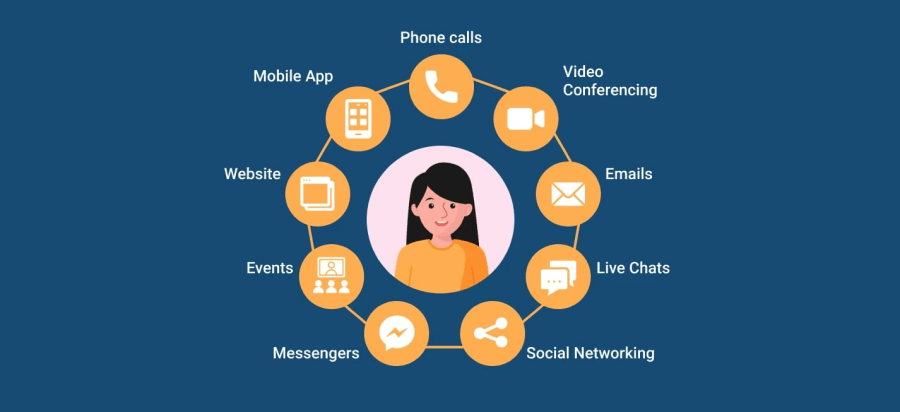
Omnichannel lead generation means using all of your channels to interact with your potential prospects, delivering one cohesive experience. You can send an email to your recipient who will answer to you via a live chat, ending a conversation on LinkedIn. All this is possible without leaving a single platform while having all communication history right in front of you.
Obviously, such an approach feels more natural, personalized, and engaging, which makes it essential for an effective lead-generation strategy. To support omnichannel interactions, companies need the help of technologies, and that’s where a lead generating CRM system comes in handy.
Integrated with a mail server, phone system, chatbot, messengers, and social networks, CRM enhances interactions with the leads. Your reps can communicate with potential clients via any channel from a single CRM interface. Moreover, marketing automation tools can help you streamline interactions with clients.
For example, you offer different educational courses, and a potential client visits your site and fills out a form to subscribe to one of them. After that, your lead generation system captures their contact information, like an email address or phone number. Ultimately, it automatically sends follow-up emails and text messages to ensure smooth and ongoing interaction with your platform.
Learn how CRM Integration with a Live Chat and a Website Streamlined Lead Communications for a Car Dealer
Such integrations make it easy to offer omnichannel communications, collect meaningful insights, convert leads into customers, and enhance customer experience.

Gaining Control of Customer Engagements
3. Comprehensive Data

There’s a large amount of all sorts of data involved in the lead generation process. It comes in different formats — emails, notes, call records, analytics, social media messages, etc. Luckily, marketing automation tools like CRM enable storing all data in one place, effectively organizing, managing, and leveraging it.
CRM collects extensive data and facilitates its processing. Knowing the potential of your platform, you can effectively use data to easily qualify, segment, and prioritize leads, defining if they are ready to go through the pipeline.
On the contrary, dirty data is one of the reasons why marketing efforts might fail. Inability to reach contacts through emails, messengers, and phone calls, poor forecasting, or delays in closing deals — these are the consequences of incorrect, incomplete, or missing information. Clean CRM data ensures that your sales reps focus on the right leads and have comprehensive details about each of them.
Modern CRM systems working in tandem with cleansing software enable sales and marketing teams to validate and update data to ensure effective lead generation. This can be achieved by:
- Purging duplicates
- Archiving old data
- Limiting and automating manual data entry
- Collecting only relevant data
4. Empowered Lead Tracking
Effective lead generation requires understanding your potential customers, where they came from, how they’re interacting with your reps and agents, and what their current status is in the journey.
A process-driven CRM platform allows you to build structured and effective workflows to organize marketing opportunities, keep track of your leads in one place, and move them through the sales funnel. Thanks to AI technologies that make CRM platforms even more powerful, you can access relevant insights and use them to direct your leads.
Read more about the Role of AI in Business
CRM also enables setting up automatic lead scoring according to your preferences, so your reps can contact each of the leads at the right time while having all valuable data at hand. This practice ensures that leads don’t fall through the cracks and reps follow up on them without time wasted.
5. Smart Analytics
One of the most powerful advantages of CRM software is analytics tools. These tools open vast opportunities to know your leads better and measure the results of your marketing efforts. With the help of AI and ML technologies combined with data mining techniques, you can explore what your leads want and timely provide them with relevant information.
Customized dashboards and reporting tools built into your CRM facilitate analysis of your sales and marketing efforts. They show what campaigns and activities drive the most profit and why certain reps and agents close more deals. On top of that, CRM empowered with call analytics and speech recognition enhances the quality of interactions and speeds up the sales cycle.
Learn how Call Analytics Increased Conversion Rates and Efficiency for an Inbound Call Center
6. Mobile Accessibility

And the last huge pro a robust CRM solution offers is engaging with leads on the go. Probably, your sales team uses their smartphones 10 times or even more frequently than their desktops. So, if they have to go back to their desks to reach out to leads, it can take a while. Whereas, with a mobile-friendly CRM in place, they can effortlessly collaborate with potential clients in real time.
Plus, mobile-powered CRM solutions are especially beneficial for instant lead capture during business forums or other meetings where you have a potential audience. Consider that you attend a conference and a potential client approaches your company’s booth to learn more about your services. Here, it’s a wise move to strike while the iron is hot rather than wait.
Hence, instead of jotting down their contact details on paper, your sales team can enter data into the mobile CRM app, along with relevant notes about their current interests in your services. This ensures accurate lead management in CRM, allowing you to send welcome emails and follow-up messages to establish quick and effective communication with your clients.
Generate Leads and Drive Sales
Your customer base and sales results greatly depend on the efforts you put into lead generation. Thus, it’s essential to use tried and tested methods and leverage the right technologies to attract high-quality leads and convert them into clients.
When used to its maximum capacity, CRM software helps marketing and sales teams efficiently identify, nurture, and manage leads. However, it can be challenging to find the CRM that meets your business needs or define what software solutions it should be integrated with to ensure seamless marketing operations.
Velvetech’s team has extensive expertise in CRM consulting and development services. We’re ready to help you with the implementation of best-in-class CRM platforms and their customization according to your requirements
If you need an exclusive CRM solution to cover unique business processes, we’ll be happy to build it for you from the ground up. Contact us for a free consultation.