
Have you ever thought that technology might understand your future shopping preferences better than you do? You may not even think that you need the current products or services, while technologies can think in advance and suggest them ahead of time. It’s not magic. It’s the power of predictive analytics.
Businesses do the trick thanks to the advanced retail and eCommerce software. Basically, to get to the point, retailers first collect our historical shopping data. Then they implement advanced data analytics practices to monitor our purchasing behavior, search habits, and other activities to suggest products aligned to our needs.
One of these practices is predictive analytics, which significantly drives the eCommerce industry. By employing it, you can open a range of possibilities, from successful inventory management to increased customer loyalty.
Curious to explore more about the opportunities that predictive analytics can bring for retail? This article will sort out things. Let’s dive in.
The Strategic Value of Predictive Analytics in the Retail Industry

At its core, predictive analytics has many advantages to offer the eCommerce sector. It can empower businesses to tap into a treasure trove of valuable insights derived from customer preferences, market trends, and purchasing patterns.
With the above data at hand, retailers can forecast the demand for products. So, they may create tailored marketing strategies and offer personalized shopping experiences. Thus enhancing customer satisfaction.
Ultimately, predictive analytics acts as a potential tool to boost overall business operation efficiency and revenue growth. And these are just a few modest examples of how predictive analytics is being used in the retail industry. There are more rewarding use cases, which we will discuss in the upcoming chapter.
Learn more how to Enhance Your Retail Operations with Data Analytics
Use Cases of Predictive Analytics in Retail
So, predictive analytics holds significant value across various activities such as inventory optimization, pricing strategies, trend forecasting, and more. It can go even further by assisting in the selection of the optimal store locations. To get a full grasp of the potential of predictive analytics in the eCommerce sector, let’s dive into its most prominent 10 use cases.
1. Customer Identification and Retention

Sounds quite simple, right? However, if you have a big store with thousands of diverse products and an even larger audience seeking suitable items, it can be challenging. And predictive analytics can become a foolproof option to address these kinds of issues effectively.
By utilizing this advanced analytical approach, you may effectively segment your audience based on their unique needs. That is to say, you can create a personalized shopping experience.
Furthermore, predictive analytics goes beyond merely identifying and retaining valued customers. It enables you to pinpoint potential customers and attract them with valuable offers.
2. Forecast Trends

Let’s picture that your store specializes in fashion and aims to forecast the types of products that can capture a larger audience. By analyzing customer preferences, purchase patterns, or browsing behaviors, predictive analytics can find out a certain style of clothing or a particular color that is gaining traction.
As a result, you can ensure your offerings are consistently aligned with current trends and customer demand. Thus boosting both your sales and customer satisfaction. It is a vivid example of how predictive analytics helps the business stay competitive and take the lead in their industry.
3. Inventory Optimization

By analyzing vast amounts of historical sales data, this analytical method helps foresee future demand. As a result, retailers can avoid excess stock and stockouts.
Discover how the right Inventory Management Software Streamlines Operations
4. Dynamic Pricing Strategies

Dive in to learn more how to Transform Your Sales With AI
Moreover, with predictive analytics, you can forecast the potential impact of different discount levels on sales. It will help provide attractive promotions to customers and boost profits.
5. Upselling and Cross-Selling Opportunities

With this precious data in place, you can identify products that are likely to be of interest to specific customer groups. As a result, it will lead to better-targeted cross-selling and upselling recommendations.
6. New Products Launch

In particular, you need to analyze sales, demand, and other variables of similar existing products. It will help forecast the performance of your new item. Armed with this knowledge, you can successfully launch a new product.
7. Better Targeted Marketing Campaigns
“There is only one winning strategy. It is to carefully define the target market and direct a superior offering to that target market”.
— Philip Kotler, Father of Modern Marketing
7. Better Targeted Marketing Campaigns

One of the ways to achieve it is by implementing a well-functioning CRM platform. Overall, CRM platforms play a central role in how companies deal with customer interactions and data throughout the customer journey. By integrating predictive analytics with CRM platforms, businesses gain valuable insights into customer behavior which enhances the effectiveness of targeted marketing.
Discover more Benefits of CRM Software
Let’s give an example. Consider a sports shop introducing a new line of hiking shoes. The main goal of the shop is to promote its products to the relevant audience. Through analytics, the company can identify historical customer data and individuals who have previously purchased various hiking-related items.
As a result, you will optimize marketing efforts, achieve a higher response rate, and ultimately drive increased sales. This example shows how predictive analytics can enhance the retail businesses growth.
Don’t miss Top Sales Technology Trends to Streamline Marketing Operations
8. Customer Lifetime Value Prediction

As a result, you can take action to reduce churn. For instance, offering promotions, sales, or special discounts to the segment identified as being at risk of churning can be an effective solution. Additionally, it will ensure sustained relationships with clients and cultivate loyalty.
9. Store Layout and Merchandising Optimization

Predictive analytics often acts behind the scenes. It helps analyze customer movement patterns and purchasing behavior, empowering retailers to know exactly where and what to position within the store. It’s a perfect example of how merchants through the power of predictive analytics can enhance their sales, encouraging us to buy what we may not have initially intended to buy.
10. Identifying Ideal Store Location

You might not have thought about it, but predictive analytics can also aid in identifying the optimal store location for your shop. With the right tools in hand, like geographic information systems and network analysis tools, you can assess traffic patterns and transportation alternatives. So, you may understand how easy it will be for your customers to reach a potential location.
Navigating Key Retail Challenges Through Predictive Analytics
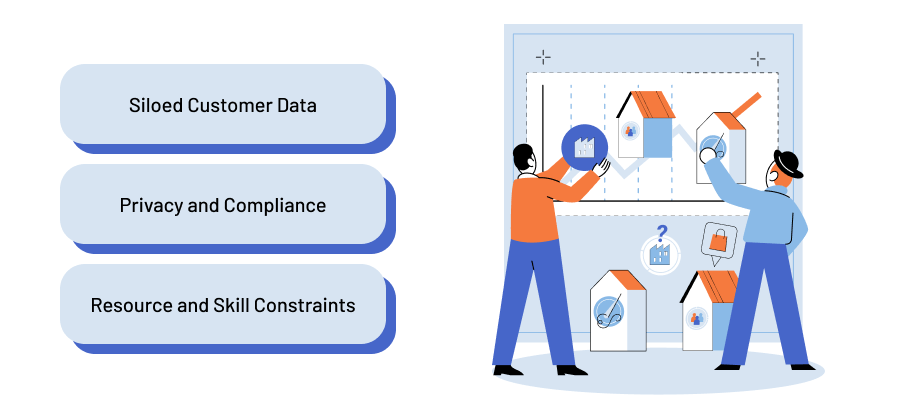
Seeing so many cutting-edge use cases of predictive analytics in retail, you probably feel motivated to apply it to your business. However, the path comes with some challenges. There are some crucial pitfalls you need to navigate to harness the full potential of this advanced analytical method. Let’s discuss the basic ones.
Siloed Customer Data
In many retail companies, information is frequently fragmented and stored in isolated databases. For example, customer data may be separated from sales data. This isolation makes information silos. It becomes harder to gain a holistic picture and analyze data across various aspects of the business.
Data silos result in ineffective and inaccurate predictive models. One of the effective ways to address this challenge is by centralizing customer information into a well-structured data warehouse. This data management system enables easier access and analysis of customer information from various sources, leading to improved clients insights and personalized experiences.
Additionally, consider implementing data modeling techniques to make it easier to integrate and analyze information from different sources and departments.
Learn more about Cutting-Edge Data Modeling Techniques
Privacy and Compliance
Aiming to provide you with relevant information about your customer, predictive analytics often collects and analyzes sensitive or private information. So, privacy considerations should be at the forefront. Simply put, you must handle data properly and in accordance with applicable privacy laws and regulations.
Ideally, retailers need to adhere to privacy regulations like the General Data Protection Regulation (GDPR) or the California Consumer Privacy Act (CCPA).
If you operate in the EU, then you need to follow GDPR guidelines. It sets rules for the collection, processing, and storage of personal information, with a focus on consent and data security. If your business is located in the USA, then CCPA can be a good option. It is designed to enhance privacy rights and consumer control over personal information.
Resource and Skill Constraints
Developing and integrating predictive analytics models may require skilled data scientists and analysts. In this case, you must be ready for additional investments. Alternatively, you can suggest some relevant training to your staff empowering them with the knowledge to operate effectively with data. That can be a much more cost-effective solution.
Additionally, it is possible to employ analytics tools like Tableau, IBM Watson Studio, or Google Analytics. They come with user-friendly interfaces and can be easy to use.
BI for Business
Take the Action: Implement Predictive Analytics in Your Retail
As you can see, predictive analytics stands as a critical tool in the modern retail industry. It helps forecast trends, optimize your inventory, reduce customer turnover, and much more. Simply put, it empowers you to drive business success and gain a competitive edge in the market.
Doesn’t it sound compelling? However, fully leveraging the potential of predictive analytics is no easy feat, especially without a skilled team and right data analytics tools. But do not worry. With our proven expertise and experience in this scope, we will assist you in developing the robust retail and eCommerce software to propel your business forward.
Want to be at the industry forefront? Contact us today for more details and consultation.