
How do you use your smartphone? Nowadays, it’s not only the means of communication, its functionality has gone far beyond. Taking and storing photos, videos, and music, conducting payments, using GPS navigation, and more. Roughly speaking, a smartphone can be considered a universal device that can be used instead of many others.
We wish it were that simple if we spoke about systems used by real estate companies and agencies! A single multi-functional software used for clients’ and employees’ communications and management, document storage, property management, data analysis, and more.
However, as practice shows, it’s a rare case that real estate companies use only one system within their firms for a variety of reasons. But there’s a nuance that they must work in sync, providing the possibility of better control over internal operations.
That’s what we are going to speak about in this blog post — integration of real estate solutions. How do companies benefit from them? Why are integrations between internal systems more challenging? What should be known when fine-tuning communication? Let’s dive into the topic!
Connecting the Dots. Why Real Estate Companies Make Integration Endeavor
Data is key to decision-making, that’s not a secret. However, the approach matters: the way you extract, transform, store, aggregate, and visualize your data directly affects the majority of processes flowing within the company and strategies elaborated on their basis.
Real estate companies operate huge volumes of heterogeneous data extracted from an immense number of sources. This specificity encourages them to look for ways that help to automate the data management process and improve its overall efficiency.
Here we’d like to give an example of our customer coming from the industry. They have multiple departments in their company, including capital investment, acquisition management, and property management. The customer’s problem lies in the lack of automation and chaotic data storage.
Their capital investment department used CRM software, and the acquisition management dealt with Excel sheets, MS Teams for internal communications, and Outlook for emails. Imagine the volumes of precious data stored in different places that must be processed manually!
Also, the risk of human error shouldn’t be discounted. Just one minor mistake may translate into material losses for the company. Since the deals’ scale may reach billions of dollars, huge amounts of money are at stake.
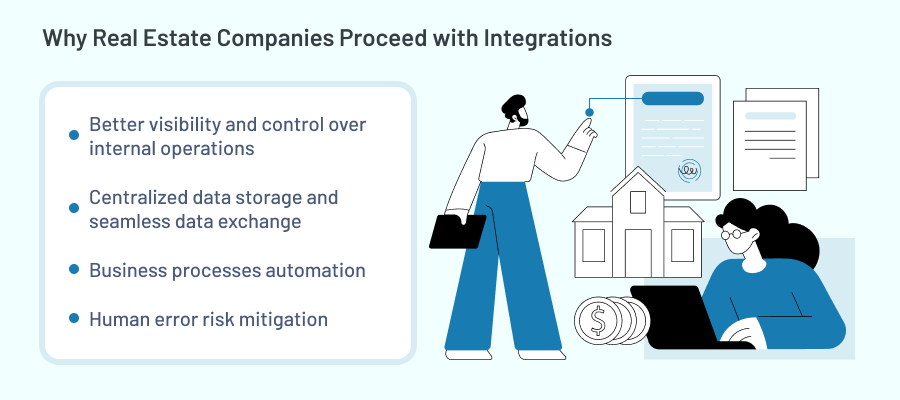
That’s why our customer ventured to integrate their systems in use — to have centralized access to mission-critical data, get rid of manual task processing, and perform better control over business operations. More than enough to plunge into the effort and begin a time-consuming integration journey, don’t you think so?
Read about 9 Types of Software to Connect CRM With
What Can Be Integrated? Spoiler Alert: Almost Anything, but with Caveats
Yes, all the systems are subject to integration at any level. It all depends on your aims and the resources you are ready to allocate. Let’s go over several options to have a better understanding of integration levels.
UI Integration

At this level, systems don’t communicate in any way, they don’t have any data exchange. Roughly speaking, the second system you use the widget from may not even know about yours.
One-Way Integration

They turned to us with the request to supplement their existing solution with the data analytics tool. The issue is that they extract data from Multiple Listing Services (MLS) and their amount exceeds 400.
In this case, their system gains data from external databases but doesn’t request any in return. This type of integration can be done via API calls, but keep in mind that you need to develop separate APIs for each data source.
Explore more details on the delivered Real Estate Data Analytics Solution
Two-Way Integration

Say, your real estate company utilizes CRM and document management software. To reduce manual data entry and ensure seamless access to all client-related documentation, it’s desirable that both systems work in sync and transmit data in both ways.
Therefore, we need to conduct a real estate CRM and DM software integration and configure instant data exchange between two stand-alone applications, which can also be done via API requests. Our task is just to fine-tune synchronization depending on the frequency we need, e.g. once or twice a day.
Discover The Power of CRM and Document Management Systems Integration
Caveats We Can’t Fail but Mention

Meanwhile, some systems may not have any accompanying documentation at all. But even here there’s a way out, which is called reverse engineering. For instance, there is a system that communicates with the database but only God knows how exactly.
Engineers sort out how the process flows, analyze the source code, and reinstate the simulation of requests to the database. Obviously, the approach takes time, but what else is left if documentation is poor or absent at all?
That brings us to the question, what’s easier to integrate: internal or external systems? As practice shows, internal systems are much more poorly documented than external ones, which automatically turns integration into an adventure. However, there is one unquestionable advantage — there is a team of engineers developing the system. This can be considered a saving straw since they have knowledge of the system’s working principles.
Integration Steps that Mustn’t Be Skipped to Ensure Seamless Systems’ Communication
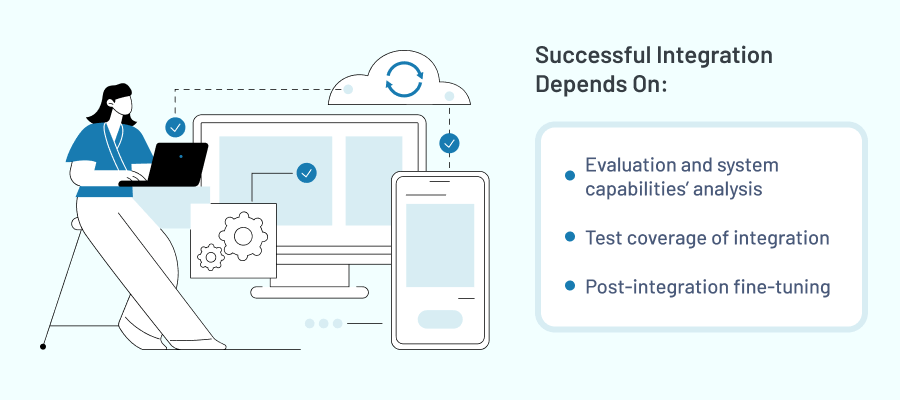
Real estate platform integration’s roadmap hardly differs from a comprehensive software development lifecycle — all the steps are similar. That’s why we’d like to highlight just several of them that may require special attention.
Thorough Analysis and Evaluation
Before you get down to work, you need to evaluate the capabilities of this particular system. If you selected the simplest type of integration, the system is well-documented and features multiple public APIs, it’s not a big deal and might take just a couple of hours.
Alternatively, you might need to enable real-time data exchange between conditional Document Management System and a CRM. If these systems weren’t originally designed to work together, it may be necessary to modify the source code of both platforms to ensure their compatibility. Obviously, in this case, you won’t be able to pull it off within hours; it may take days or even weeks, depending on the level of complexity, of course.
Do Not Skimp on Testing
One does not simply conduct integration and not allocate some time and effort to check how it works in the field. Or you can, but the consequences might be dramatic.
We strongly recommend not to neglect full test coverage of the integration. Manual testing and unit testing will help you ensure that data flow correctly, systems communicate as expected, and no accidental disruptions occur. In most cases, it is much cheaper and easier than to conduct fixes post-factum.
Allocate Time for Post-Integration Fine-Tuning
It happens that requirements change after everything is seemingly settled. Stakeholders may want to expand access to another system or alter data exchange frequency. Therefore, it’s better to take some time for the fine-tuning process.
For example, you build integration with a system that provides some pieces of data with no authorization needed. After all is done, there is an understanding that it’s not enough, and you need data accessed through authorization only. Therefore, an engineer on the other side is expected to enter the system and provide rights to API calls. Coordination and implementation will also take time, so be prepared for that.
Integration Challenges or What to Keep in Mind
Poor Documentation or Its Complete Absence

There are also cases when documentation exists, however, it hasn’t been updated for some time. When you start dealing with integration, you fail to get data from the system you establish a connection with, because you follow the described approach (which has been changed, but alterations hadn’t been recorded in the documentation).
Therefore, you have no idea what went wrong and have to look for a way to gain the necessary data. This can be done through the engineering team on that side or the trial-and-error method.
Absence of Access to Test Data

Test data empower you to simulate various use cases and scenarios to detect system vulnerabilities before the integration rollout. Another bonus is that you have the freedom to apply different types of tests, including load, unit, performance, and integration.
Improper Functioning of the System You Integrate With

It makes little sense to establish a connection with the system like that. You’ll have to put an enormous effort into data- and bug-fixing, troubleshooting, and communication with the development team on that side. Of course, it’s up to you to decide, but it’s better to think thrice before embarking on such an adventure.
Key Takeaways
Integration can help real estate companies with better visibility, smooth data exchange, and process automation. However, piles of intricacies must be kept in mind for the best result: the approach you select, system specifics, requirements alterations, data sensitivity, and more.
If you want your integration to go off without a hitch, partnering with seasoned real estate software customization and integration experts is essential. Our team helped multiple companies coming from the industry to overcome their tech challenges and stands ready to assist with yours. Explore our real estate software integration and consulting services, and let’s embark on this journey together!