
Changes are necessary. Without evolution and willingness to develop, humanity would have been stuck in the Stone Age. The same applies to today’s business — if you don’t adapt to shifting market conditions, emerging technologies, and evolving customer needs, you risk being left far behind.
The good news is that organizations fully or at least partially acknowledge this plain truth, and at the moment companies that lack a minimal set of digital solutions may hardly be found. Even if it’s a limited off-the-shelf CRM solution — it’s still much better than nothing.
However, the introduction of digital solutions into business processes at different levels is associated with a bunch of risks. Today, let’s speak about the key challenges and opportunities of digital transformation. What exactly this term means, why it can be interpreted in different ways, and which hurdles lurk on the path to digitalization.
Digital Transformation in Context: Exploring the Term
Digital transformation is quite a broad concept, and we are free to imply almost anything here. It can refer to the adoption of innovative tools, the overhaul or replacement of existing systems, or the reorganization of business processes at various levels. Essentially, any initiative aimed at modernizing and optimizing how a business operates can fall under the umbrella of digital transformation.
Typically, the drivers of digital transformation are external factors. These might include increased competition, global economic shifts, or unexpected crises like the COVID-19 pandemic. However, the need for transformation can also stem from internal motivations, such as business restructuring, rebranding, or significant events like mergers or acquisitions.
As you see, the digital transformation concept can be interpreted in various terms and can be caused by many reasons. But there is a characteristic that remains unaltered when we speak about the process — it’s definitely not a one-off thing that can be initiated and finished in any foreseeable time frame. Let’s review some examples here so as not to be unfounded.
Regulations-Driven Transformation
At the turn of the 1990s, the U.S. government implemented regulations mandating healthcare organizations to abandon paper records, digitize health data, and establish electronic health records (EHRs).
This is a clear example of a compelled digital transformation driven by changes in governmental policy. At first glance, this might seem like a one-time transition, completed once the records are digitized. However, this assumption couldn’t be further from the truth.
- First, after the transition, organizations often find that the chosen solution falls short of expectations. It may lack the necessary functionality, fail to integrate smoothly with existing systems, or prove cumbersome for end-users, requiring further adjustments or upgrades.
- Second, policies and regulations are rarely static. Over time, new rules may emerge, necessitating additional adaptations or enhancements to ensure compliance.
Integration of Legacy Models with Modern Systems
Before the usual personal computer was invented in the early 80s, organizations used mainframes occupying a separate building or even a complex of them. Sure thing, companies tend to abandon them, however, it’s not an easy and quick process at all. For example, NASA shut down its last mainframe only in 2012, but there are corporations using them until the present day!
While the approach of using mainframes still lingers in certain niches, it’s far more common for organizations to rely on software developed in the 1990s or early 2000s. Unfortunately, moving away from outdated systems is rarely a quick or painless process.
Why does it happen? The reason is simple: all because these systems have been the backbone of business operations for decades, and a one-off abandonment would paralyze the entire workflow. Hence, if business owners realize that new functionality is needed, they have to look for opportunities and resources to integrate their good old system with brand-new platforms.
Integration is a challenging endeavor itself, but connecting with severely outdated ecosystems is exponentially more complex. In some cases, systems may lack integration capabilities entirely, requiring creative or unconventional solutions, such as establishing communication through the user interface instead of the standard APIs we are used to today.
As you can see, efforts to refine or replace these legacy systems are also vivid examples of digital transformation. Whether refining an existing digital solution or replacing it entirely with a new one, these initiatives represent critical steps toward keeping businesses competitive and efficient in today’s digitalization era.
Explore How to Update Legacy Software: Options & Best Practices
Digital Transformation Challenges and Strategies to Overcome Them
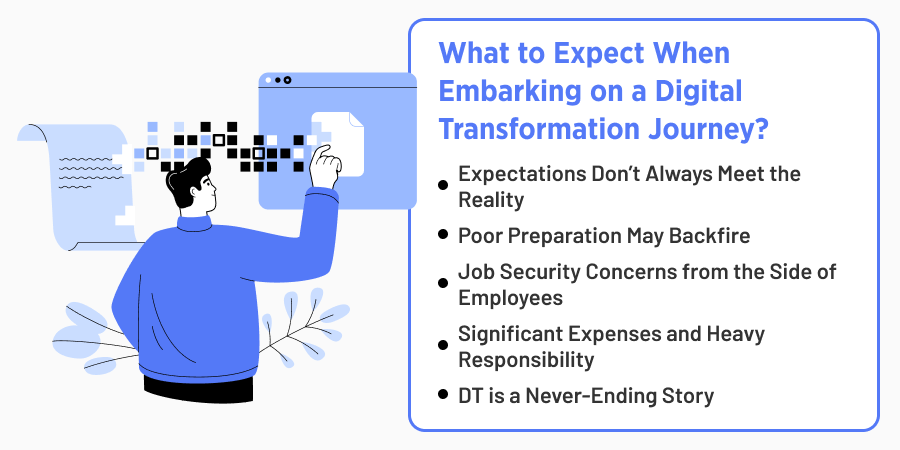
According to Deloitte, only about 30% of digital transformations are considered to be successful. Not that much, agree? Such figures prove the process to be full of obstacles and pains on the way to success. In this section, let’s review some biggest challenges of the digital transformation process.
Unrealistic Goals and Inflated Expectations

If your hypothesis falls short of expectations, don’t view it as a failure. In fact, you can draw a parallel with the experimental nature of hard sciences, where a negative result is often seen not as a setback but as a step toward progress.
Yes, digital transformation can also be considered an experimental process, which we have to understand and accept. Therefore, the agile approach to digital transformation plays a vital role. We try, test, and make conclusions about which approaches work and which are better to avoid. Continuously work with improvements, and in case of failures, we remember the issue and look for alternative ways to fulfill our tasks.
Find out What Is Agile Software Development
Modern realities showcase agility and adaptability are not optional — they are essential. You need to accept the fact that not all of your goals are feasible, but to mitigate the related risks, each step of successful digital transformation must be coupled with regular feedback and continuous improvements.
Poor Preparation for Digitalization

Let’s review a simple example. There is a travel agency experiencing sudden customer churn. This can happen for a variety of reasons: poor communication between travel agents and customers, irrelevant offerings — whatever. However, the lack of transparency is the main obstacle to understanding the root of the issue to have an opportunity to eliminate it.
Here we can observe a kind of vicious circle — to gain visibility, you need to introduce appropriate digital solutions, and for successful implementation, a clear understanding of internal processes is of paramount importance. However, there is a way to break it off.
The key lies in incorporating a comprehensive and detailed analysis of workflows at all levels as part of your digital transformation strategy, especially for ambitious, long-term projects. This involves a meticulous review of existing documentation and extensive engagement with stakeholders through surveys, interviews, and discussions. While it’s a challenging and time-intensive process, the insights gained are invaluable for setting a strong foundation for transformation success.
Business Analysis in IT
Resistance to Change and Organizational Buy-In

At first glance, such threats might seem relevant only to field staff and primarily in the context of workforce reduction. However, the reality is more complex. These challenges of digital transformation in organizations extend to management as well. Managers are equally apprehensive about job security and are often wary of an increased workload that might come with the introduction of new systems.
This intersection of motivation, psychology, and change management makes addressing these concerns particularly challenging. Unfortunately, a one-size-fits-all solution to this problem doesn’t even exist.
The role of a digital transformation vendor is crucial here. Their job is to suggest a win-win strategy, ensuring that the transformation delivers clear value not only for the business but also for the people within it — managers and field staff alike.
A thoughtful approach that would demonstrate how new tools can assist people in their work through inefficiencies reduction and new opportunities creation is key to overcoming resistance across all levels of the organization.
The Longer the DT Circle Is — the More Expensive and Risky It’s Doomed to Be

Let’s review two examples here. First, we have a small travel agency wishing to automatically reach out to clients who didn’t contact them sometime after the initial call. This is the only task they want to resolve whether through the tools that are already in use, or through migration to any other platform. Only after this issue is successfully addressed, they can shift the focus and take another step on the way to digital transformation.
In this case, the only things we risk here — budget, time, and effort we allocated for this small task. However, such an approach will hardly work for large-scale organizations, and here’s why.
For one of our major clients, we’re developing a comprehensive solution to streamline their warehouse processes. Prior to our involvement, their approach to digital transformation was incremental — addressing improvements or adding functionality only when critical needs arose.
Read how we developed the Warehouse Management Mobile App
Why is this approach problematic, you may ask? First, tackling changes in such small iterations led to the accumulation of significant technical debt. Second, their product gradually drifted away from its strategic goal. While they continued refining their internal system, their ultimate aim was to launch it for a broader audience.
Do you see the difference? Developing a product solely for internal use is one thing, but it’s an entirely different story when your vision extends beyond internal workflows to a much broader scope.
Why? Because external-facing solutions demand careful consideration of multiple factors that might be less critical in internal-only systems. Scalability, flexibility, integrability, and UI, which must not only be functional but also intuitive and appealing to meet the expectations of a wider audience.
As you can see, taking this ambitious route demands a completely different approach to development and design — one that small, incremental iterations simply can’t achieve. So, what’s the solution? It often involves adopting a fresh approach, which may mean fully replacing outdated software that no longer aligns with your objectives. However, this shift comes with its own set of digital transformation risks and challenges, which we’ll explore in the next section.
Impossibility of One-Off Abandonment of the System In Use
However, there is one caveat. If it’s a comprehensive multi-modular enterprise software and all company workflows hinge on it — a one-off transition is hardly possible. Here you must realize that during the time your system is being migrated, you’ll have to support an old platform too, so as not to disrupt your workflows. Yes, this kind of project is ambitious, expensive, time- and effort-consuming, but at the end of this path, you’ll gain a product that will cover all your business requirements.
Learn how we conducted Stepwise App Migration for Customs Bond Service Provider
Wrapping Up
Digital transformation is neither fast nor easy. Everything’s changing and evolving, that’s why be prepared that once you initiate the DT process, most likely, it will be never-ending. The same applies to challenges lurking on the way to success.
If you want the initiative to go without a hitch, you can’t do without a reliable partner providing digital transformation services – with integrated quality assurance services, you ensure every step meets excellence.. Our team is equipped with the knowledge, tools, and experience to guide you through every step of your transformation journey, from strategy development to seamless execution. Reach out to us, we’ll help you turn your vision into reality!