
You know that, in most cases, the successful implementation of a software development project heavily depends on the diversely skilled team working on it. However, it’s true that business analysts are the ones who buckle down from the very beginning.
Every team member indeed plays an important role, but the participation of a Business Analyst (BA) might not always be clear. Anyway, the impact of their work is valuable. This specialist ensures the desired outcomes during every stage of your project.
So what does it take to be a seasoned BA? What should bу the Business Analyst qualifications? And what is this role actually about?
You can listen to the IIBA podcast shedding light on the essential aspects of being a BA. Meanwhile, we’ll cover the basics regarding the responsibilities, skills, and fundamental certifications necessary to become a qualified BA. At the end of the article, we’ll also explore how to be a good Business Analyst. All of these will help you set criteria to choose the right people for your team.
The Role of a Business Analyst in Software Projects
The role of Business Analysts is far more than just collecting project requirements. Firstly, they are with you during the discovery phase to analyze and document the business process and determine the scope of work. Further, they help your project achieve initial goals through other development stages.
Generally, BAs define functional and non-functional requirements and assist you with setting clear goals a project must meet. On top of that, they analyze and model the potential value delivered by a set of requirements, monitor it during the project implementation, and modify it over the course of a change if needed.
Providing continuous support to stakeholders, BAs help find business opportunities, deliver data-driven recommendations, and create bridging stories between you and other team members.
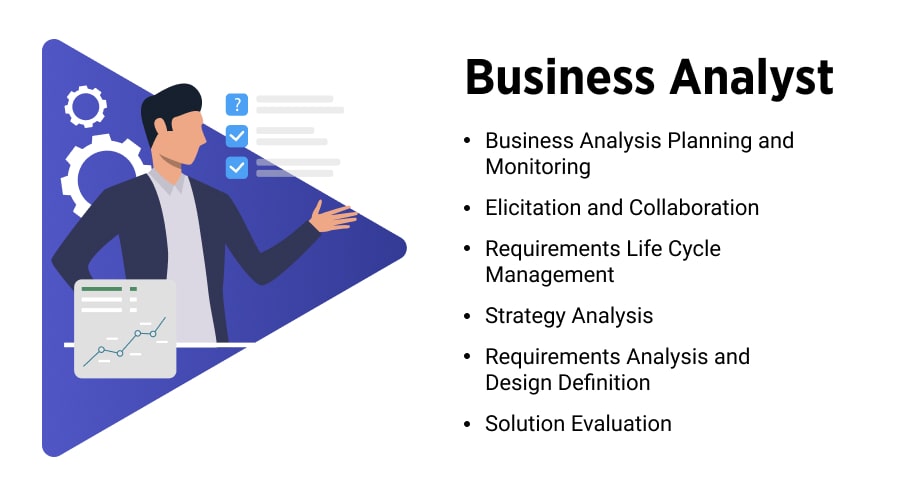
The core responsibilities of a Business Analyst usually include but not limited to:
- Business Analysis Planning and Monitoring
- Elicitation and Collaboration
- Requirements Life Cycle Management
- Strategy Analysis
- Requirements Analysis and Design Definition
- Solution Evaluation
To achieve strong expertise and provide more value, years of experience should be complemented with professional background. While driving better outcomes across software development projects, BAs should follow efficient global standards and approaches.
With a few vital certifications, BAs can elevate their knowledge, expand the opportunities, and improve the performance.

Business Analysis in IT
Background and Certifications for a Business Analyst

Becoming a Business Analyst requires more than just having a degree in one of the relevant fields. There are several beneficial backgrounds that help BA become successful. Majorly, when it comes to software development, BAs should understand both business processes and technical aspects. Thus, the focus on business and IT environments adds the most value.
In addition to a strong background, BAs master their expertise and knowledge by achieving industry-recognized certifications. It’s an important step to validate the skills, acquire key competencies, and boost efficiency.
The International Institute of Business Analysis (IIBA), the International Qualification Board for Business Analysis (IQBBA), and the Project Management Institute (PMI) are the principal organizations providing BA specialists with vast opportunities.
What Is IIBA Certification

IIBA, that serves the business analysis industry for more than a decade, is considered to offer the most common certifications in the world. Depending on the level of experience and BA needs, this institute has designed a number of options.
Their certifications include:
- Entry Certificate in Business Analysis (ECBA)
- Certification of Capability in Business Analysis (CCBA)
- Certified Business Analysis Professional (CBAP)
- Certificate in Cybersecurity Analysis (CCA)
- Agile Analysis Certification (AAC)
- Business Data Analytics Certification (CBDA)
Most of the mentioned above certifications are based on the BABOK Guide and require a comprehensive understanding of this globally recognized standard. The difference is that the eligibility for each certification involves a varied number of hours of business analysis work experience.
For example, to earn the CCBA designation, candidates must have 3,750 hours of experience in the last seven years, while CBAP entails 7,500 hours of experience in the last ten years.
Following IIBA recommendations, BA should:
- Study BABOK
- Complete certain hours of professional development supported by endorsed training providers
- Have required experience
- Pass a certification exam
The Competencies Required for a BA
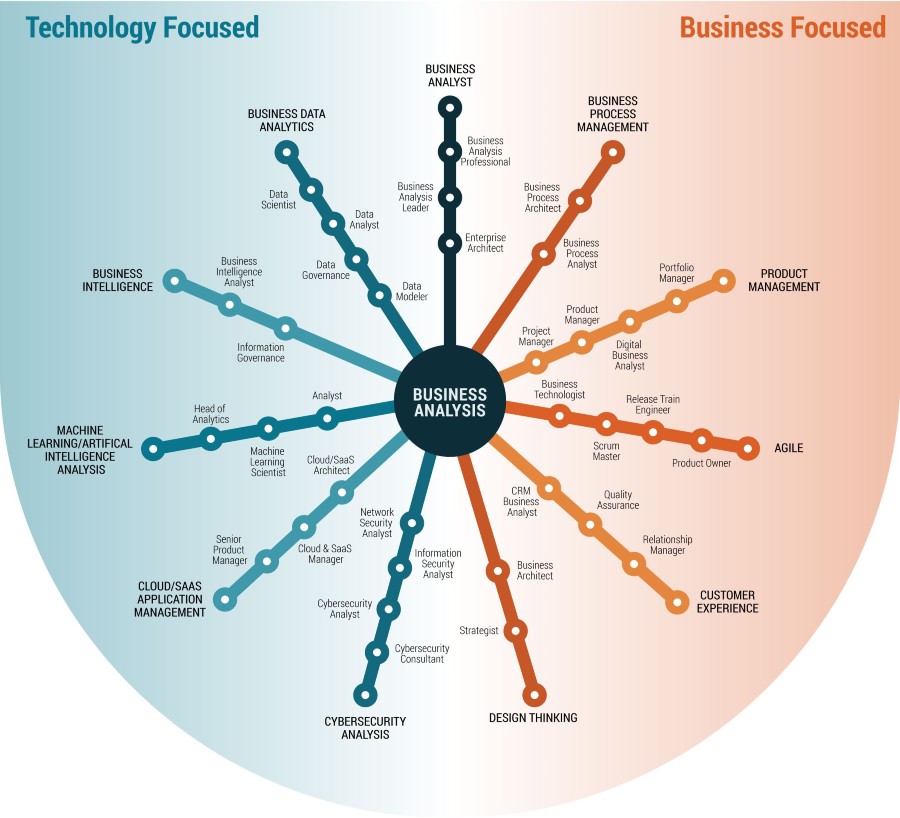
The role of tech BA implies possessing both hard and soft skills. Business Analysts need to research, analyze, review, and structure a vast amount of data, document and present it using varied formats to the clients and project team members.
The essence of a Business Analyst is to align IT solutions with business operations. So, to successfully and efficiently perform this functionality, the core competencies for a Business Analyst incorporate:
- Communication skills
- Analytical thinking and problem solving
- Business knowledge
- Interaction skills
- Decision making
- Organizational skills
- Tools and technology knowledge
On top of that, BAs should always master the experience with the professional software tools, be aware of the industry best practices, have a good business structure understanding, and improve their Unified Modeling Language competencies. With such an arsenal of skills, BAs can expand their roles to enhance business results.
Source: IIBA
BA Tools and Software
In addition to certification programs and courses aimed to help BAs master their skills, there are software tools that streamline the delivery of business analysis services. With numerous solutions presented on the market, BAs mostly rely on project management, documentation, and modeling tools in their work.
Read more about Top 5 Business Analysis Tools
Project Management Tools
As part of the BA’s responsibilities involve defining project development activities and task management, tools like Trello, Asana, and Jira find their way to support business analysis processes.
These collaboration tools allow BAs to plan sprints, assign and track tasks or issues, and communicate with a team to propel the project implementation.
Documentation Tools
While working with a pile of documents and analyzing requirements, BAs need tools to write, exchange, accumulate, and store valuable data. GoogleDocs, DokuWiki, and Confluence help Business Analysts streamline work with project details and ensure quick access to them anytime.
Prototyping and Modeling Tools
Communicating the vision of a designed software project to stakeholders, BAs need solutions like Balsamiq or Pencil to build prototypes showing how the final product will look and feel. Similarly, wireframes and flowcharts created with, for example, a business modeling tool like Microsoft Visio help explain the project idea to the developers.
Learn How to Explain Your Project Idea to a Dev Team
How to Become a Business Analyst: Key Steps to Consider
So, you see that becoming a Business Analyst is not a trivial endeavor. It obviously takes more than having an appropriate background, acquiring the right qualifications, and knowing how to use the key tools. As with any other profession, it involves having a suitable set of soft skills and a strong desire to continuously learn and strive for excellence.
To help you get a full, complete picture of what path a seasoned BA should follow, we’re finally moving to the last part of our article. It consolidates essential steps to become a Business Analyst on software projects.
#1 Obtaining Education and Qualifications
While there are no strict Business Analyst education requirements, it is a good choice to opt for a bachelor’s degree in a related field, such as business, computer science, information technology, or engineering. Many talented professionals in this arena also have qualifications in business administration and management, as it helps them craft a solid understanding of business processes, operations, and concepts.
#2 Developing Core Business Analysis Skills
One of the previous chapters has already uncovered the crucial for a Business Analyst arsenal of skills. Here, we want to highlight that it doesn’t happen in the blink of an eye. One really needs to work on developing the required skills, and often it can be achieved only through gaining practical experience.
#3 Learning Tools and Gaining Technical Knowledge
This is another vital step on the way to becoming an experienced BA. And here again, it takes time to get familiar with software tools and understand software development processes, methodologies, like Agile or Waterfall, and technology platforms.
Read about the Top 15 Software Development Methodologies
#4 Earning Certifications
This is not a compulsory part to earn relevant certifications, however, doing so definitely demonstrates the expertise in the field. You see, acquiring the necessary skills and knowledge that we were talking about before can be done particularly through certifications, coursework, and practical experience. And that is our next point.
#5 Building Practical Experience
This part can be tricky but certainly necessary. To ensure predictable outcomes in IT projects, a BA should gain years of extensive hands-on experience.
By collaborating with cross-functional teams, including software engineers, QA specialists, project managers, and stakeholders, Business Analysts pave their way toward a better understanding of the practical aspects of the job. And that helps them bridge the gap between business needs and technical solutions, ensuring the delivery of software projects that meet both functional requirements and strategic objectives.
#6 Continuously Improving
This one doesn’t need much explanation. To stay competitive and keep delivering great results for clients, BAs should be up to date with technological advancements, new practices, and modern tools. Make sure that a BA on your team is open to feedback and continuously seeks opportunities for improvement in skills and knowledge.
Choose Your Way to a Seasoned BA
So in a nutshell, a Business Analyst is an essential part of every software development team. These professionals help define project requirements and product features, plan workflows, and build prototypes and wireframes.
Being a BA in the software development field means having both technical and business knowledge, getting certified with, for example, IIBA programs, and acquiring certain skills like strong communication, problem-solving, and analytical thinking.
Our team consists of experienced BAs with beneficial backgrounds. They grow professionally nonstop, expand their knowledge, and earn certifications. Relying on their deep expertise, you can ensure that your software development project will meet initial goals and needs.
About the author