
You are thinking about buying a coffee machine. You want it to make espresso, americano, and cappuccino as well as froth milk whenever you need it. You also would like it to be red, work quietly, and make a cup of coffee within 10 seconds. Consider this as a simple explanation of functional and non-functional requirements.
Requirement analysis is crucial for project success. It helps Business Analysts and Project Managers define the needs and conditions to be met, set the right goals, and create necessary product documentation. So, in this article, we’ll explore the main types, distinctions, and examples of functional and non-functional software requirements.
Types of Requirements in Software Engineering
Any project starts with an idea and a range of criteria to be met. The requirements outline the features a product should have in order to address your needs.
First, all the requirements can be divided into three main categories that describe the business, user, and system guidelines.
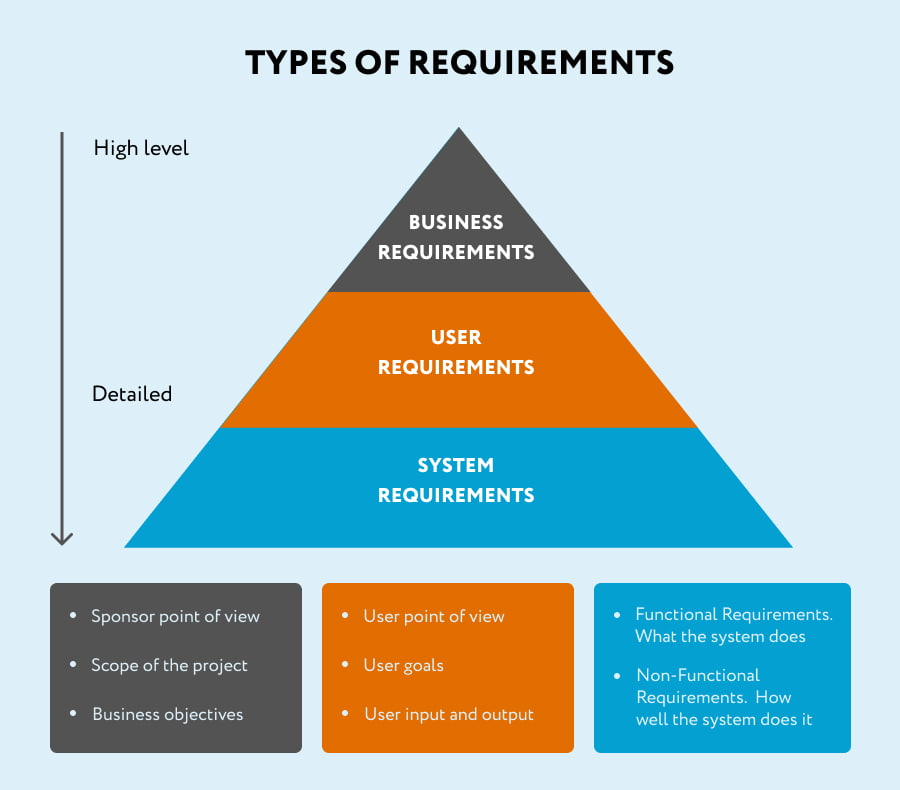
Business requirements describe the high-level goals of the company and stakeholders’ vision of what the solution should do.
User requirements define what users can do with the system, their needs, and a list of activities they expect to perform.
System requirements are the building blocks that are used to create a software solution in practice. They can be functional or non-functional.
Clearly defined requirements help the development team and client move in the same direction and achieve initial goals. Generally, they are captured in requirement documentation that enables covering the following moments:
- Setting the right goals
- Defining team roles
- Estimating project time more accurately
- Foreseeing and avoiding possible pitfalls
- Eliminating miscommunication
It is crucial to pay attention to detailed requirements beforehand as further adjustments during the development process often cause project delays and a cost increase. On top of that, there is even a risk of a failure if the key points are determined imprecisely.
Learn How to Estimate a Software Development Idea
Understanding the definition of requirements in software engineering plays an essential role. First, it helps deeply analyze project needs and identify the right scope of work.That being so, it results in cost optimization as your custom tech product product will include only the most significant features.
Furthermore, knowing the differences between functional and non-functional requirements will empower you to support customers with a better experience.
Project Estimates
What Are Functional Requirements?

To put it in simple words, functional requirements (FRs) describe the basic software system behavior. It points out what the application should do and what should not to work in a trouble-free manner.
Learn how to Build a Killer App with a Minimum Feature Set
When we talk about the features and functions the product must have to meet user needs, we imply functional requirements. They include the actions users take to interact with the system as well as specific operations the system should perform. Usually, these operations are data input and output, calculations, or workflows.
Functional requirements greatly impact and even define the entire engineering process. They are covered in a software requirement specification (SRS) that provides detailed descriptions of the product functions and capabilities. This document enables considering key moments of the project, addressing the needs, and ensuring a smooth and efficient development process.
Commonly, SRS documentation contains such important parts as:
- Purpose of the solution
- Overall description of the system
- Specific requirements
- Use cases
- Work breakdown structure
- And other
Everything may sound easier in theory than in practice. If it is still puzzling for you to determine the FRs, then let’s move to the list of realistic examples. They will allow you to have a better idea of what kind of features and functionalities you should identify in the first place.
Examples of Functional Software Requirements
Whether it comes to web app development or a mobile product, there is a variety of functional requirements that apply to both cases. The examples include:
- Authentication
- Levels of authorization
- System reports
- Administrative functions
- Certification requirements
- Audit trail
- Transaction corrections
- Interactions with external systems
If we delve even deeper, then more detailed examples would be the following:
- A system should charge the customer for the service when a certain action is completed
- A system should be able to create an account, modify and delete it
- A system should send an email or pop-up notification when a certain condition is met
So, having answered the question what are functional requirements in software engineering, let’s move on to the next one you naturally wonder about.
What Are Non-Functional Requirements?

On the contrary, non-functional requirements (NFRs) define the quality attributes of the system. They outline how the system should perform and the ways the product should behave.
Even if, for some reason, these requirements are neglected, the system will still provide its basic functionality. Then you might ask why they are important at all? A short answer is that non-functional requirements immensely impact the user experience, which is something you would not want to ignore.
Learn why NFRs Are One of the Top Considerations for Realistic Software Estimation
Non-functional requirements are essential to ensure the overall usability and efficiency of your solution. They highlight particular conditions for the system to operate under, rather than certain behavior.
While underestimating them leads to poor user experience and inability to meet their expectations, overestimating causes the rise in software development costs. Thus, it is vital to define the most significant ones to deliver a successful product and stay on budget. Brainstorm ideas with all stakeholders, classify NFRs according to execution and evolution qualities, and engage with your development team.
Examples of Non-Functional Software Requirements
Now, let’s look through some examples of NFRs to help you facilitate their identification in your project. Here they are:
- Execution qualities
- Usability
- Security
- Reliability
- Regulatory compliance
- Evolution qualities
- Scalability
- Maintainability
- Testability
- Extensibility
- Stability
Below you can find a more specific list of non-functional requirements examples:
- A website should load in 2 seconds
- An e-commerce platform should be able to handle 500,000 users simultaneously
- A banking app should be available for users 24/7 without downtime
- An abandoned cart email should be sent 3 hours after the user leaves the cart

Business Analysis in IT
Functional vs. Non-Functional Software Requirements
All the information covered above serves as a guideline to pave the way for a top-notch solution. We have summarized the key differences between functional and non-functional requirements so you can have a brief look at them once again.
Functional Requirements |
Non-Functional Requirements |
|
|---|---|---|
Key Question |
What should the system do? | How should the system perform the tasks? |
Result |
Product features | Product properties |
Focus |
User requirements | User expectation and experiences |
Property |
Use cases | Quality attributes |
Role |
System functionality | System performance |
Significance level |
Mandatory | Optional |
Identification difficulty |
Quite evident to define | Quite hard to discover, unobvious |
Software Requirements Documentation
We’ve already outlined some moments regarding the documentation, but let’s get a tad more specific and discuss what is important to consider while working on it. As we found out, there are essential differences between FRs and NFRs. However, in practice, they are often documented together within a comprehensive software requirements document.
Besides the overview that provides a high-level introduction to the project, its objectives, and the scope of the software, this document contains several key components. One of them is obviously functional requirements that include use cases, user stories, and acceptance criteria to outline a detailed understanding of user interactions and expected outcomes.
Another evident one is non-functional requirements that, as you know, specify criteria and metrics related to the system’s behavior and performance. Of course, that’s not all the components your team should think about. For example, dependencies and constraints identify any external factors, dependencies, or limitations that may impact the development or deployment of the software.
The documentation also introduces assumptions made during requirement gathering and potential risks that may affect the project. Also, don’t neglect such thing as traceability matrix. As the name implies, it establishes better alignment between requirements and project goals and objectives. Lastly, there’s a change control aspect to outline a process for handling changes to requirements. It will help you ensure that modifications are carefully considered and documented.
So, all in all, your documentation should include:
- Introduction and overview
- Functional requirements
- Non-functional requirements
- Dependencies
- Constraints
- Assumptions
- Potential risks
- Traceability matrix
- Change control

So, Does It Make a Difference?
To make a long story short, functional requirements describe what features and functions a solution must have to enable flawless and uninterrupted operation. They are derived from the business idea and responsible for the basic system behavior.
On the other hand, non-functional requirements help determine how the system should work and how to provide users with a seamless experience. At this stage, consider the performance, convenience, and usability of your future product.
Although functional and non-functional requirements in software development sound easy to reveal, they often leave companies perplexed. Understanding the differences between them is essential for a successful outcome. Thus, having a technology partner by your side will help cast light on the subject, optimize project time and costs, avoid major pitfalls, and ultimately deliver a robust product.
Velvetech is staffed with experienced teams of BAs, PMs, and developers who aspire to know more about your tech idea. Our expertise goes far beyond project estimations and covers all aspects of business analysis and IT consulting services to ensure custom software solutions meet the most challenging needs. Share with us your vision and we will help with its realization.