Every project owner desires to know the financial implications and time frames for the completion of an intended project, right from the word go. Irrespective of how small or simple a project may seem, the process of estimation is always a big deal because of its significance.
Key Highlights
- If you have limited information about the project, then the analogy estimation method will be a wise pick.
- The bottom-up method divides a project into multiple tasks and subtasks, which takes more time to estimate but gives the best level of accuracy.
- If you want to estimate the software implementation based on your team members’ feedback, then Planning Poker will be a perfect choice.
- The most effective way to enhance your project estimation accuracy is by combining multiple techniques.
There is a lot to consider depending on the case of estimation, be it a new project, changing teams for an ongoing project, or just contemplating a new idea for investment. There are also some possible factors to put in the list of considerations, such as a detailed specification, functional requirements, the risks involved in the intended project, and so on.
Making a workable estimate that is precise and accurate to the last penny takes the discipline of a surgeon.
The objective of estimation is to predict the amount of funding, resources, and time needed to create a project. Considering these factors, project stakeholders can make informed decisions and ensure a smooth and efficient delivery and implementation.

Project Estimates
Why Is Estimation Important
People often confuse an estimate with a budget. They are similar but a step apart from each other. An estimate becomes a budget after approval from a project owner. Only after that can funds be allocated. Therefore, there can be no project funding without an estimation.
An estimation accounts for producing and managing a project. It provides the calculation of resources, effort, cost, and timing it might take to achieve the successful completion and delivery of a project.
As for you, the project owner, it should be understood that an estimate does not indicate the final cost but just a ballpark range. The intention of the estimate is to secure a budget or investors and get the project started. It is more like a prerequisite to the development phase.
To accurately estimate your software project, you need to first and foremost understand the requirements and specifics of your product. Afterward, it’s critical to choose the right estimation methodology. You can also mix several ones depending on your project requirements.
The right technique will assist you in accurately pinpointing the approximate timeframe, resources, and, of course, budget required for app development. With this information in hand, you can confidently tap into implementation.
Learn more about Custom Software Development Cost
Major Components of Project Estimation
Even if every project differs in size, complexity, technologies, and requirements in general, the components of the estimate remain more or less the same. They don’t usually depend on the type of estimation methodology and are used to reflect various sides of product development efforts.
A standard estimate must be transparent and fair. To provide a clear and accurate picture of your future project and its cost, it should include the following elements:
- Tasks: The details of what should be done
- Resources : The human efforts, the number of experts
- Rate: The ratio of cost to time, the currency of payment and discount
- Duration: The length of production in hours or days
- Third-party services: In case of additional services that might not involve the software vendor directly.
Now, let’s take a look at some of the best methods for estimating IT projects that help stakeholders stay aligned with expectations, optimize resources, manage risks, and improve the likelihood of project success.
Ready to take over your project?
Software Estimation Methodologies
1. Estimation by Analogy

To have an estimate by analogy, the cost of production from similar projects in the past is reviewed and compared to the one at hand. The differences between them are noted. Those could be such factors as complexity, the scale of the project, anticipated delivery date, location, inflation, present exchange rates, etc.
The resulting project estimation can be fairly accurate if a good analogy is found. Remember that no solution is exactly the same. Work on your estimates systematically and justify them to the project stakeholders.
Let’s have it in mind that if the project size in terms of scope, capacity, or performance of an intended project is twice as much as that of the analogy project, then the resulting estimate of the analogy must be “scaled up.” There is a bit of caution here – twice the size might not equate to twice the cost. The ratio of size to cost must be analogous.
This method is preferable when you have limited information about the project to be estimated.
2. Constructive Cost Model

Also known as COCOMO, this method also aims to calculate the approximate cost of software creation. So, how does it work? COCOMO is a mathematical model trained in different projects, which leverages equations and various parameters to estimate your app development budget.
There are three stages of COCOMO to consider:
- Basic: Estimated app budget based on development efforts, specifically assessing lines of code.
- Intermediate: Merely assessing lines of code may not be enough for accurate cost calculation. So, here is where the intermediate stage of the COCOMO steps in. It involves processing of other characteristics like the size and complexity of the app and hardware attributes to improve budget estimation.
- Detailed: As the name implies, this stage goes further and processes project-specific factors (e.g., team size and expertise, development framework and tools, security and compliance requirements, maintenance and support expectations) to establish more realistic development costs and time.
Project cost estimation is crucial to avoid failure halfway through due to a lack of money. Some project estimation methods, like COCOMO or analogy, can help you calculate an approximate budget for your endeavor.
However, it’s worth assessing critical factors such as technical requirements, potential pitfalls, and the timeline. Additionally, consider the platform choice, the overall complexity, and most importantly, the specifics of your solution. Keeping an eye on these factors will help you estimate a realistic budget for your project implementation.
3. Bottom-Up Estimates
In this method, the project is divided into several tasks and subtasks that can be easily defined and managed. Hence, it becomes easier to estimate. All the tasks are then separately estimated and totaled from the bottom to the top to provide a final estimation.
This style, “bottom-up“, takes more time to make an estimation, but it gives the best level of accuracy if all the component details are taken into consideration.
4. Project Evaluation and Review Technique or Three-Point Estimates
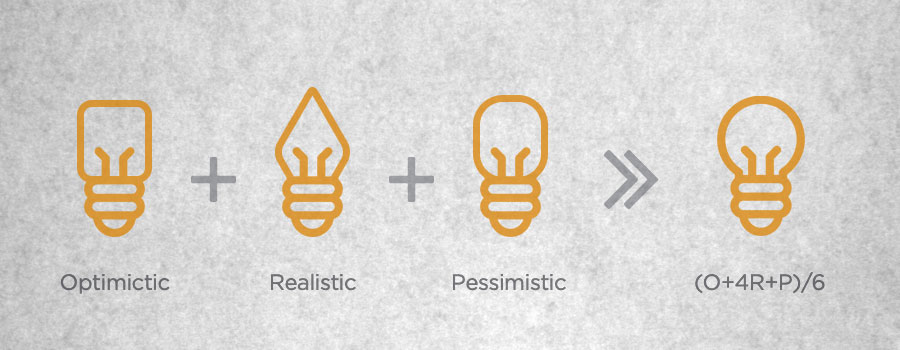
In this methodology, three ranges of estimates from three data points are first provided. The three data points are “best scenario”, “worst scenario”, and the “most likely scenario”. The final estimate is the weighted average of the estimates.
The three-point estimate has the advantage of reducing the chance of an inflated estimate. It is also one of the simple yet accurate project development cost and time estimation methods. The three estimates to be averaged can be done by different people for better precision.
5. Parametric Estimating

This method is similar to estimation by analogy but with more accuracy. Parametric estimation involves a statistical or mathematical approach:
- The first step is pinpointing the factors of development, e.g., business or functional requirements, non-functional requirements, the complexity of the project, and technology.
- Next is getting information about the required work to complete one unit from similar past projects, then relating it to the total number of units applicable to the present project.
- Lastly, the cost is determined by an empirical relationship between the factors involved and the total units of the project. Scalability is then used for accuracy.
If you want to set realistic deadlines and deliver your app on time, take the following steps:
- Clearly define your project’s scope and requirements
- Shortlist the key features for an MVP
- Consider potential risks
- Split the project into tasks and set deadlines for each
- To elevate your effort, pick up the most relevant estimation techniques
- Make sure you have the relevant team on board
6. Use Case Points
This type of estimation is used to predict the software size, especially if Unified Modeling Language and Rational Unified Process methodologies are to be used for the software design and development.
The project size estimation is calculated considering elements of the system use cases, technical, and environmental factors. The result is then applied to calculate the efforts for the project.
Learn more: Practical Tips to Get a Realistic Project Estimation
7. What-If Analysis

What-if analysis refers to the process of exploring different scenarios and assessing the potential impact of changes or variations on the project scope and estimate, in particular. It is used to analyze how modifications to various factors can influence the project’s timeline, effort, resources, and costs.
Actually, what-if analysis is one of the widespread types of estimates in project management. Meaning, it goes far from merely being a software development assessment approach. Overall, what-if analysis enables managers to anticipate potential changes, risks, and uncertainties. By exploring different hypothetical scenarios and evaluating their impact, you can make more informed decisions, improve planning accuracy, and increase the chances of project success.
8. Planning Poker

This technique is common in Agile frameworks and involves the whole team in the estimation process. Each member is given a set of cards with numerical values, typically based on the Fibonacci sequence.
Discover more interesting ground about Agile Software Development
The team reviews tasks one by one, and everyone selects a card to estimate the required effort to complete it. If there is no consensus, the team taps into discussions and votes again until an agreement is reached.
As a result, it is possible to achieve more accurate and realistic estimates. Additionally, it significantly increases both the team’s satisfaction and their sense of responsibility to deliver the project on time. Obviously, when team members feel that their voices have been heard, they are more motivated to put in their best efforts to ensure a smooth and successful implementation.
9. Function Point Analysis

This is one of the famous project estimation techniques in software engineering. It aims to accurately assess the overall size and complexity of the software based on different functionalities. This model measures features from the user perspective.
Specifically, it assesses elements such as inputs, outputs, user inquiries, external interfaces, and the like. Afterward, it converts these measurements into development timeframe, cost, and resources.
After all, it’s a good idea to define how long it would take to deliver the core functionalities of your solution. Hence, this method can become a perfect addition to other methods to elevate the accuracy of project estimation.
10. Monte Carlo Simulation

Before tapping into your app’s implementation, ideally, you need to have a solid understanding of possible pitfalls and their potential impact on your project. The Monte Carlo Simulation model will assist you in getting there. Generally speaking, it processes historical data to showcase what would happen if something goes wrong.
Probably the cherry on top of this method is that it brings to the table a range of outcomes, rather than a single averaged estimate. After all, as the saying goes, “forewarned is forearmed.” Hence, with this estimation method in place, you can identify many potential pitfalls that may cause serious delays and costly mistakes during product development.
Like the previous model, Monte Carlo Simulation can also be mixed with other estimation methods.
11. Expert Judgment

That’s one of the easiest techniques in terms of time and effort required. Often, it’s used when you only have a project vision with not much data available and want to get an approximate idea of how much the development would cost.
Expert judgment involves seeking input and guidance from project managers and other IT experts who can provide a qualitative and subjective approach to estimation. In this case, costs will be based on their knowledge and experience.
However, it is important to note that expert judgment is not that foolproof and accurate. So if you can share more details with the team, then this method should be used in conjunction with other techniques to enhance the estimate.
Need to estimate your project?
Estimating Pitfalls
The software project estimation process can be challenging, and there are several common pitfalls that project teams may encounter. Being aware of them can help project owners, managers, and other stakeholders mitigate risks and improve the accuracy of the process.
Here are some project estimation pitfalls to watch out for:
- Insufficient requirements
- Optimistic bias
- Time pressure
- Inadequate historical data
- Neglecting risk assessment
- Overlooking dependencies
- Scope creep
- Lack of stakeholder involvement
- Inadequate experience and expertise
The Secret Behind a Robust Software Project Estimation
So far, we have discussed the core methodologies used for accurate software project estimation. And probably, it’s needless to say that these methods won’t go far without cutting-edge technologies in place. Hence, we couldn’t wrap up without zooming in on two main innovations making smart estimation possible: AI and ML.
It’s worth noting that to calculate the approximate efforts needed to successfully develop the project, you need to process a huge dataset. And it can hardly be possible without artificial intelligence. The immense role of AI here is endless: fast data processing, minimized human bias and errors, risk prediction… The list goes on.
The next technology that is definitely worth mentioning is ML. You see, many estimation approaches rely on historical data to calculate the resources needed for successful project implementation. And what if not ML algorithms can accurately process historical data and elevate predictive analytics?
So, when applying an estimation tool, ensure that it incorporates AI and ML. Otherwise, achieving effective results may be challenging.
The Best Alternative
One of the crucial aspects of software engineering is applying appropriate techniques for accurate project size and cost estimation and ensuring the successful planning and execution of development tasks.
Having considered all the top eleven estimation models mentioned above, there is still the question:
Which method is the most efficient for getting a software development estimation?
Project management and estimation tools can be of great assistance. In some cases, automated software estimating tools can even be more effective and accurate. However, the most considerable way to achieve a great estimation is by combining multiple techniques.
About the author

Reach Out to Us