Asking a mobile app developer or an app agency the right questions will make or break your mobile app project. Your interview questions will immediately reveal to mobile developers whether you are in the know about mobile app development, and if they can quote you some extra. Developers’ answers, in turn, will let you choose the best candidate.
You can also skip to questions you are most interested in:
- General App Development Expertise
- Advanced Mobile Experience
- App Development Cost
- App Building Process
- Post-Development Assistance
- Closing Round
Key Highlights
- If the mobile app development agency has at least 10-12 quality apps in their portfolio, that’s a good sign; you can confidently move forward with them.
- It’s a wise move to ask for a reference from the client, for whom your considered dev team previously built an app.
- Setting up your own code repository and requesting daily code commits gives you solid visibility into the process and reduces the risk of vendor lock-in.
- Since Apple and Google release new OS versions frequently, choose a candidate who offers ongoing maintenance and support to keep your app updated.
Without further ado, let’s jump right into these questions. If you only read some, then skim over the first ten questions. You’ll learn what questions to ask and what red flags in the answers to watch for.
Lack of Developers
Questions about General Mobile Development Expertise
To get the ball rolling, fire these initial questions at a mobile development agency you are considering. The questions will help you to quickly interview the candidates, shortlist them to pros, and fish out wannabe mobile developers.
1. How many apps have you developed?
Everybody is after numbers these days, big numbers that is. Ask anyone what the best proof of the claimed experience is, and they’ll tell you it’s the number of successfully completed projects.
And so these app agencies will pour you with numbers: “We have developed over 101, 200, 300, etc., apps!” What nobody says is that half these apps are nothing but an icon (outdated and taken down from app stores), while another chunk never made it to the stores (remained a proof of concept). In practice, there is usually only a handful of high-quality apps in a portfolio that you’d even risk installing and reviewing.
Takeaway: You are looking for quality apps that are more than icons in someone’s portfolio. Ten to twenty quality apps are a good sign.
2. What apps can I download from the App Store or Google Play?
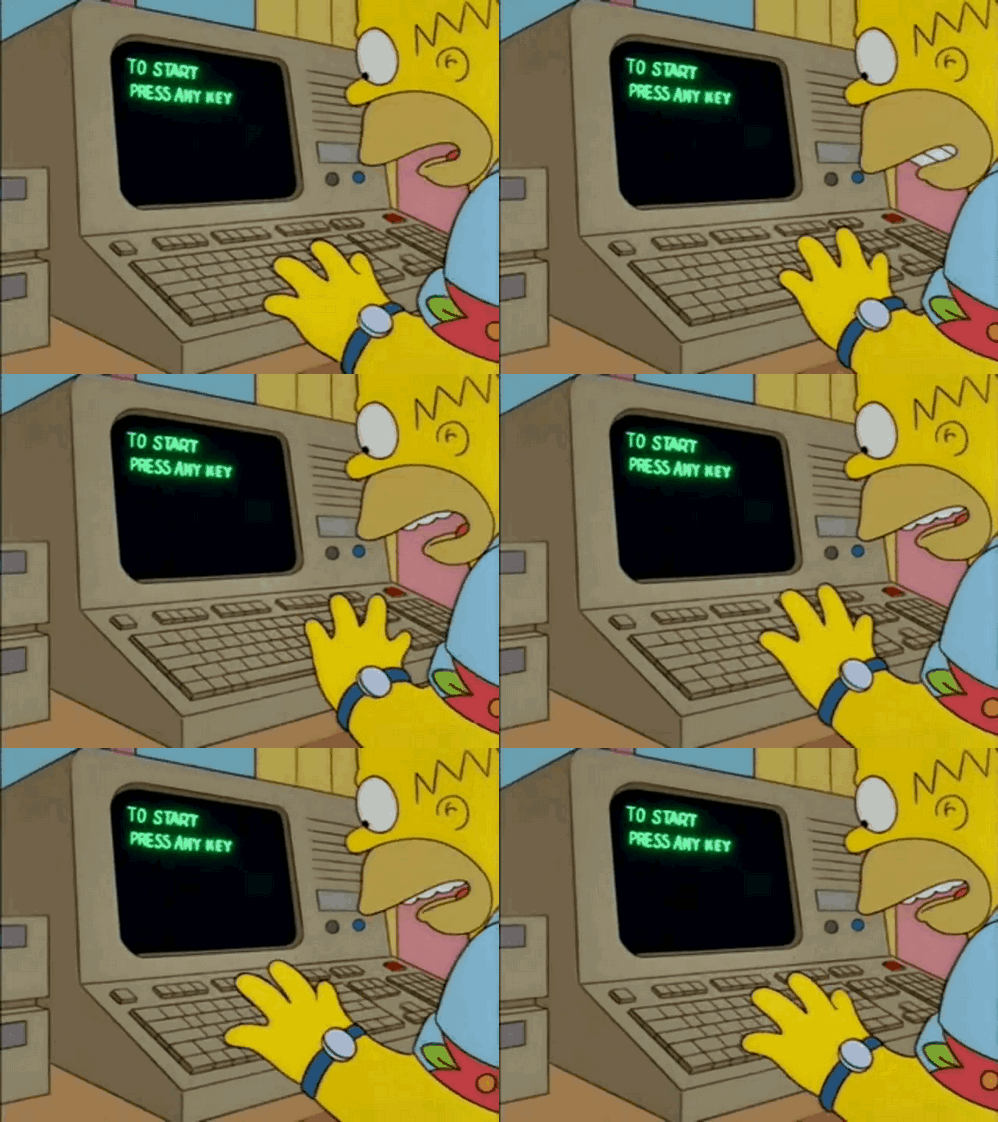
Following on our previous question, this one is a logical continuation. If an app agency has a rich portfolio of apps, they should provide proof links. Ask for a couple of apps they are proud of, download one, and put on your Homer’s hat: tap around and see if you get any positive vibrations.
The thing is, a portfolio is always nice on a website or in a brochure they send you. By contrast, a live app on your own smartphone will paint a completely different picture.
Takeaway: Check out the app on your own device: a running app and doctored screenshots are different things.
PS If you seek to develop an enterprise app (generally not available in the app stores), and the company is offering you a live demo of an enterprise app they did, go for it.
3. Can I talk to the client for whom you developed the app?
Yes, still going down the rabbit hole. You will be surprised how many teams will send you links to apps where they did only a fraction of the scope. Therefore, talking to the client who financed the development of the app you just played with is always a good idea.
You’d want to learn how the dev team delivered on the promises, what their strong sides and shortcomings are, etc.
Takeaway: You are looking for a reference from the client whose app you have tested.
4. What programming languages do you work with to develop native apps?
Well, this one might seem odd, as nowadays, iOS apps are mostly developed with Swift and Objective-C, while apps for Android — with Java or Kotlin. However, your CTO may have a better say in this, especially if you already have an app and need to build on top of what’s already been produced. If you’re evaluating teams for Android-native work, understanding whether they provide Java development services can help you assess their long-term stability, especially when building from existing Java codebases.
Takeaway: Bid them farewell if they use something different from Swift or Objective-C for iOS and Java or Kotlin for Android.
Interested in Java development services?
5. Do you have experience in developing cross-platform apps?
Cross-platform app development frameworks serve a great purpose: they let you optimize the app development budget. Some of the most popular tools on the market that produce quality cross-platform apps, like the My BMW app, Google Pay, or eBay Motors app, include Flutter, React Native, KMM, and Xamarin.
Takeaway: If developers stand their ground, repeating a “we-develop-only-native-apps” mantra, that’s totally fine. In the end, native apps are designed to fit their native platforms perfectly. Yet, with the recent upsurge in cross-platform development, you’ll likely want to partner with a team that can do it.
6. Is it a good idea to use a cross-platform development framework for my app?
It’s one thing to get a nod from your potential development team on using a cross-platform app development approach. And it’s quite another to get them to explain to you why. Why should you build a cross-platform app rather than a native one?
Takeaway: They should talk to you about opportunities to reach a wider audience, faster time to market, a wider range of skills within a team, reduced development budget, and snappier delivery.
Choosing a Winning App Development Strategy
7. Will my app work as designed on iOS or Android?
This is one of the trickiest questions for a mobile app developer, and it works best when you have at least a high-level requirements document. A competent app development agency should be able to immediately spot weak areas in your app functionality and draw your attention to them.
Takeaway: Pick an app feature you are most concerned with and ask how they will tackle it. Can they offer you an alternative to reach the same effect if Apple or Google is restricting this functionality?
8. What if I don’t have the requirements for my app?
The drill is “We will help you draft the app requirements,” but make sure you get your hands on some samples of their requirements documentation to check the quality.
Takeaway: A skilled business analyst and project manager are a welcome addition to any mobile project. So check if your candidates have one.
9. What is your app back-end development expertise?
Listen carefully to what your developers have to say because the back-end is the second big thing after the app itself (if not bigger). Your app will work with a server to store data, sync it with other devices, get notifications, etc. So your mobile development team should absolutely have a full-stack engineer or two to build a back-end for your app.
Takeaway: The most experienced teams will offer both custom back-end and third-party solutions like Firebase, Back4App, or similar services.
10. Have you worked on similar apps?
Here we keep digging to see if they have the specific expertise you are looking for. After all, developing a simple reference app and building a mobile enterprise solution will require different skills.
Takeaway: Keep in mind that you will never find a team that has developed exactly the same app as you need. Because if they did, why are you building another one?
11. What is your mobile development capacity?
In other words, how many mobile developers they have on their team. As app development comes underway, having enough developers for things like sick days and sudden scope changes will become crucial. You can also ask about team capacity measured in hours. For example, 400 hours per month is a good reference point.
Takeaway: Remember that more is not always better. However, in most cases, two developers will deliver an app faster than one.
Expanding a Team
Questions about Specifics of Mobile Development
Even though it may seem like you have already asked enough questions, you’ll do no harm by asking more. It’s what they call real due diligence, and it always pays off. The answers will show if the candidates are sincerely interested in working with you, as they’d have to go the extra mile to have you pleased.

12. How can you ensure my app’s accessibility?
Modern apps can reach a global audience and therefore need to speak different languages. However, that’s surely not the only aspect of accessible experience. You’d also want to support users with low vision or hearing impairment, cognitive disabilities, or limited physical abilities.
Takeaway: Ask if they provide a translation service packaged into their proposal. Check if they can implement features like screen readers, voice commands, and display customizations.
13. What hardware did you have the chance to use in apps?
Questions about hardware expertise are very appropriate when you are devising an Internet-of-Things application, or otherwise want your app to support some specific hardware features of a smartphone, be it gyroscope, Bluetooth, NFC, or something else.
Takeaway: So ask a developer during an interview: Does their sample app work? If not, do they have a prototype? If not, can they build a prototype to show their expertise with a specific piece of hardware?
14. What monetization strategies do you suggest for my app?
Not everybody can afford an app just for the fun of it. If an app is not promoting a brand, it must bring in profit in some other way. Knowing your monetization options will help you decide the route: paid, free, in-app purchases, ad-driven revenue, etc.
Takeaway: The team should explain why such and such a monetization strategy is ideal for your particular app.
15. Have you worked with any mobile ad frameworks?
Mobile ads will probably come up during the previous question, as one of the revenue – generating options for your app. There are four biggest players in this market: Google, Facebook, Twitter and Apple.
Takeaway: Get down-to-earth and start thinking about what ad types each ad framework can offer to appeal to your target audience best.
16. What OS versions and device models should my app support?
Of course, you should do your own research and know your target audience’s preferences, but keep in mind that the more device models and OS versions your app will support, the higher will become the app development budget.
Takeaway: As of November 2025, iOS and Android still dominate the global OS market. So, focusing on these platforms with reasonably up-to-date versions is usually enough to reach most users without hurting the app development budget.
17. What mobile analytics do you advise building into my app?
Every app has a purpose beyond making you rich and famous. And that’s solving a particular problem for your customers. How do you know if your customers are using the app as you envisioned? Well, just as there is web analytics for websites, there’s also mobile analytics for mobile apps.
These tools let you see how your app is used and identify potential bottlenecks for your users.
Takeaway: AppsFlyer, Google Analytics, Flurry Analytics, Localytics, these are the names you want to hear from a reliable partner. And you can pick any: they are all really good.
18. Can you build my app in pairs with smart devices?
You can add a little twist to your questionnaire and ask something that not many mobile developers can answer affirmatively. Indeed, IoT development occasionally goes hand-in-hand with mobile apps, but it’s also true that not every mobile team has to know it like a book.
What you will definitely like is how developers will try to impress you with something else instead.
Takeaway: It’s OK, really, if the company does not have hands-on experience with smartwatch apps or other connected devices.
19. Are you experienced with payment integrations?
If your app is supposed to allow users to make or receive any payments, then one of the top questions you obviously need to ask the team is about mobile payment integrations. One-time payments and in-app purchases, including subscriptions, are other things you want to question them about.
Takeaway: If the team is talking about payment gateways, Apple IAP, Google Play’s billing system, as well their fees, requirements, and restrictions, that’s a good sign.
20. What are the best UI/UX practices recommended by Google and Apple to follow?
You want to make sure your app is built in adherence with the best UI/UX practices and respective principles of both operating systems. That includes design guidelines and app development rules that contribute to a consistent user experience. Screen sizes, navigation, fonts, grid-based layouts, and padding, the team should be an old hand at this.
Takeaway: Be all ears when they are talking about the nuances of Human Interface Guidelines and Material Design (and they should be). These are the guides from Apple and Google.
21. How do you ensure my app’s security?
That’s the question that should be top of your mind, especially if you’re in highly regulated fields like healthcare or fintech. Your app has to protect sensitive data and other personal information, for that matter. That’s why the team is better to know about single sign-on, two-factor authentication, and secure data storage.
Takeaway: Ask them if they know how obfuscation works and what rooted or jailbroken devices are. It would be great if they described the proper way of storing and processing biometric data. Challenge them about addressing reverse engineering and network traffic analysis risks. If they can elaborate on that, they’re the masters of their craft.
22. Do you test the app’s impact on the device performance?
Firstly, do they care about the app optimization given the mobile device nature? Did they have to deal with app battery drain? Here, we mean battery consumption. Did they have to handle memory usage issues, like memory leaks, and how?
Takeaway: Listen to them speak about caching frequently accessed queries in memory and reducing requests to a server. Make sure they talk about optimizing the asynchronous requests sequence, background operations, connectivity, etc.
23. Have you used any extended functionality provided by OSs?
If you want to push it a step further and make your app stand out, don’t leave out this question. The answers can really inspire you to implement more than just basic features. For example, consider expandable notifications, speech recognition, or multi-touch gestures.
Takeaway: That’s not a cornerstone moment, of course. You can still hire the team lacking experience in this if your app doesn’t require advanced functionality. It’s just their level sign.
Questions about Mobile App Development Cost
Of course, the app cost is going to be one of the deciding factors for choosing one team over another. So take your time to go through these questions about the cost of mobile app development. This will help you align the budget for your product.
You might also want to check out our blog post that details how much it costs to develop a mobile app to gain a better understanding of the mobile app development budget.

24. Can you work out a fixed quote?
What you ask here, in reality, is whether they work on a fixed-price or time-and-material basis. Both approaches have their own pros and cons. Be mindful that a fixed quote also means you agree to have less freedom to change the scope during development.
The approach with a fixed quote also presupposes that you already have well-documented requirements for your app. Otherwise, you’d have to wait for the team to work out the Functional Design Specification document for your project.
Takeaway: Get yourself an agile team that works on time and material, and limit the total number of hours they can burn per month.
25. What is your hourly rate?
Some people open with this question and end the conversation right there if the rate is higher than what they expected. However, how do you know the amount of work that goes into the rate? Ask additional questions to find out what the rate includes, e.g., engineers’ work, project manager’s work, etc.
Takeaway: Don’t make the rate your sole decisive factor. Try and check what amount of work and efforts go into the rate. How much output will you be getting with a given rate on a weekly basis?
26. What do you need from me to provide a quote?
If your candidate hasn’t asked you a ton of questions already, ask yourself. Find out what you need to provide for the team to come up with an accurate estimate. Some teams will ask only for requirements, others will need designs.
Takeaway: Simply ask: “Have I given you everything to work on a quote? Do you need anything else?” Those questions will make them double-check if they have enough to prep a quote.
Project Estimates
Questions about App Creation Process
You will be spending at least a couple of the next months with these guys. It may be worthwhile to check out their internals: what their development process looks like, what you should expect, and what you shouldn’t, etc.

27. Do you provide a roadmap?
With this question, you basically request that they provide you with a roadmap for developing different parts of your app. The roadmap should be divided into sprints and contain specific dates for delivering specific functionality.
Takeaway: Make sure the roadmap is reviewed and updated each couple of weeks, as there will undeniably be changes, and it’s better if you know of them in advance.
28. Who owns the source code during development?
Yes, developers can hang on to the code, especially when working on a fixed-price basis. Usually, there is a clause in a contract that says something like “the client gets the code once the final payment has been completed,” only in legal gibberish.
Takeaway: When working with an agile team on time and material, make sure you set up your own code repository and request daily code commits.
29. Who’s on your mobile app development team?
A decent team for developing a mobile app would typically include mobile engineer(s), server developer(s), a business analyst, a project manager, a UX/UI engineer, and an account manager. Of course, you can always hire a single developer, just be ready to wear many hats while building the app.
Takeaway: Ask for CVs and check if you will have direct access to developers. You want to work with real people, not some abstract mobile developers.
30. Can you describe a project where you collaborated with a cross-functional team?
It’s worth noting that collaboration is a cornerstone of each successful project implementation. Ideally, your candidate should have excellent communication skills. So, it won’t hurt to ask an interviewee to share their previous working experience with a cross-functional team.
Takeaway: If the developer describes a smooth workflow, including regular meetings with a designer, a PM, and other developers to discuss the development process and fix bugs, then confidently move forward with them.
31. How do you prioritize features during development?
You may feel eager to implement numerous functions at once in your product. Yet, the professional developer is the one who can accurately prioritize just the main features for your MVP. So, how to assess a candidate’s ability to prioritize?
Takeaway: A skilled developer starts by assessing your business goals and end users’ needs. Afterward, they should distinguish between the must-have and nice-to-have features. Drawing parallels with similar existing products and pinpointing what will help your product stand out are compelling reasons to hire this candidate.
32. What is your experience with cloud services?
Security, scalability, deployment speed, real-time updates, and accessibility, much more than meets the eye, when it comes to the benefits of the cloud infrastructure. Let alone the fact that such solutions are pretty cost-effective. So, you’ll definitely want someone on board with hands-on experience in cloud services.
Takeaway: Ideally, your candidate should clearly showcase how they integrate cloud services into a mobile app. It will be a big plus if they mention experience with AWS, Azure, and Google Cloud.
Want to learn more about our cloud app development services?
33. Waterfall or Agile?
Which is a polite way of asking: “Are you obsolete or not?” Seriously though, there are still some pundits who cherish waterfall as a secret gift of IT gods, and there are certain merits to this approach. However, nowadays agile is the only king in thesoftware development realm.
Takeaway: Get an agile team.
34. What is your QA process? What do I need to be able to test?
This is where your app development candidates will start to raise their eyebrows as clients never ask such things. You want to find out what their test devices are, especially when developing an Android app.
Takeaway: If they ask about your phone model, the app will one hundred percent work on your device. Test the app on a couple of alternative models too.
Need QA automation and software testing services?
35. What has been the biggest issue on a mobile app project?
Here, you just try to establish a deeper level of trust with the team. With that said, it’s a good moment to ask about their experience with the app review process for the stores and issues they faced. Any app rejections from App Store or Google Play while publishing?
Takeaway: Have they also elaborated on how they had addressed those issues and how they could be avoided?
Questions about Post-Development Assistance
Your app is out, congrats! Now what? Well, before you buy a Concorde and fly all over the world, there are some things you need to take care of to make sure your app is on the right track.

36. Do you provide app maintenance and support?
First, you should check if a candidate provides maintenance and support services. Apple and Google churn out new OS releases at a steady pace. You’d want to keep your app updated with the latest and greatest features.
Takeaway: Consider 15-20% of your total app development budget for maintaining an app on a yearly basis, once it has been released.
37. Do you have ASO expertise?
For your app to be noticed in the app store, you need to spend some time taking care of the app’s description, keywords, screenshots, etc. There are many minute details that will influence download rates.
Takeaway: It’s not critical if the company does not provide such services. You can get these services from a firm focusing solely on digital marketing, including SEO and ASO.
38. How will you gather and act on user feedback after launch?
The best way to assess your app’s performance and measure user satisfaction is by gathering feedback. Generally speaking, developers themselves are not directly involved in collecting this data or analyzing it. But they should definitely stay informed about users’ needs to fix bugs and make necessary adjustments.
Takeaway: Typically, developers receive feedback from the product owner, who analyzes user input. The PM then prioritizes the most critical items during sprint planning based on reviews and data, so the developer can see what to fix next.
39. Once I accept the app, is there a guarantee period for bug fixing?
No one can guarantee the complete absence of bugs. Even after rigorous QA rounds, there is still a chance that a little bug got hidden under one of the options in the app. It may be really hard to spot; hence the guarantee.
Takeaway: Check if they limit the number of bugs they fix for free during the grace period.
When You Are Ready to Pull the Trigger
So you’ve got this far. How do you make the final decision? Well, let’s see if we can squeeze some perks out of your future app development team by going the extra mile.
40. What do you expect of me on the project for us to succeed?
Different things may happen during the project. You are better off aligning your expectations with reality. Stay proactive, ask questions, provide feedback, demand status reports, and sometimes let it go to get a top-performing app in the end.
Takeaway: Be proactive and know what developers expect of you on the project from the get-go.
41. Do you have any mobile-related open-source contributions?
This question is just to surprise them. The chances are, they do not have such contributions and so will try to come up with something interesting to seal the deal. In case the team does contribute actively to the developers’ community, you’ve discovered a gold nugget of a firm.
Takeaway: Just have some fun and take it easy if there are no specific contributions.
42. When can you start?
Your development team has been waiting for this very question from the beginning. The question may sound trivial, but at the same time so awesome for the team. The question is also important for you: the sooner the team starts building the app, the sooner you will get a killer app!
Do you have more questions on how to interview a developer on your project or how to onboard a new team to accelerate mobile application development? Bring them on! We’ll be happy to help you tackle them or go deeper into some of the questions above.
About the author

Reach Out to Us