
It’s no news that in recent years mobile device popularity has skyrocketed. The frequent smartphone releases and the daily addition of apps to stores continue to drive the market. Not to mention, it was recently revealed that people spend five to six hours on their phones daily.
Key Highlights
- DevOps brings software development and IT operations together so the whole team stays on the same page and achieves better results.
- The product owner supervises the entire app development process and ensures the solution is useful to the end users.
- Choosing a cross-platform framework means working with one team and one codebase, while a native approach requires separate teams for iOS and Android.
- Aiming to speed up your app implementation and not to break the bank in development, opt for outsourcing.
What does all this mean for business leaders? Well, for starters, you can’t overlook the importance of mobile app development any longer. After all, if users are spending so much time on their smartphones and you aren’t present there, you’re missing out.
However, there’s one thing you’ve got to figure out before building your own solution. You need to find an effective mobile app development team and decide on the type of partnership that you want to go with.

Expanding a Team
Chances are, as an experienced organizational leader, you already know the importance of surrounding yourself with people who are great at what they do. Yet, what you may not be aware of is which roles have to be filled for a successful mobile app project and the pros and cons of in-house development vs. outsourcing. So, that’s what we’ll talk about today.
Effective Mobile App Development Team Structure
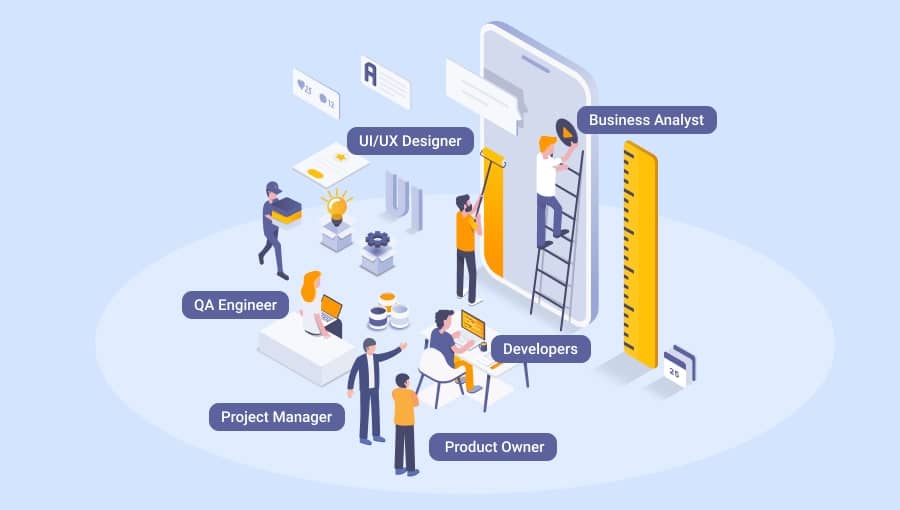
Whether you’re looking to build an employee- or customer-facing app, you’ll probably turn to an agile team structure. After all, agile software development relates to the most popular project management approach in recent years.
Discover the Top 15 Software Development Methodologies
Before moving on to the key roles your application development team has to encompass, it’s worth noting that the number of people for each position and overall team structure will depend on your project size, complexity, timeframe, budget, and the mobile development approach you choose. Now, let’s get started.
Product Owner

Specifically, the product owner will maximize the value of your application by managing and optimizing the product backlog so that the priorities of the development team are always clear.
Project Manager

Moreover, a PM is a person who establishes a clear communication with the clients, understands their pain points and keeps them informed every step of the way. Thus, giving the client peace of mind about the progress and quality of their mobile app development.
Find out the 6 Traits of Effective IT Project Managers
Essentially, a PM is someone who continuously monitors project progression and makes sure everything stays on track, the team is motivated, and the client is happy. This is the person you or your пroduct оwner will probably be in contact with most as they are the ones bridging the gap between business and IT universes.
Often, a project manager is mistaken for a product manager, but these are two different roles. Typically, when building a team for a mobile app, you may consider having both of these roles on board. So, it’s worth understanding their key differences. Let’s take a look at the comparison below.
| Project Manager | Product Manager |
| Plan and develop project scope | Define project strategy |
| Define budget and resources | Define and prioritize features |
| Monitor project progress and set deadlines | Analyze competitors, conduct market and customer research |
| Overcome challenges in the development process | Make sure that the product meets both the business and the end users’ needs |
| Communicates with the team and stakeholders to assess work performance and ensure the project will be delivered on time | Communicates with the team and stakeholders to define what to build and why |
Business Analyst

Specifically, BA services include a discovery to understand your idea, a layout of functional and non-functional requirements, an estimate of the project cost, and prototyping of an intuitive interface.
All in all, BAs are essential members of the mobile app development team. They always keep the business value in mind, continuously analyze processes, and help clients reach the goals that were discussed at the start.
Learn more about what it takes to Become a Seasoned Business Analyst
UI/UX Designer

Discover how Velvetech improved the UX through a Medical Reference App Redesign
Whether you’re developing an insurance mobile app, a healthcare solution, or a tool for any other field, designers are must-haves in your team. They are the key players who think about the usability of your product and always strive to deliver an app interface with a pleasant look and feel.
Keep in mind that their efforts can determine the success or failure of your project. Therefore, prioritize the mobile UI/UX design services provided by your team right from the start.
Mobile App Developers

Developers are the people who transform all the UI/UX layouts into a real application. Thus, they should be experienced in working with your chosen operating system and its corresponding languages or cross-platform tools.
When opting for a cross-platform framework for your mobile app development, things become much easier, as you only need to work with a single team. However, if you decide to build separate native apps for iOS and Android, you will need two development squads: one for iOS and one for Android.
Whether you hire iOS or Android developers, or opt for a cross-platform team, depends on your project requirements. Overall, it’s worth considering separate iOS and Android developers if you need platform-specific features and advanced hardware integration in your solution. Plus, the native app approach is a foolproof option to ensure a robust user experience. However, it can turn out to be quite costly.
A cross-platform team, on the other hand, may save you a pretty penny and speed up development, though it may not always be ideal for very complex apps. In general, it can serve best for a simple app or an MVP creation.
At times, if the project is very complex, you’ll also need to enlist the help of backend bevelopers. The people in this role focus on server-side work. They ensure the behind-the-scenes elements, like application logic and architecture, are top-notch so that your solution performs in the best possible manner.
Finding good mobile and backend developers isn’t usually the easiest endeavor. However, if you turn to an experienced mobile development company, they’ll likely be able to quickly find a suitable team for your project.
DevOps Engineer

Primarily, this is because DevOps brings together software development (Dev) and IT operations (Ops). Needless to say, when your whole team is on the same page, it’s much easier to achieve the desired results.
Dive into Key Principles of DevOps
In addition, DevOps enables rapid and frequent releases, minimizes deployment failures, and supports faster recovery in case of issues. So, as you can see, this member is definitely worth having in your app-building team.
Eventually, your DevOps professionals, together with your mobile developers, will be responsible for ensuring smooth maintenance, updates, and support for your app.
Interested in DevOps services?
QA Engineer

Hence, a QA engineer ensures that your application doesn’t contain any bugs, adapts to various devices and browsers, and generally meets all the requirements.
Discover how Velvetech Helped Build a High-Quality Dating App
Immediate perfection is almost always impossible to achieve, but a QA Engineer will work with the entire app development team to get your product as close to flawless as possible. In short, they’ll do so by testing the solution and checking its performance, security, usability, and overall quality.
Startups aiming not to break the bank on mobile app development should focus solely on the key roles. Specifically, it’s worthwhile to have:
- Coss-platform developers (instead of separate native developers, if possible)
- Backend developers
- A UI/UX designer
- DevOps support
These roles are typically enough to create a robust MVP. After the company grows, you can bring other specialists on board, like a QA tester, a PM, etc.
Finding a Skilled Mobile App Development Team

Now that you know what roles constitute an effective mobile app development team, it’s time to talk about actually finding one.
At the end of the day, there are three approaches you can take. One option is to create your own in-house department that will work on the app project. Alternatively, you may outsource and rely on external experts to deliver a good solution.
In-House
The in-house approach is probably something you’re most familiar with. You reach out to HR and put out a search for someone who can spearhead application development and subsequently build an efficient team.
As you may know, this can be quite time-consuming and costly. After all, it’s not just one person you need. Moreover, the nuances of paperwork, employment benefits, and the like can end up outweighing the benefits of having someone work on the project internally.
Outsourcing
Essentially, it involves partnering with an external software development vendor to deliver a part of the project or the entire solution.
An experienced vendor will help you estimate the cost of mobile app development, be able to get started almost immediately, and guide you throughout the entire process. As a result, this approach tends to be speedier and more cost-effective than building an in-house team.
Be prepared by knowing the Pitfalls to Avoid in Software Outsourcing
Lack of Developers
Hybrid
As you can guess from the name, this model is something in between in-house and outsourcing. This approach means adding manpower or team members with new roles to your in-house resources. As a result, you access top talents to handle specific tasks. Plus, this model is quite scalable, so you can scale resources up or down when needed.
It all depends on your project size, budget, and end goals. In general, in-house teams are a better option for larger companies that are ready to offer compensation, benefits, and competitive salaries, and are building a long-term product. Outsourced teams may work best for startups or projects that are looking for cost-effective mobile app development.
Lastly, the hybrid approach can be a real helping hand for those who need flexibility, as it allows you to bring in skilled experts or even just one specialist for specific tasks and then remove the role once the work’s done.
Ready to Work With a Mobile App Development Team?
So, now you know what it takes to assemble a mobile app development team for your iOS or Android solution and that it can be challenging to find a company with the right expertise. Yet, it is doable when you know what people to look for and the type of engagement model you want to have.
If outsourcing mobile app development is something that’s of interest to you, don’t hesitate to reach out to Velvetech. Our team has years of experience in working with companies to deliver software solutions that drive efficiency and business growth. We’ll be happy to discuss how we can solve any IT challenges you may have.