
Replacing something obsolete or switching to something absolutely new is always an exciting matter. However, it’s always fraught with adaptation stress and the necessity to put some effort into transition.
Even if you switch to another laptop — just imagine, you’ve used your old one for more than a decade. It contains tons of personal data and dozens of needed frequently used applications, and its interface is painfully familiar. After you receive a new device, you have to migrate the existing data (and make sure nothing is lost on the way) and get used to a new UI.
Unconditionally, these all are pleasant chores. But it does not negate the fact that they require endeavor and time. The same appeals to any software introduction, just the scale and responsibility level are completely different.
Today, we continue the topic of ERP systems, and this time, we uncover the complexities of the implementation process of this kind of software. What is ERP implementation? Why successful introduction is inconceivable without proper planning, which hurdles make the journey filled with adventures, and why it’s more a human than a technical matter? Read about ERP system implementation steps and find answers to these questions in this blog post.
Discovery Phase. Why Proper Planning Is Half the Success
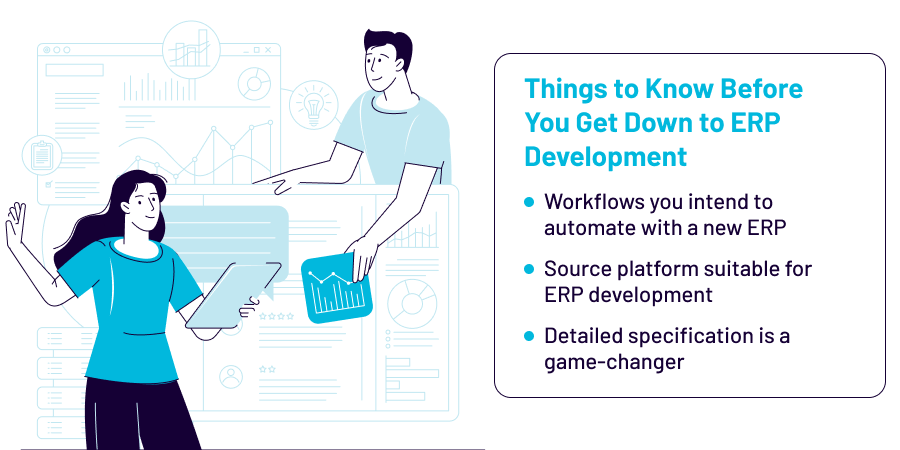
Enterprise resource planning implementation begins long before development even starts. The thing is that this kind of software may embrace literally all business processes within a company, and potentially their amount might be huge. To avoid being an “expectation — reality” meme hero, the way how this or that workflow will be carried out within a new system must be carefully planned.
From this, the discovery phase might take the lion’s share of the entire ERP implementation life cycle. In this section, let’s review some intricacies inherent to the pre-development stage in the context of ERP introduction.
Firm Knowledge of Workflows We Intend to Drag to a New ERP
Why do I need an ERP and which problems will it solve? Without the answer to this simple and meanwhile complex question, it makes little sense to initiate the process. Therefore, the discovery phase must be started from a high-level analysis of the existing landscape, without delving into complex specifics.
The reasons for which workflows will or won’t be realized in a new ERP system may be absolutely diverse. For example, you already utilize a standalone accounting software embracing dozens of financial operations, including fine-tuned automated reporting to an audit company. Sure thing, you won’t experience a great zeal to transfer the well-established flows to a new system. And in general, it might not be even needed, and that’s exactly what you should primarily determine.

Business Analysis in IT
Specifications Might Be of Different Quality
A specification is an integral part of any ERP implementation plan, and it’s a common story when a company looking for a software development partner already has a kind of specification elaborated by their in-house team of developers and business analysts. Why? Because, as a rule, the choice of the vendor is carried out on a tender basis due to ERP’s high implementation costs, complexity, and project scale.
However, the reality is that it’s a double-ended sword. On one hand, having a specification may be perceived as a blessing, because it’s some sort of a fulcrum, from where you can start. On the other hand, upon closer examination, it may turn out that this document is of poor quality.
Crucial aspects may be overlooked entirely, while others might be only partially covered. It’s also common for such documents to start strong, only to become increasingly vague or incomplete toward the end. This is hardly surprising, considering that specifications are written by humans — often with initial enthusiasm that gradually fades into fatigue by the time they reach the final sections.
Meanwhile, with the emergence of generative AI, we observe a sustainable trend for GPT-generated specifications. In contrast to a human, this tool is never tired and therefore, the problem described above will hardly appear. But there’s another, perhaps even worse one.
As a rule, when an AI assistant generates a specification on the basis of the prompt provided, the result is rarely checked from cover to cover by a human. Therefore, it can distort the facts and generate irrelevant or absolutely incorrect content. As a result, such specifications are barely useful and serve as an additional complexity factor at the stage of requirements definition.
GenAI for Business
Source Platform Selection
By the end of the discovery phase, you should know the answer to the question: how are we going to implement our new ERP system? Therefore, it’s logical to have a sketch of the future architecture, at least on a sheet of paper. But we can’t do it without an idea of which platform we take as a basis for future development, or maybe we need to design a fully custom one.
Why so? Because comprehensive analysis can be conducted only when there is a profound understanding of platform capabilities and its flexibility boundaries. Taking note of the fact that ERP introduction is a costly matter, there’s nothing good if you find out that it’s not a perfect match for your needs post-factum.
Yes, a certain degree of risk always exists, and no one can guarantee that you won’t face some limitations in the future, especially if we speak about cloud-based ERP implementation on platforms like SAP or Oracle. However, to maximally protect yourself from unpleasant surprises, it’s better to follow the data-driven approach to substantiate the choice.
Meanwhile, there’s more to come, and the risk of resting against the selected platform’s limitations is not alone. Another aspect you should bear in mind is expenses that might seem non-obvious at the beginning.
Here we mean the licensing policy vendors have. Most ERP systems operate on a per-user licensing model, which might seem manageable initially. However, as your team expands, these costs can quickly skyrocket. Planning for scalability from the start can help you avoid unexpected financial strain down the road.
Learn about Major Types of ERP Systems
Intricacies of Replenishing an IT Ecosystem with a New ERP
Full Transformation of Existing Business Processes

For instance, imagine implementing an ERP module that fully automates certain tasks. What once required manual effort is now handled by software, potentially making some roles redundant. If that’s not a business process transformation, what is it?
Data Migration to a New System
Potentially, the data migration process might be a very challenging task to tackle. Let’s review one example from our practice, from which you’ll understand why. Our team helps a US-based customs bond service provider with application migration. We’ve been working on the project for more than two years, and haven’t transferred all the workflows to a new system yet.
Learn how we conduct Stepwise App Migration for Customs Bond Service Provider
Therefore, we follow the stepwise migration approach here not to disrupt the current workflows. During this period, both the old and new systems must coexist, making one-off data migration unrealistic. From here stems the necessity to establish smooth data synchronization between the systems.
Even if you intend to replace only one system with a new ERP, it’s far from easy. But if there are ten or even more? Each software must be integrated with the new one, ensuring seamless data exchange and stable operation of the entire organization.
As you see, the aspect of data synchronization and migration is a complex and labor-intensive process. And the more systems you want to replace, the more expensive and challenging this journey will be.
ERP Implementation Is Equally a Human and Technical Matter. Why?

Technical complexities are only half the trouble when initiating the ERP implementation. Another half is represented by a human factor.
All because systems don’t operate by themselves, they are managed by living people. And these are company employees for whom ERP is designed, which makes usability a highly important component of the platform.
Now, picture a manufacturing company with 10,000 employees, spanning different ages and backgrounds. Longtime staff, especially those nearing retirement, may resist switching to an unfamiliar system after years of using the old one. The learning curve alone could slow down operations if not handled properly.
That’s why ERP implementation isn’t just about technology — it’s about people. A successful rollout requires a well-thought-out transition strategy. How will the system be introduced? How will employees be trained? Most importantly, how do you ensure they use it as effectively or even more efficiently than before?
To ease the transition, it’s better to follow agile practices and involve end users early in the requirement-gathering phase. By engaging employees from the start, companies can build an ERP system that meets their needs while minimizing resistance to change.
Learn The Difference Between Functional and Non-Functional Software Requirements
Forewarned Is Forearmed or Examples of Things that Might Be Revealed During ERP Introduction
Integration Surprises

The abundance of different platforms subject to integration means the abundance of vendors you have to communicate with to establish connections with the new system. And here you might face some unexpected and unpleasant surprises.
For example, a system in use is very old, and the vendor folded their business long ago, therefore, there’s even no contact to communicate with. In this case, abandonment is not an option, and the only way out is to conduct reverse engineering of the old code, which is a time- and labor-consuming effort.
Another thing, if an old ERP was integrated with other parts of the infrastructure illegally, say, in violation of the licensing policy. How could this be left unnoticed until the introduction, you may ask? If the discovery analysis had been conducted superficially, which highlights the importance of thorough planning once again.
Business Logic Twists

Here’s a real-world example from our experience. While assisting a client with the implementation of a new system, we uncovered discrepancies during the testing phase. In other words, calculations performed by the old and new systems didn’t match. After further investigation, it became clear that the previous platform had been generating incorrect calculations all along, without anyone noticing.
Can you imagine the consequences of wrong calculations? Potential issues may involve incorrect invoices sent to customers, unreasonable charges, or enormous debts. As you see, if a company uses incorrectly functioning software for many years, the financial and operational damage can be severe. Revenue losses, compliance issues, and eroded customer trust are just the tip of the iceberg. Fixing such errors retroactively can be time-consuming and costly, making it crucial to ensure system accuracy from the start.
At the End of the Day
The ERP implementation process is no walk in the park, there is an abundance of things that might go wrong. Sure thing, all risks can’t be fully eliminated but still can be mitigated. That’s why it’s better not to ignore the discovery phase. Yes, it will take time and effort, but you’ll be sure that you gain the product that really works and solves your issues with maximal efficiency.
Beyond thorough planning, a successful ERP rollout requires a trusted technology partner with proven expertise. At Velvetech, we’ve helped numerous companies across various industries streamline their operations through business process automation. Ready to transform your ERP experience? Let’s connect and tackle your challenges together!