
If you’re setting out to develop a new software product, it is likely that the feeling of excitement was one of the first things to emerge. After all, there is so much potential in front of you. However, creating an IT product that end users love isn’t the easiest endeavor. Anticipating what people want, what their challenges are, and how you can cater to their high expectations can be rather hard.
You shouldn’t allow these potential difficulties to deter you because there is a way to handle all that uncertainty and that is by relying on user-centered design (UCD). In this post, that’s precisely what we will talk about.
So, if you’re about to start your next software development project and are interested in building a product that end users are delighted with — keep on reading.
Today, we will cover:
- What is user-centered design
- UCD principles
- Top user-centricity methods
- User-centered design process
Understanding the User-Centered Design Approach
Let us begin by first defining user-centered design and what it entails. In short, it is an approach to software development and UI/UX design that places the end-user front and center.
Meaning, that the IT team is focused on users, their needs, and pain points throughout each phase of product creation. Thus, ensuring that the final solution reflects target user requirements while also catering to the needs of the business.
This approach typically results in the following benefits:
- Successful market entry
- Better adoption rates
- Higher user satisfaction
- Lasting loyalty and profitability
- Lower expenses
Although the term itself has the word “design” within it, it’s worth pointing out that user-centricity should be the focus for your software development team throughout the entire project, not just the design phase. That’s the only way to truly leverage the capabilities of this approach and benefit from the advantages it delivers.
“Many a time, the process for providing a good user experience is treated separate from the process of developing the product or software. There is an increased awareness that the two processes need to integrate and proceed hand in hand for success of the product.”
Key Elements of UCD
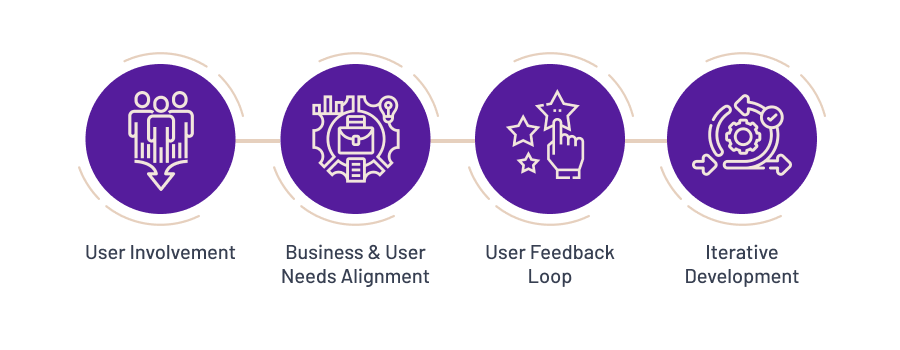
We’ve now established the meaning of user-centered design, but let’s take it a step further and look at its main principles. That way, you’ll know the four core elements to keep in mind when starting your project.
User Involvement
First and foremost, as the name implies, it is important to involve your software product’s end users into the development and design process from the beginning. This might be the most crucial part of ensuring user-centricity. After all, if you don’t know what your target audience wants, how will you be able to determine how to best cater to their needs?
So, make sure to involve users from the get-go by having conversations with them during your research phase, incorporating their ideas, and so on. Then, once you begin designing your solution, don’t forget to check in with your audience to see if it is coming along in a way that engages them. Not to worry though, we’ll talk more about how you can do that later.
Business and User Needs Alignment
Another important aspect of user-centered design is the alignment of business needs with user needs. At the end of the day, you aren’t creating a software product solely out of the kindness of your heart, you need it to be viable, successful, and potentially profitable too.
Whether you’re designing an enterprise solution or a consumer-facing tool, you have business goals to achieve. In the case of the former, you may be looking to enhance efficiencies and with the latter, to earn profit.
Learn about the Difference Between Consumer and Enterprise Apps
Either way though, the business objectives you have need to come to life in a way that aligns with the pain points or needs of end-users. That is how you increase the chances of the final product actually being used as intended.
User Feedback Loop
Frequent collection, analysis, and incorporation of feedback is non-negotiable when it comes to user-centered design. In essence, it means you’ve got to gather insights from users and integrate them into your process so that any adjustments can be made swiftly.
Hence, you need to have a consistent user feedback loop throughout the product life cycle, including post-deployment. That is the best way to ensure that the end product continuously meets the needs and expectations of your target audience.
Iterative Development
Lastly, iterative or agile development is also a major element of user-centered design. As we have already stressed the importance of consistently incorporating feedback and reworking aspects of your application, the iterative approach allows us to do precisely that.
By splitting up the building process into multiple sprints, your team will work on a specific part of the software product and then get together to analyze whether everything is on track. Thus, helping ensure that the project doesn’t get off course and continues to prioritize user needs.
User-Centered Software Product Design Techniques
So, how do you actually implement the UCD approach into your project? That’s what we will look at below. The truth is, there are multiple ways to incorporate user-centricity into your software initiative, and these techniques are suitable for various stages of the development process. However, some are more prevalent at the early stages while others at later ones.
Interviews

So, how do you conduct a good interview that will be useful in your product development efforts? Here are some steps you can follow:
- Determine who to conduct interviews with. Assess which internal experts or external potential users are worth speaking with, what their demographics are and how their answers might impact your software initiative.
- Outline your questions and goals. This is the only way to stay on track and make sure you don’t forget anything.
- Create a trusting and comfortable atmosphere. Introduce yourself, briefly explain why you’re conducting the interview, and make sure the interviewee knows if they are being recorded or observed.
- Try to eliminate personal preconception or biases. You need to clear your mind and enter the interview process without expectations. Just listen to your interviewee.
- Save the answers and take time to analyze them. To make sure the interviews were not in vain, you need to keep track of the answers you’ve received and spend some time analyzing them for key insights.
Following the interviews, you should have a better understanding of your potential end-users and get a clearer vision of the next steps you need to focus on.
Surveys

The usefulness of surveys boils down to the fact that they are easy to create and scale. Plus, they allow you to ask participants for suggestions and opinions directly without much supervision from your side.
Of course, surveys aren’t without risks. One of the major challenges of this UCD technique is that not many people may be eager to complete an entire survey without any incentive. Thus, you might have to consider providing some sort of motivation for them to do so in the form of a coupon, early access to your product, and the like.
User Personas

Typically, the description of a persona you outline should cover:
- Behavioral patterns
- Demographic information
- Attitudes
- Goals
- Skills
- Frustrations
By outlining your user personas (there can be several of them), you will help keep the development team focused on specific attributes of your audience instead of an abstract user group.
PoC
In essence, it is just a way to materialize your idea in its most basic form in order to get a better understanding of market needs, the feasibility of your concept, product limitations, and financial implications. So, the whole point of a PoC is to discover what is worth investing in and what might need tweaking or eliminating.
Get inspired by looking at Blockchain Proof-of-Concept Examples
MVP
In other words, product teams build MVPs that look like the closest iteration of the solution to the final result but only possess some basic functionality. This is done to gather in-depth feedback, assess the acceptance of the software, and make any necessary changes prior to full-scale deployment.
A/B Tests

A/B testing is a method of experimentation where two or more versions of a variable are displayed to segments of the audience to determine which works best for driving business results like conversions.
For example, if you’re building a subscription-based mobile app, you may want to test two paywall designs to see which leads to more transactions. Or, if you’ve developed a website, you may want to test two differing color themes to see which leads to more time spent on the page.
Whatever the case may be, A/B testing can help as long as you run the experiment on a large enough audience to reach significance and make sure to only test for one variable at a time.
Analytics

So, which metrics should you keep an eye on? Typically, these are the most popular ones to track and scrutinize, but of course everything depends on the product you have built:
- User behavior and engagement
- Sales data
- Feature adoption
- Churn rate
- Support requests
By gathering this kind of business intelligence, you will gain timely insights that power decision-making and help improve your product in a way that aligns with the evolving user needs.
Find out how AI Call Analytics Helped Boost Conversions
Direct Feedback

Direct feedback can come in a range of forms, including:
- App store reviews
- Social media comments
- Automatic user log collection
- Emails to your support staff
- In-app surveys
It’s easy to underestimate the value of direct feedback, but this method is excellent for uncovering usability issues and learning more about your user’s behavior. So, definitely don’t forget to keep your feedback channels opened.
User-Driven Approach
Key Steps of the User-Centered Design Process
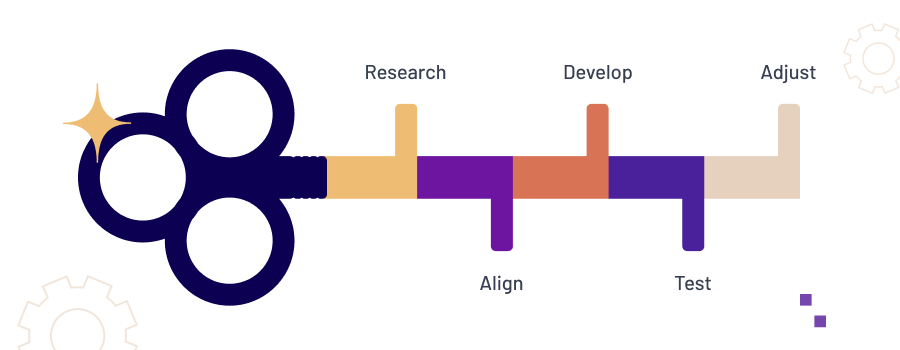
You now know the top techniques used in UCD, but to completely solidify what the implementation process might look like, let’s cover the main steps of user-centered design so that you can see where each method might be incorporated.
1. Research
Naturally, everything begins with research in order to understand why and how your target audience might use the software product. After all, if you don’t have an in-depth understanding of who your users are, how can you design a solution that fits their needs?
So, at this stage, you’ll likely rely on interviews, surveys, focus groups, and similar techniques to create accurate user personas which will guide your team throughout product development. This step of the user-centered design process is critical. So, don’t rush the research phase and spend some time truly understanding how your final solution will deliver value.
2. Ensure Alignment
Once you’ve defined your users and their unique challenges and preferences, it’s time to ensure alignment between their requirements and that of your business. How will your software product cater to the needs of the target audience while also driving revenue for your organization? That’s the question you have to answer to pinpoint the perfect intersection of user and business goals.
For example, if you’re interested in selling digital art on an NFT marketplace, you might develop a simple platform but then realize that users are interested in engaging more with the community. How might you facilitate that?
One of our Clients chose to do so by augmenting their NFT marketplace with a DEX and a prediction game. Thus, catering to user needs while also expanding their service offering.
Read up on our DEX Development Project for an NFT Marketplace
3. Develop
Now, it’s time to build your product based on all of the findings you’ve uncovered during research. Here, you’ll likely start by creating user journey maps, sketching wireframes and mockups, developing prototypes, and eventually a PoC or MVP.
At this phase of the UCD process, you’ll basically go through multiple iterations that’ll help get your software product from an idea to a concrete solution. If you’re building a web-based tool, you’ll take some time to create a well-functioning web app architecture. If you’re developing a food delivery app, you’ll likely focus on constructing an MVP with some core functionality that you can build upon later.
4. Perform Tests
Next, with your MVP ready, you can finally deploy the preliminary version of the product and conduct usability testing to see how your intended audience actually uses the software. This part of the process is crucial for the long-term success of your product. That’s why you’ll need to rely on the techniques you’ve used at the research stage to gather feedback on the current state of software design.
So, conduct interviews, survey your users, and generally gather as much information as you can about how they use the solution, what they like and don’t like, etc. Then, you’ll be able to make tweaks and adjustments before rolling out a fully-fledged product.
5. Monitor and Adjust
Finally, you’ve deployed your final product, but the hard work doesn’t quite end here. In fact, user-centricity must remain top of mind while the solution is out in the world. At this stage, you have to rely on various types of data analysis to monitor the performance of the tool and make adjustments when needed.
Similarly, you have to ensure you’re collecting direct feedback from users as it’s the best way to learn about people’s behavior and gain insights that will enable you to take the product to the next level.
Get Help with Incorporating UCD in Your Next Product
We’ve certainly covered a lot of ground in this article, but we hope it’s been helpful for you to learn about user-centered design and its capabilities. The truth is, this approach isn’t that difficult to incorporate once you know what to do. However, it will definitely be easier if you get help from professionals.
At Velvetech, we understand the importance of user-centricity and know how to stay focused on the needs of your business as well as the target audience throughout the project lifecycle. We have spent years delivering successful custom software development initiatives and would be thrilled to collaborate with you on your next endeavor. So, don’t hesitate to reach out and schedule a consultation.