Whether you realize this or not, different categories of embedded systems are everywhere around us and even across the various functions of your business. Smart devices in homes, cars, hospitals, manufacturing plants, and the like are all powered by these platforms. So, it’s only natural to spend some time learning about them and how they can improve your company.
Key Highlights
- Whether integrated into a larger platform or operating as an independent system, embedded software is designed to cover a specific task.
- Due to their size, a comprehensive UI isn’t available on embedded systems, so they operate with minimal or no user interface at all.
- By implementing AI in your embedded system, you can significantly speed up data processing in real time and elevate decision-making.
- Low-power embedded systems can harness energy from sources like sunlight, vibration, or heat, thereby minimizing energy consumption.
Today, that’s what we will be focusing on. Having delivered multiple embedded software solutions to clients from a variety of industries, we have come face-to-face with the different types of these platforms. Hence, we’d like to share what options are out there and what each of them might be used for. Let’s take a look.
What Are Embedded Systems?
First, let’s get the basics out of the way and define embedded systems. In short, they are simply a combination of computer hardware and software tools. Specifically, the term refers to hardware that has been embedded with a particular kind of software to perform a concrete function.
Embedded systems can be independent or work as part of a larger platform, but whatever the case may be, each unit is programmed to carry out a specific task. Often, they will be used to monitor the performance and operations of the device they are embedded into. Thus, helping ensure that everything works properly.
By their very nature, embedded software is designed for specific aims. So, they need to adapt to specific hardware devices, such as sensors, microcontrollers, and robotics, to boost their performance and support real-time operations.
In comparison, standard or regular software serves general purposes like image editing, communication, and document management. Typically, standard software runs on PCs, laptops, smartphones, etc. Compared with embedded software, they are way simpler to develop. That is specifically because they don’t necessitate work around strict hardware limits. Plus, there are plenty of available tools and frameworks to design standard software.
Overall, the following are the main characteristics of embedded systems worth keeping in mind:
- Task-specific: These systems tend to perform a concrete task repeatedly throughout their lifecycle. So, a microwave will only ever function as a microwave.
- Time frame limit: Embedded systems have to perform the required task within a particular time frame. For example, an anti-lock braking system needs to work quickly, otherwise accidents can occur.
- Minimal UI: Typically, the system will have minimal or no user interface, as a comprehensive UI isn’t available due to the size of the system.
- Power efficiency: Embedded systems are typically small and can function with a lower amount of power while not being overly expensive.
- Durability: The systems need to be reliable and stable in order to work for a long time without interference.
- Device cost: This is one of the major constraints when it comes to selecting an embedded system. So, spend some time reviewing the different options.
- Size: For embedded devices, it is also an important aspect since the size of the system will impact where it can be used.
These solutions are used in a wide range of ways. There are many embedded software examples in consumer electronics, industrial machinery, automobiles, wearable devices, medical equipment, and more. So, no matter the business sector you operate in, chances are high that embedded systems can benefit your firm.
Main Types of Embedded Systems
Now, let’s move on to the core of today’s topic. Overall, there are multiple ways to classify embedded systems.
Specifically, an embedded system can be grouped based on its performance and functional requirements or the performance of its microcontroller. So, for the sake of thoroughness, we will cover both of these classifications below.
Performance and Functionality Requirements-Based Classification
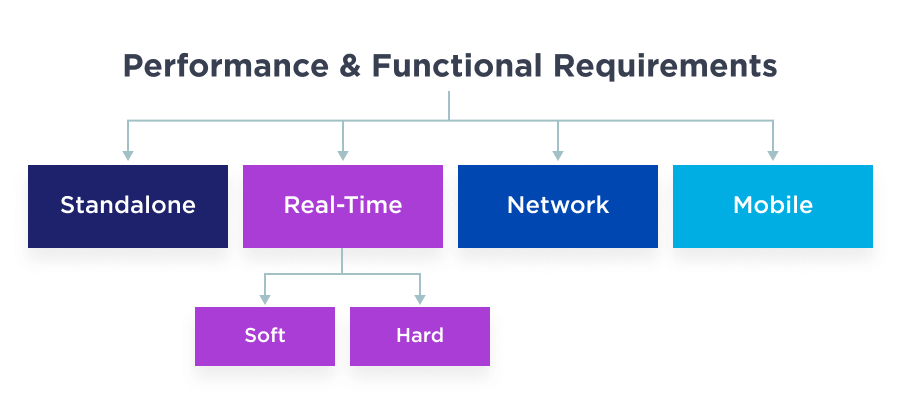
This classification splits embedded systems into four categories: standalone, real-time, network, and mobile. Below, we’ll discuss each in more detail.
Standalone Embedded Systems
This type of embedded software, as the name suggests, can work by itself, without requiring a host like a computer or processor. It simply takes input data in its digital or analog form and delivers an output that might be displayed through a connected device.
Instruments like cameras, digital watches, and MP3 players are all examples of standalone embedded systems. They work by themselves, without relying on a larger platform.
Real-Time Embedded Systems
This kind of embedded software needs to deliver outputs promptly, within a particular time frame. Hence, it is often used in time-sensitive sectors like transportation, manufacturing, and even healthcare, as all of these spheres rely on delicate processes to perform their business.
Some examples of real-time embedded systems are aircraft or autonomous vehicle controls, traffic monitoring tools, and the like.
These kinds of embedded systems can be further broken down into “soft” and “hard” types. The former refers to those in which the time frame doesn’t need to be strictly followed. That is to say, if the deadline of a particular task had passed and the system didn’t produce the needed result in time, the output would still be accepted.
Conversely, in the case of hard real-time embedded systems, the time frame has to be followed strictly, and if the deadline is not met, the result may not be accepted. To get a clearer picture of the differences between the two, here are some examples of each:
- Soft real-time embedded systems: temperature or humidity monitoring tools. A minor delay in the acquisition of real-time temperature data might not be considered too critical, and obtaining the information a bit later will still be valuable.
- Hard real-time embedded systems: aircraft control platforms. In this case, even a small delay in data acquisition can lead to disastrous consequences, as the pilot might make a decision based on outdated information.
Read about our Real-Time Cold Chain Monitoring Project
Network Embedded Systems
This type of embedded system relies on wired or wireless networks for output generation. Often, these kinds of platforms are built on general-purpose processors and consist of various components like sensors, controllers, and the like.
The most popular examples of embedded system products in networks are home or office security systems, point-of-sale tools, and ATMs. All of these solutions rely on networks of other devices to carry out their function. For instance, a security system includes sensors, cameras, alarms, and similar gadgets to monitor for intrusions and alert the relevant staff.
The main common security risks of embedded systems are malware, hacking, physical attacks, and software vulnerabilities.
The best ways to keep your system reliable and secure are:
- Regularly update firmware and libraries
- Employ strong authentication
- Implement hardware protections, such as tamper detection and secure elements
- Encrypt data whether in transit or at rest
- Segment networks so that a compromised device can’t access the entire system
Mobile Embedded Systems
Finally, mobile embedded systems are those that are portable and easy to move around. Typically, they are used in different kinds of mobile devices, but naturally have some constraints when it comes to memory size.
As you can imagine, despite the memory and functionality limitations, mobile embedded systems are quite popular solely because they work on the go.
Want to develop a cutting-edge mobile solution?
Microcontroller Performance-Based Classification
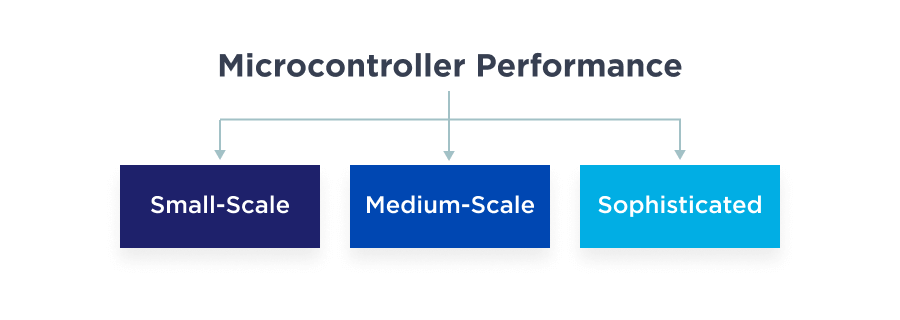
Now, let’s take a look at embedded systems from a different perspective and go through the different types based on microcontroller performance. It splits these tools into three relatively straightforward types: small-scale, medium-scale, and sophisticated.
Small-Scale Embedded Systems
A small-scale embedded system is designed using an 8-bit or 16-bit microcontroller and can be powered by a battery. In this case, the processor utilizes a minimal amount of memory resources and works at a limited speed.
These systems are typically used in devices that have basic functions such as temperature monitoring, simple displays, and basic input/output operations.
Medium-Scale Embedded Systems
This category is developed with 16-bit or 32-bit microcontrollers and often with Java, C, or C++ programming languages. Naturally, these embedded systems are faster and somewhat more complex than the small-scale ones.
For example, these systems are often used in devices that require more complex functions like digital signal processing, data storage, and UI control.
Sophisticated Embedded Systems
Finally, sophisticated systems work on multiple algorithms and have complex hardware and software components. Often, they require a processor that can be configurable and allow for the programming of a logic array. These solutions are designed using various 32-bit or 64-bit microcontrollers and require a lot of memory to perform well.
The exact amount of memory required for a given sophisticated embedded system will depend on its specific requirements and design. In general, however, it may require anywhere from a few megabytes to several gigabytes.
In essence, these are the most powerful embedded systems that use advanced microcontrollers with high processing speeds, large memory capacity, and vast peripheral support. Typically, this category is used in devices that require complex computations, such as robotics, autonomous vehicles, and advanced medical equipment.
Key Trends to Elevate Your Embedded Systems
Now that you know what kinds of embedded systems are out there, you would also like to figure out how to boost the performance of your product. Well, let’s take a closer look at the key trends to improve the efficiency and capabilities of your system.
AI-Powered Systems

Primarily, executing AI directly on devices rather than relying on cloud services enables real-time data processing with minimal latency. Moreover, AI-powered embedded systems can work even with poor internet or no connection at all. Eventually, not sending data to the cloud significantly minimizes the risk of security breaches.
Interested in AI development?
Security-First Design

Energy‑Efficient/Low‑Power Systems

Check out how IIoT can Assist in Improving Sustainability
Specifically to improve their environmental impact, companies are now designing low-power-consuming embedded systems. For example, many systems are capable of harnessing power from solar light, vibration, or heat. Meaning they don’t rely on external power to operate. This not only elevates sustainability but also notably extends device lifetime.
As the name suggests, energy-efficient embedded systems are devices designed to perform with minimal energy consumption. Typically, they rely on energy harvesting to reduce reliance on external power.
Generally speaking, there are numerous use cases for such devices that you can find today. Take smartwatches, fitness trackers, or heart-rate monitors, for instance. They typically rely on low power, thus ensuring long battery life.
Another use case of energy-efficient embedded systems can be found in smart agriculture. For example, soil moisture sensors often use solar energy to operate in remote fields.
Fault-Tolerant Systems
Yet, you still can design a fault-tolerant and resilient system to withstand possible failures. One of the good practices to get there is to use RAID configurations for storage. This allows distributing the same data across multiple devices within the same system. If one drive fails, data can be restored from the other, thus ensuring smooth and uninterrupted operations.
RISC-V Architecture

The term open source probably speaks for itself. As you may know, these platforms provide numerous tools and libraries to simplify development. Additionally, open source products have strong community support. Meaning your developers can promptly address any issues that arise during implementation.
Last but not least, open-source approach does not consider licensing fees or vendor lock-in, which gives you a chance to significantly cut on development costs.
Leverage the Right Systems for Your Business Needs
As you can see, there are two main ways to classify the various forms of embedded systems. The microcontroller performance-based approach is a little more technical, which is why we didn’t go into too many details on it. However, we hope you still have a good understanding of what options are out there.
It can be difficult to determine exactly which kind of embedded system you require. However, you could do that by following these steps:
- Determine the requirements of your project
- Assess the constraints of the initiative
- Research the various microcontroller options
- Consider the scalability of microcontrollers
- Evaluate the development ecosystem
- Create a prototype to evaluate microcontroller performance
We are happy to offer extensive embedded software development services to clients from a range of industries in order to help them acquire the best solutions for their needs.
If you’d like a consultation, simply fill out the contact form below, and one of our experts will get back to you shortly.
About the author