Companies across a wide range of industrial sectors are increasingly focusing on sustainability initiatives. Manufacturers, energy companies, and others are interested in reducing the adverse environmental effects of their businesses, and many are looking at the Industrial Internet of Things (IIoT) to help.
A few months ago, ABB commissioned a research study to examine, among other things, the value of industrial IoT for sustainability. The findings ought to grab your attention, especially if you feel that your company might be behind on its environment-friendly strategies.
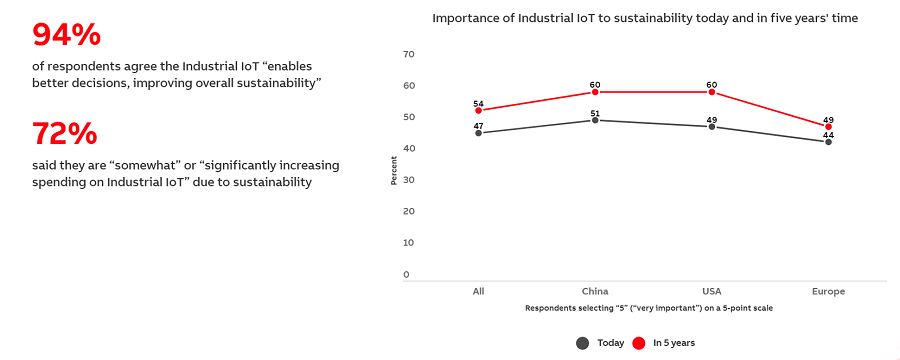
One of the findings revealed that 94% of key decision-makers across 12 industrial segments agree that IIoT can improve overall sustainability. Moreover, 72% are looking to increase spending on this technology due to its impact on sustainability.
So, it is clear that industrial IoT has caught the attention of many business leaders. However, before jumping headfirst into the implementation phase, it’s important to understand how exactly IIoT can benefit environmental monitoring. So, that’s what we will focus on today.
Concretely, we’ll cover:
- How IIoT helps with environmental management
- Benefits of IIoT for environmental sustainability
- Top uses of industrial IoT for sustainability
- Key barriers to implementing IoT devices
Now, let’s get started.
How Does IIoT Help With Environmental Monitoring?
The term IIoT unsurprisingly originates from the Internet of Things (IoT) in general. However, it refers concretely to connected devices that transmit information about remote objects in industrial settings like manufacturing, energy, logistics, construction, and the like.
To make the most of IIoT, industries often rely on tailored digital tools. For example, companies invest in manufacturing software development to streamline production lines, adopt energy software development for monitoring and optimizing power usage, and leverage logistics software development to improve supply chain visibility. Likewise, builders turn to construction software development to enable real-time tracking of equipment and reduce environmental impact across projects.
Discover how we developed an IIoT System for an Engineering Company
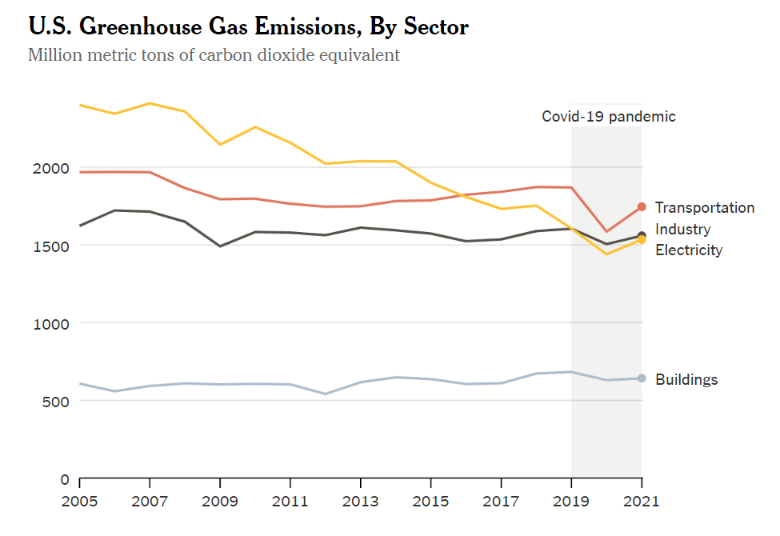
As you know, these business sectors are some of the top ones contributing to the world’s greenhouse gas emissions. In fact, according to the New York Times, as the economy began recovering from the pandemic in 2021, America’s greenhouse gas emissions from energy and industry rose 6.2%.
Naturally, many organizations are looking to reduce their negative effects on the environment. This interest is driven not only by consumer demand for more sustainable initiatives, but also because doing so can decrease operating expenses and ease regulatory compliance.
Using industrial IoT for environmental sustainability can play a crucial role in helping achieve these objectives. After all, smart sensors can help monitor emissions or inform you when machinery becomes faulty. Thus, empowering your organization with actionable insights that can drive your environment-friendly decisions.
Benefits of Implementing Industrial IoT Devices
Now that we’ve looked over the role of IoT in environmental monitoring across industries, it’s time to discuss the main benefits of implementing smart sensors. Indeed, there’s more for you to gain than just contributing to better sustainability practices.
Cut Costs
In an industrial setting, a bottleneck in the production line, sudden machine failure, or even a minor non-compliance with environmental regulations can have an enormous effect on costs. Thus, any way of reducing the possibility of these occurrences is highly welcome.
With Industrial IoT, time-consuming and inefficient processes can be eliminated or, at the very least, optimized. Thanks to connected devices and artificial intelligence technology, avoidable bottlenecks can be spotted, and corrective action suggested.
Plus, when you’re empowered with real-time data about the emissions being produced, the likelihood of compliance mishaps is reduced as are the potential fines.
Extend Machinery Lifetime
Machinery and equipment doesn’t usually come cheap. Thus, every industry player is interested in extending the lifetime of its assets and reducing downtime. As you may have guessed, IoT has a role to play here.
With intelligent asset management, you won’t have to worry about surprising failure of your machinery. Instead, you’ll not only be aware of the state of your wide-spanning, remote equipment but also get alerts whenever predictive machine learning tools forecast that maintenance is needed.
Improve Brand Reputation
As we’ve mentioned, consumers are demanding a more conscious approach to the environment from manufacturing companies, energy suppliers, logistics providers, and others.
Thus, if you commit to implementing industrial IoT solutions for better sustainability practices, your company reputation will immediately benefit from it. Especially, if you’re transparent about the efforts you’re making, the improvements already made, and the road that is still ahead.
Top Uses of Industrial IoT for Sustainability
The advantages of IIoT-powered environmental sustainability solutions are evident. So, let’s get more concrete about the potential uses of this technology. Hopefully, they’ll help you identify your specific business areas that can benefit from implementing IoT devices.
Asset Control
When you add IoT devices to your operations, these adverse effects can be diminished. Data collected from sensors can be analyzed with AI and ML algorithms to predict issues and recommend maintenance actions. Thus, not only helping avoid energy inefficiencies but also extending machinery lifespan and thereby reducing waste.
Find out how Velvetech Developed an Energy-Efficient IoT Product
Fleet and Supply Chain Management
First, connected devices can be installed to monitor temperatures during transportation. After all, if fresh produce or other materials aren’t stored appropriately, they can quickly deteriorate and lead to unnecessary waste.
With smart IoT sensors, that doesn’t have to happen. They keep track of the air quality, humidity, and temperature under which a product is being transported and promptly alert the relevant staff if there’s an issue.
Discover how we Built a Cold Chain Monitoring Solution
Secondly, smart tools along with GPS and telematics technology can keep track of vehicle location and health, driver behavior, fuel consumption, and the like to warn about the need for fleet maintenance.
Further, when route planning is done in real-time depending on a vehicle’s location, fuel usage can be optimized, and harmful emissions caused by staying idle in traffic can be reduced.
Intelligent Waste Management
For example, companies can install smart sensors on production lines to distinguish non-recyclable materials from recyclable ones. Thus, providing an opportunity to reprocess some of the so-called waste. Or, in the food industry, temperature control and alert tools can be implemented to ensure produce is stored at optimal temperatures. Hence, allowing to decrease spoilage.
Additionally, IIoT can help with sustainable waste management by showing real-time information on waste container fill levels so that they can be emptied out promptly. Plus, this data can be used to gain a better understanding of how quickly debris accumulates. That way, pickup schedules can be optimized so that transport costs are lower and the environmental impact is less severe.
Emissions Monitoring
By combining smart IoT sensors and data science tools for in-depth analytics, you can take environmental monitoring to the next level. These solutions can surveil and report, with a high degree of accuracy, on gas emissions that facilities, engines, or value chains produce. Thus, empowering you with insights about GHG emissions across all areas of operations.
Naturally, the information is presented in a digestible manner so that you can not only take quick action but also clearly report your emission levels to the authorities. Thus, simplifying and improving regulatory compliance and, hopefully, lowering the carbon footprint of your organization.
Smart Agriculture
Luckily, IoT sensors,integrated with agriculture software, can contribute to sustainable food production practices. Smart devices are able to collect and analyze data on soil moisture, light access, air quality, and more crucial factors that influence the growth of crops. Then, predictive platforms can inform you when unfavorable conditions are created so that necessary action can be taken and the produce isn’t spoiled.
Moreover, IIoT tools help reduce the use of pesticides and fertilizers by informing farmers to dispense them solely where necessary, not across entire fields. Thus, decreasing the negative environmental effects associated with pesticide use.
Key Challenges to Boosting Sustainability With IIoT
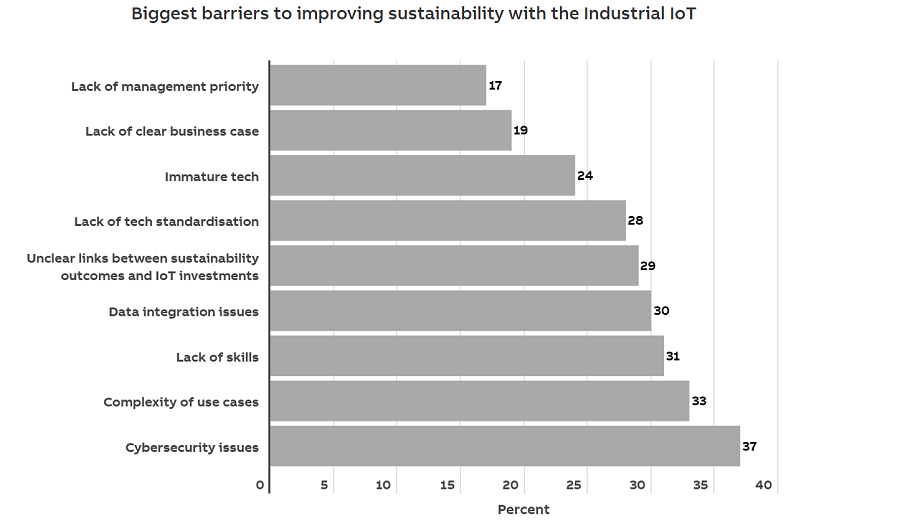
The previously referred to report by ABB also explored the biggest barriers to improving sustainability with industrial IoT technology. You can see the full list of challenges below, but let’s discuss three main ones.
Cybersecurity
Cybersecurity is the top challenge listed by industrial decision-makers in embracing IIoT for sustainability. It is of little surprise considering that to reap the rewards of connected devices, a lot of data has to be collected and analyzed. Naturally, this creates a target for cybercriminals.
However, this challenge shouldn’t deter you. Rather, it’s important to keep it in mind when embarking on your implementation journey. It’ll be crucial to come up with a comprehensive strategy for minimizing data security risks. So, make sure you work with experienced software development vendors who have expertise in building safe and long-lasting solutions.
Find out how we helped Protect a Clinic From Security Breaches
Lack of Skilled Talent
Another major challenge to implementing IoT-powered environmental monitoring is the lack of skilled talent. Finding experts in this relatively new technology is still difficult, especially if you’re looking only within your geographic region.
In this case, it’s important to consider whether you want to hire someone in-house and go through the often time-consuming talent search or if outsourcing development might be a better option. Of course, the latter doesn’t come without its own pitfalls, but it does open you up to the potential of finding someone with ample experience.
Data Integration
Issues with data integration can also be a roadblock to seamless IIoT implementation. Legacy systems and outdated software might simply be incompatible with the modern IoT technology you’re looking to add.
So, don’t forget about integration capabilities when discussing the project with your team. Although it might slightly delay the implementation phase, it’s definitely worth it to integrate your new solutions with existing systems properly. After all, that’s the only way to truly make the most of industrial IoT.
Learn how we improved a Legacy System for a Plant Growing Company

Project Estimates
Ready to Leverage IIoT for Sustainability?
There is no doubt that IT solutions themselves have an adverse effect on the environment and sustainability. At the end of the day, they too need to be disposed of once no longer effective. However, as we have seen through the use cases and benefits outlined above, the potential of digital devices to enact positive change on your company’s carbon footprint is huge.
At Velvetech, we have spent years accumulating invaluable experience in providing industrial automation strategy consulting services and building innovative IIoT software that helps clients boost efficiencies, reduce costs, and minimize side effects on the environment. We have vast expertise in developing manufacturing solutions, tools for energy companies, and various IT systems for top players from other industries.
So, if you’ve got an IIoT project in mind or would simply like to discuss your options — don’t hesitate to reach out to our team. We are always looking forward to a new collaboration.
About the author