
The business world has undoubtedly been transformed from the moment innovative technologies like machine learning (ML) and the Internet of Things (IoT) hit the market. After the initial fear of the unknown wore off, companies started leveraging the benefits of these novelties to drive business growth.
Increasingly, organizations from various industries are relying on machine learning to analyze enormous amounts of data and forecast future events. Similarly, many are excited to implement IoT solutions to improve operational efficiencies or monitor assets from afar.
Separately, the two technologies have already proliferated in multiple business sectors. Yet, there’s also tremendous potential to tap into when they’re merged. Today, we’ll discuss what that might look like by going over the top uses of machine learning in IoT. Let’s dive in.
GenAI for Business
Why Merge Machine Learning and IoT
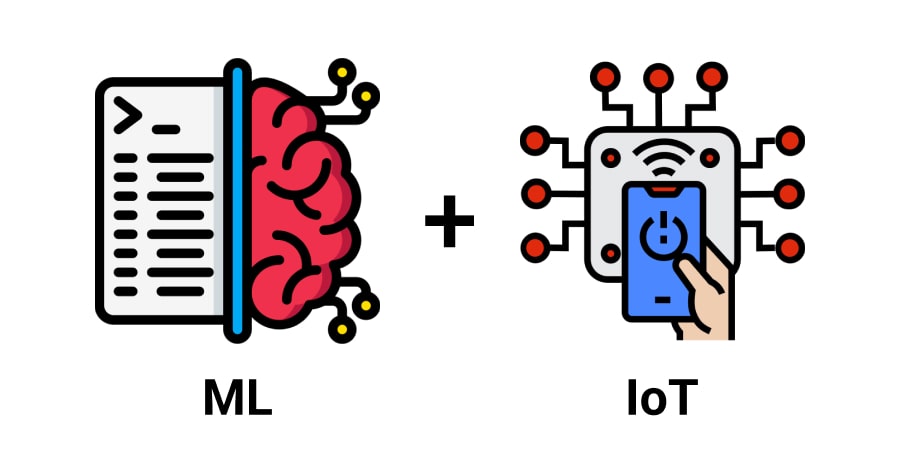
Before we talk about the potential uses of ML in IoT, let’s take a quick look over the separate benefits of each of these technologies and establish why making them work together is a good idea.
Reasons to Leverage ML
As you may know, machine learning is a subset of artificial intelligence that is used to automate data analysis, identify patterns, and make important decisions with little human involvement.
Find out the Power of AI in Business
Overall, machine learning brings several advantageous capabilities:
- Quick identification of trends and patterns that a human may overlook
- Ability to learn from experience and improve outcomes based on it
- Automation of repetitive tasks usually handled manually by employees
- Highly accurate prediction of future events through speedy data analysis
Advantages of Using IoT
Then, we’ve got the IoT. In recent years, this technology has become highly sought-after across multiple industries. Especially, across manufacturing, logistics, and healthcare sectors that are looking to streamline interactions between people, processes, and objects.
Discover the Growing Trends of IoT in Manufacturing
The Internet of Things refers to a network of connected devices that exchange data with other systems over the internet. This can include industrial solutions for monitoring the supply chain or medical tools for tracking a patient’s health. The applications of IoT-based software are truly widespread.
All in all, the Internet of Things provides companies with:
- Access to real-time data gathered from embedded sensors
- An ability to increase productivity and efficiency of operations
- The chance to improve the safety of personnel
- The opportunity to boost waste management efforts
The Power of Tech Combo: ML and IoT
As you can see, both technologies can deliver a myriad of benefits to business. However, everything gets even more interesting if we combine them.
While connected devices do generate enormous amounts of valuable data and empower organizations with potentially hard-to-acquire insights, all this information has to be analyzed. That’s precisely where machine learning can come in to help.
Given that ML algorithms require large quantities of data to learn from and base their predictions upon, IoT devices are excellent to provide them with precisely that. Thus, making the use of machine learning a logical approach to boost the performance of any organization.
In general, companies that implement IoT-based projects empowered by machine learning tools get a vast number of advantages. While further below we’ll talk about the applications of these technologies in more detail, we’ll now briefly highlight the core benefits of the IoT and machine learning duo:
- Automated business processes
- Enhanced risk management
- Waste reduction
- Safe working environment
- Better customer experience
- Cost-savings
- Improved performance
- Transparency and operational efficiency

Lack of Developers
Top Use Cases of Machine Learning in IoT
Now, let’s take a closer look at the role of machine learning in the Internet of Things. All in all, there are five top ways these technologies are used together.
Data Analysis Automation

Of course, the key value of IoT technology stems from its ability to provide hard-to-access data in order for important insights to be extracted. Yet, analyzing it all isn’t the easiest undertaking. Hence, it’s a good idea to employ machine learning algorithms and automate the analysis of a large volume of data generated by smart sensors.
Specifically, ML tools that have data science at their core can be used to support or replace manual processing by going through large volumes of data in seconds, detecting anomalies, and uncovering patterns or correlations. Thus, leading to fewer errors and providing more time for your employees to focus on value-generating activities.
Read up on the Benefits of Enterprise Data Science
Predictive Analytics

Specifically, predictive analytics can help foresee customer behavior changes, inventory level discrepancies, and even future cash flows. Additionally, there are plenty of industry-specific uses.
For example, while delivering manufacturing solutions, machine learning and industrial IoT are used to forecast equipment failure, thus minimizing maintenance-related costs. In auto insurance, on the other hand, the technology can help with risk assessment activities by looking over driver behavior data to determine the probability of accidents.
Discover how we developed an Innovative IoT Product for the Automotive Market
Quality Control

So, instead of relying on human quality control, consider embracing machine learning in IoT devices. By doing so, you’ll be sure to minimize losses that can appear from subpar products.
Security Augmentation

However, ML can help. First, by automatically monitoring IoT devices across the entire network and shutting down potential cyberattacks before any lasting damage appears. The speed at which all this occurs is the primary advantage of machine learning in IoT security. A human would simply be unable to keep track of the behavior across all the relevant connected devices.
Secondly, machine learning can provide IT teams with smart forecasts that are based on previous cyberattack patterns. Thus, not only helping them enhance existing security standards but also empowering them with the opportunity to take protective action as soon as they are alerted to seemingly suspicious activity.
Edge Machine Learning

In essence, edge ML refers to the movement of processing power and intelligent computations to local servers or to the devices themselves. Thus, allowing for analysis to take place closer to original data sources and speeding up response times.
Read also about IIoT Edge Computing
In the healthcare sector, among others, there is enormous potential for edge ML. Given that the industry deals with people’s wellbeing, it is crucial for patient-related insights to be accessible in real-time with the lowest possible latency.
Thanks to machine learning and the Internet of Medical Things (IoMT), this has become possible. Through “on-device”, ML-powered data processing, information on brain activity, heart rate, and any other vital insights can be analyzed swiftly and delivered to healthcare professionals at a fraction of the time it would usually take.
Learn more about the Role of IoT in Healthcare
Employ ML in the Internet of Things Products
As we have seen, there is a multitude of potential for ML-powered IoT projects across all kinds of industries. The combination of two innovative technologies can automate data analysis, boost quality control efforts, and even strengthen security standards. Why wouldn’t a company want all these advantages?
If you’re as excited as we are about the power of this tech union — don’t hesitate to reach out to Velvetech. We’d be thrilled to help you combine innovative machine learning solutions with state-of-the-art IoT applications that drive business growth.
Our team has years of experience in developing software that solves our client’s most pressing challenges. Hence, we’d be happy to discuss your next project and come up with optimal ways for you to leverage ML and IoT technology.