

As a business leader, regardless of industry, you understand the importance of delivering high-quality products and maintaining the best levels of efficiency within your organization.
Well, whether you are developing digital products for consumers or utilizing the latest technologies to improve your operations, chances are high that you rely on embedded systems.
The truth is, these platforms are becoming increasingly vital across various business sectors, including healthcare, automotive, manufacturing, and more. So, it’s a good idea to familiarize yourself with embedded systems design (ESD) in order to be able to identify opportunities for innovation and gain a competitive advantage in your respective market.
In this blog post, we will explore the basics of embedded systems design and the challenges that IT teams must take into account when working on building these tools. Let’s get right into it.
Main Steps of the Embedded System Design Process
In the interest of being on the same page, let’s get the following question out of the way. What is embedded system design?
Briefly speaking, it is the process of building specialized computer systems that perform very concrete tasks. There are different types of embedded systems and they can be found in a range of products, from cars and airplanes to medical devices and home appliances.
Now, let’s take a look at the key steps involved in embedded system design.
1. Determine System Requirements

- Who is going to use the final tool?
- Which specific functions does your embedded system need to perform?
- What is the amount of data processing that is required?
- Which hardware and software components will be needed?
- How many inputs/outputs will there be?
- What integrations with existing internal and external systems are needed?
- What kind of security and durability requirements do you have?
Once these questions are answered, your software engineers will need to create a document that details the technical specifications of the embedded system. Here, everything the team has discussed above should be noted down.
2. Assess Project Constraints

In essence, you’ve got to evaluate the power consumption, physical dimensions and weight, and cost constraints of the entire project as these elements tend to have a big impact on the type of microcontrollers (MCUs) you’ll be able to use.
Another important constraint to keep in mind and assess is the availability of hardware components. In the last few years, the industry overall has been experiencing a shortage of certain hardware parts. So, it’s a good idea to try and forecast which pieces you may require and purchase them in advance. Plus, don’t underestimate the value of building relationships with hardware providers. By doing that you’ll be able to manage the acquisition of needed components more seamlessly.
Lastly, depending on your project, you may have to think about the risks associated with using third-party tools. After all, infringing the intellectual property rights of third parties can lead to very costly consequences.
3. Design the Hardware

Find out how we helped an Engineering Company Develop Hardware
Here, it’s important to consider the various MCU options that are out there. So, make sure to research the different MCUs available on the market and compare their processing speed, memory, power consumptions, and the like. Additionally, don’t forget to think about the scalability of your project and whether an MCU will be able to accommodate the potential future requirements.
Besides researching different MCUs, it’s also important to consider System-on-Chip (SoC) solutions and ready-to-use modules like the ESP32.
SoCs combine multiple components, such as a processor, memory, and input/output interfaces, onto a single chip, making them a popular choice for sophisticated ESDs. Ready-to-use modules like the ESP32 provide an all-in-one solution that includes a processor, wireless connectivity, and other features, reducing the time and effort required for development.
Next, your IT team will also work on creating printed circuit boards (PCBs) for the embedded system. This is a sensitive process that will require some brainstorming by the specialists to determine the best ways to ensure reliability, especially for RF applications.
By the end of this stage, you’ll also be able to prototype the hardware and test its functionality. Thus, letting you move on to the creation of the required software.
4. Develop the Firmware and Software

Firmware is a type of software that is stored permanently in non-volatile memory blocks such as ROM, EPROM, EEPROM, and Flash. Embedded systems often incorporate firmware, including real-time operating systems (RTOS), which provide an immediate response to external events.
So, depending on need, developers will also choose from various real-time operating systems to base the hardware on. For example, FreeRTOS, Zephyr, VxWorks, RIOT.
5. Test and Validate

At this stage, the team will check that the final solution works at maximum efficiency and with minimal issues. It is imperative not to rush this step and debug any errors or issues that arise during testing.
So, be sure to test the functionality as well as the circuit to ensure reliability, especially when it is operating close to its limits. That way, once the system is deployed, there will be a much lower likelihood of unforeseen troubles.
5. Deploy the Embedded System

Naturally, this is also a good time to offer any relevant training to users and make sure that they have support while familiarizing themselves with the final product.
Challenges Faced During the Design of Embedded Systems
You now know all of the key steps involved in the design of an embedded system, but we couldn’t let you leave this post without quickly going over the challenges you may encounter. So, have a glance through the five main difficulties that could arise while you work on an embedded system design.
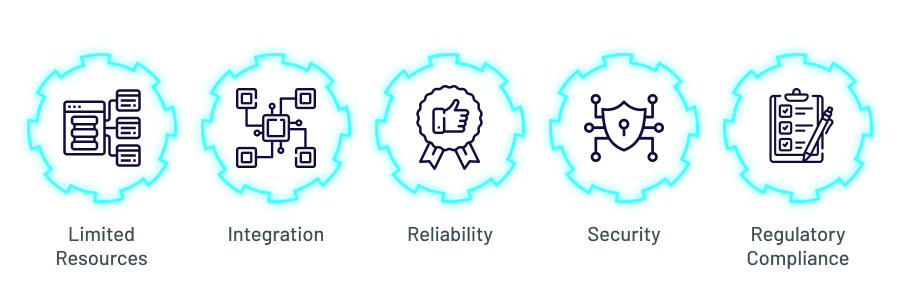
Limited Resources
Throughout this article, we’ve referred to the constraints of embedded systems several times. Like we said, these platforms tend to operate under limited memory capacities, processing powers, energy consumption levels, physical dimensions, and weight.
With so many limitations, it’s imperative for designers to look for ways to optimize performance so that the final system operates efficiently even with these constraints.
Integration
At times, integration of the different hardware and software components can pose a challenge. Of course, experienced developers will have thought of this upfront, but issues could still arise.
There’s not much you can do aside from partnering with specialists who have vast expertise in integrating systems of varying capabilities because they’ll be able to quickly pinpoint how everything should be integrated in your unique case.
Read about our VoIP System Integration with CRM Project
Reliability
As you probably know, embedded systems are often used in healthcare applications, aerospace devices, and even automotive solutions. In these areas, safe and accurate performance is of special importance as errors can lead to disastrous consequences.
Hence, embedded system designers may have to take extra measures to ensure that the final solution operates reliably and predictably even if a fault occurs. To do so, the system needs to be continuously monitored and maintained so that any risks are minimized.
Security
It’s no surprise that security made it to the list of common challenges in embedded system design. To tell you the truth, it’s probably one of the top considerations in any kind of IT project.
In recent years, hacking attempts have significantly increased across industries, forcing engineers to be particularly cautious. So, be sure to assess any vulnerable points of the system, test for security flaws, limit access, and use secure communication protocols to prevent data interception.
Additionally, don’t forget to regularly implement the latest security patches and updates, conduct frequent audits, and generally educate users on safe operations.
Regulatory Compliance
Lastly, many embedded systems ought to meet specific industry regulations since the inability to do so can result in rather large fines. So, embedded system designers you work with should be experts in delivering compliant solutions in the sector that you operate in.
Additionally, it’s a good idea to test the final platform, verify that it meets regulatory standards, and obtain any necessary certifications that attest to that.
Get Help With Your Next Software Initiative
Today, we’ve covered a lot of information related to embedded systems and the challenges one may encounter when pursuing these kinds of projects. However, we understand that it can be overwhelming and time-consuming to sift through all the details and manage development yourself.
So, our team is always ready to help. We pride ourselves on delivering state of the art embedded software development services and aiding companies across industries with their hardware and software projects.
Hence, don’t hesitate to reach out via the form below and share your IT needs with us. One of Velvetech’s specialists will get back to you shortly.