In the high-tech world that businesses operate in today, the number of software solutions a company regularly uses is steadily increasing. In fact, in 2021, the average number of SaaS applications an organization employed was 110. For reference, just in 2015, that number was 8.

With so many disjointed solutions being operated, it’s easy to see why API development services have become so in-demand. After all, there are plenty of benefits to obtain from letting software apps smoothly communicate with each other.
However, there’s no one-size-fits-all approach when it comes to the API architecture. Everything depends on the project you’re working on, existing tech stack, and sometimes even developer preferences.
Over the years, various API technologies were released to facilitate data exchange between the frontend and backend, each with its own pros and cons. Hence, picking one over the others can be a daunting and confusing endeavor.
Today, we will try to dispel some doubt and help you determine which API technology you should choose — SOAP, REST, gRPC, or GraphQL. We’ll cover when to use GraphQL over REST, gRPC instead of GraphQL, and so on. That way, you’ll be able to make an informed decision.
The Role of APIs in Microservices
Before we decipher the differences between GraphQL, gRPC, REST, and SOAP, it’s important to mention the role of APIs in microservices. You may have heard the two terms used frequently in discussions about software architecture and integrations.
APIs and microservices are vital to modern web app development. Hence, understanding both concepts is important for IT teams and business leaders alike. An API is a specific part of a web solution that allows it to communicate with other IT tools. A microservice, on the other hand, is a way of developing an app by creating separate modules where microservices can run and communicate through APIs.
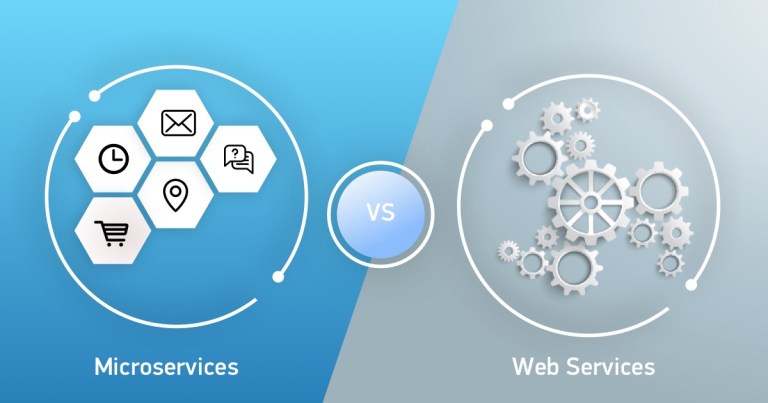
Learn more about Microservices and Web Services
In short, the two are often mentioned in tandem because microservices use APIs to communicate with each other. Of course, services can also exchange requests and responses through an event bus like RabbitMQ or Kafka, but that’s a separate topic.
So, if your project is set to employ a microservices architecture, APIs are likely to play a big role in it. Thus, choosing the best suitable one among SOAP, REST, GraphQL, and gRPC is crucial.
Discover how we replaced an insurance company’s Monolithic Architecture With Independent Microservices
Understanding SOAP vs. REST vs. GraphQL vs. gRPC
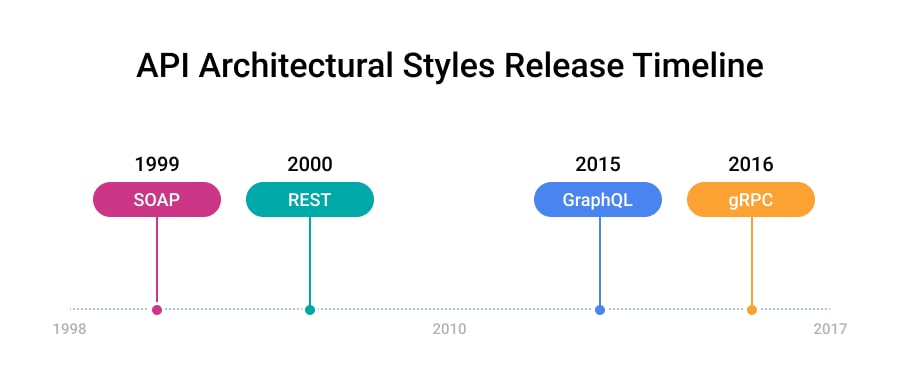
As we have established, there is a variety of API formats and no single one is a clear winner since each has its own pros and cons. So, let’s take a look at the four most well-known options in the order that they were released and see why you may want to pick one or the other for your next project.
SOAP

Typically, SOAP is used with the Web Service Description Language (WSDL), which allows for the inspection of a web service that supports SOAP and simplifies programming. Plus, it relies on application layer protocols like SMTP, TCP, UDP, or, most commonly, HTTP.
The message structure of SOAP is rather lengthy and consists of an “envelope” tag to indicate the start and end of a message, a “header” with optional attributes, a “body” with the actual request or response, and a “fault” to indicate information about errors that may have occurred during processing.
SOAP Pros
- Security. SOAP supports WS-Security and allows for encryption of messages. It meets enterprise-level transaction quality and is often used in CRM software, payments gateways, and fintech solutions.
- Stateful operations. SOAP APIs are stateless by default. Yet, stateful is also an option, making it convenient for bank transfers or flight bookings where a chain of operations has to be made.
- Compliance. SOAP supports Atomicity, Consistency, Isolation, and Durability (ACID), an enterprise-grade transaction quality. This makes it appealing for exchanging sensitive information in enterprises.
- Built-in retry logic. In case of a failed communication, SOAP’s response will showcase the error information so that the failure can be understood and fixed easily.
SOAP Cons
- Limited data format support. SOAP only supports the wordy XML structure for its requests and responses.
- Lengthy processing. Since SOAP can only transfer messages as heavyweight XML files, it will take more time to process a request and transfer a response.
- Inflexible. SOAP has its own rules and security measures which limits the freedom of the developer during programming.
- High learning curve. SOAP is harder to code as you’ve got to have a good understanding of all the restrictive rules and protocols that are involved.
REST
REST can be developed in various programming languages and supports multiple data formats, typically JSON and XML. A RESTful architecture should be aligned with the following six constraints:
- Uniform interface
- Client-server decoupling
- Stateless
- Cacheable data
- Layered system architecture
- Code-on-demand (optional)
Even with these architectural constraints, REST isn’t as strict as the previously discussed SOAP.
REST Pros
- Cacheability. REST allows for caching of data on the HTTP level. Thus, eliminating the need for constant client-server interaction, which boosts performance and scalability. This makes REST a great option for IoT-based projects.
- Supports multiple formats. Allowing for storage and data exchange to be carried out via various formats is one of the biggest advantages of REST. That’s what makes it one of the top choices when developing public APIs.
- Ubiquitous. The popularity and maturity of REST make it quite widespread. Many developers are familiar with it and can easily work on a project that requires it.
- Intuitive. Since REST is built upon the semantics of HTTP, it’s great for public-facing interfaces that need to be intuitive for the end-user.
Read up on the importance of Intuitive UI/UX in Healthcare
REST Cons
- Ambiguity. REST can be interpreted in different ways. There isn’t a single correct way to build a REST API. Practically-speaking, this can create challenges for developers.
- Lower security. Since REST doesn’t impose any security protocols, it is generally considered less safe than other web APIs. Of course, the connection can be made more secure by setting up communications through HTTPS. However, that is still an extra task that developers have to think about.
- Stateless architecture. REST’s third architectural constraint requires statelessness, meaning that each API call has to be independent of previous calls. Naturally, this might be an issue if a web service needs a chain of interconnected messages.
GraphQL
Unlike REST, GraphQL has its own specification that can be implemented using a variety of programming languages. For some, this is a clear benefit of GraphQL over REST. Additionally, this technology uses queries, mutations, and subscriptions for sourcing data, not HTTP methods that REST relies on.
In our experience, GraphQL is being relied on more and more frequently. At times, simply because it’s the most optimal option for the chosen tech stack.
GraphQL Use Cases
For instance, our team had a project in the blockchain sphere, in which a decentralized exchange platform had to be developed. Our specialists relied on The Graph API, a second-layer API solution for blockchain, to acquire the needed data. As The Graph automatically generates a GraphQL endpoint, it was the most optimal technology for us to complete the project with.
Another example of GraphQL usage was on a project where our team was working on creating universal grid tables that could obtain data from API endpoints provided by Hot Chocolate library. Naturally, to complete the task, we chose to use Hot Chocolate, an open-source GraphQL server for the Microsoft .NET platform.
It allowed us to quickly get the needed features for the grid tables because it came with ready-made filtration, sorting, and other options that the Client was looking for.
GraphQL Pros
- Better performance. Thanks to GraphQL’s ability to specify exactly the scope of data required in every instance, there’s no excess data exchange between the server and the client. This leads to better app performance and is one of the top advantages of GraphQL over REST.
- No versioning. As APIs evolve, keeping the old version while transitioning to a new one can be a hassle. GraphQL avoids this problem by deprecating APIs on a field level, allowing old ones to be removed from the schema without impacting existing queries.
- Detailed error descriptions. If an error occurs while a GraphQL query is being processed, the backend will deliver a comprehensive error message. Naturally, this speeds up any issue resolutions.
- API documentation. GraphQL autogenerates documentation on any API changes, allowing developers to spend less time keeping track of updates.
GraphQL Cons
- Complex caching. Since each GraphQL query is unique (or almost unique), data caching becomes a major challenge. To solve this problem, developers need to implement additional mechanisms. Perhaps this is one of the most serious disadvantages due to which GraphQL has not yet conquered the world.
- Steep learning curve. In comparison with REST, GraphQL is more niche and might require more time for developers to grasp.
- Crashing potential. If too many nested fields are requested simultaneously through GraphQL, a system can overload and the server may crash.
gRPC
gRPC is contract-based and uses the Protocol Buffers binary data format. It requires both the client and the server in data exchange to have access to the same schema definition.
Additionally, gRPC is based on the HTTP/2 protocol. It supports any amount of requests and responses over a single connection. Plus, the communication is bidirectional. This implies that a single connection can send both requests and responses at the same time, allowing for latency reduction.
gRPC Use Case
On an ongoing project, Velvetech’s developers had actually entirely embraced gRPC. The team was tasked with developing an online marketplace for long-term senior care residences and decided to rely on the gRPC protocol as it allows for speedy frontend-backend interactions which the Client was looking for.
The biggest advantage of using gRPC for the long-term care booking platform was that it provided streaming and duplex communication capabilities. Thus, allowing the team to build optimal interactions between the frontend and backend.
gRPC Pros
- Code generation. One of gRPC’s main benefits is the native code generation for client/server apps from Protobuf definitions to various programming languages. It helps reduce development time in applications with a variety of services.
- Heightened performance. Binary formats of data exchange tend to be more compact than text-based ones. Thus, gRPC can outperform REST and GraphQL due to its binary format requirement.
- Good security. As gRPC requires HTTP/2 and TLS/SSL, it provides decent levels of security by default.
gRPC Cons
- Limited browser support. As we’ve mentioned, gRPC relies on HTTP/2, and that makes it impossible to call a gRPC service from a web browser directly. Instead, a proxy is needed, which can come with its own limitations.
- Unreadable format for humans. Since the data is compressed to a binary format, Protobuf files become unreadable for people. As you may know, this isn’t the case with XML and JSON. Hence, extra tools are needed to analyze payloads or perform debugging.
- Lack of maturity. Other APIs, especially REST, are more popular than gRPC. So, finding skilled developers with an extensive portfolio can be more of a challenge. However, the slower adoption might just be a result of the technology’s novelty and will wear off in the coming years.
How to Choose the Right API Architectural Style
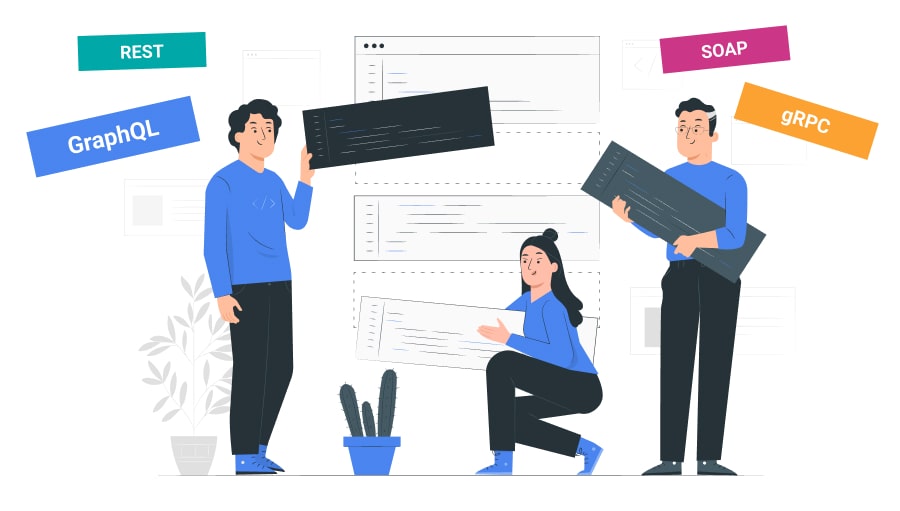
Now that we’ve gone over the various API styles, you might be asking yourself, how do I make sure I choose the right one for my project? Well, unfortunately, it’s hard to give a clear-cut answer.
You see, every API project has different needs and requirements. Thus, as we’ve already said, there’s no one-size-fits-all approach, it can really be a challenge to choose the API to set. However, typically, the choice of an API architectural style depends on the following factors:
- Programming language being used
- Development environment
- Availability of skilled specialists
- Project development time frame
Everything depends on your own priorities, needs, and goals. Knowing the pros and cons of each API style can empower you to make the best decision. However, don’t forget that these technologies can also be mixed and matched in some cases. Particularly, if your app’s architecture has multiple APIs that are to be used for separate purposes. For instance, when you have internal and public-facing APIs.
So, whatever choice you make doesn’t have to be set in stone and used universally. Just keep the following comparison table in mind when making your decision, or reach out to experienced software development vendors for a consultation.
SOAP |
REST |
gRPC |
GraphQL |
|
|---|---|---|---|---|
Organization |
Envelope message structure | Compliance with six constraints | Local procedure calling | Schema and type system |
Format |
XML only | XML, JSON, HTML, text | JSON, XML, Protobuf, Thrift, FlatBuffers | JSON |
State |
Stateful, stateless | Stateless | Stateless | Stateless |
Caching |
Caching module | HTTP caching | – | Custom caching |
Good for |
Payment gateways, CRM software, fintech tools, legacy system support | Public-facing interfaces | Command and action-oriented APIs, internal communication in large microservices systems | Mobile APIs, microservices |
Get Help With Picking an API For Your Project
We’ve covered a lot of ground today. It is evident that choosing the right API for your software project might not be the most straightforward endeavor. However, it is definitely something you need to approach seriously as it can affect the success of your solution and impact performance and scalability.
At Velvetech, we have spent years delivering great API development services to clients from a vast range of industries. So, feel free to reach out to our team if you are looking to ensure connectivity across all of your business applications. We’ll be happy to help you with API development.
About the author