There is little doubt that the global mobile app development market is experiencing immense success. The number of applications is constantly increasing, and people are spending more and more time on their phones.
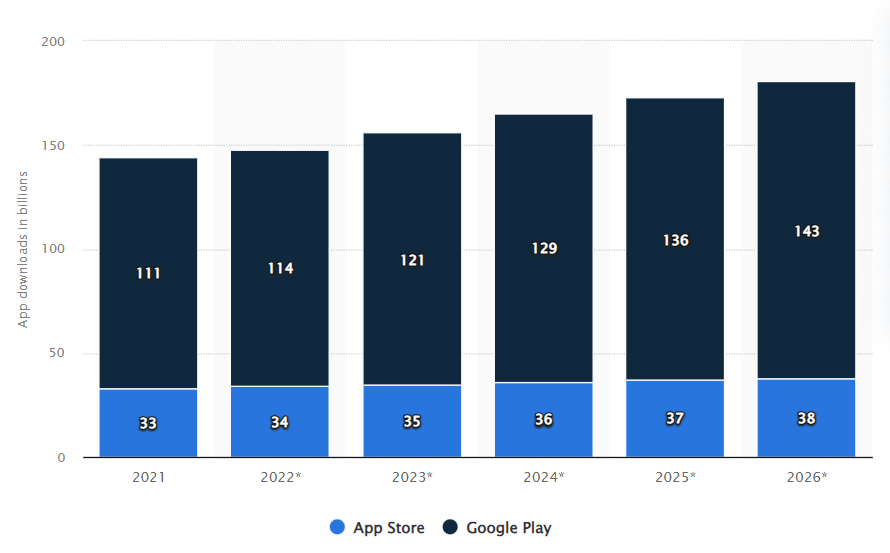
Moreover, there’s been a steady growth of mobile app downloads over the last couple of years, and companies are taking note.
While many organizations started to implement mobile apps a long time ago, some are just at the beginning of their journey. Yet, regardless of the stage you’re in, there are lots of things to think about, and the development approach you’re going to go with is one of them.
Discover the 5 Key Mobile Development Approaches
Of course, everything depends on your unique goals and business needs. However, given that most IT teams tend to prefer native mobile app development, we thought we’d give you an overview of what it is and the common benefits and considerations it brings.
What Is Native Mobile App Development?
A native mobile app is one that was developed for a certain operating system. Such an approach entails the use of platform-specific programming languages and consideration of the characteristics of each system. Thus, if you are looking to build an iOS app and an Android one, you’d have to do so separately and use different technology stacks.
For instance, a native iOS app will require Objective-C or Swift as programming languages, while an Android solution will rely on Java or Kotlin. Similarly, AppCode and Xcode toolsets might be used within a native iOS app development stack, but Eclipse or Android Studio for an Android application.
Learn more about Mobile Technology Stacks for Native Apps
As you may know, there are consumer and enterprise apps, and native development can be used for both. Some of the most well-known native mobile app examples include Twitter, DocuSign, and Magento 2 POS, which as you can see encompass consumer-facing apps as well as employee-facing ones.
So, if you’ve been asking yourself “What is native mobile application development?”, we hope it has become a little more clear. However, we’d like to add more information and cover the key differences between various popular approaches. This way, you’ll be armed with the core details you need to choose the right strategy for your app development.

Choosing a Winning App Development Strategy
Native vs. Cross-Platform vs. Hybrid Applications
Basically, there are three main app development approaches you can leverage to deliver your mobile solution: native, cross-platform, and hybrid. Each of them has pros and cons, and the choice always depends on your business goals, target audience, and available resources.
Below, we provide a table that, while having some technical details, will hopefully help you have a better picture and see if native mobile apps are a better fit in your case.
|
Factor
|
Native Apps
|
Cross-Platform
|
Hybrid Apps
|
|---|---|---|---|
| Code Reusability | Limited reusability | High code reusability (usually 80-90%) | High code reusability (usually 70-80%) |
| Rendering Engine | Native | Native | Browser |
| Development Languages | E.g. Java/Kotlin for Android, Swift/Objective-C for iOS | Typically, a single language like JavaScript or C# | Typically, a single language like JavaScript |
| Programming Tools | XCode, AppCode, AndroidStudio | React Native, Flutter, Xamarin | Ionic, Apache Cordova, VisualStudio |
| Dependency on 3d Party Tools | Less-dependent on third-party libraries and resources | Extensively dependent on 3d party tools | Extensively dependent on 3d party tools |
| Access to Device APIs | Full access to all device APIs and features | Access to most device APIs, but updates may lag behind native | Limited access to device APIs; relies on plugins for extended functionality |
| Offline Support | Full offline support | Varies by platform and toolset | Varies by toolset and may require plugins |
| Market Reach | Limited to specific platforms | Broad market reach (iOS and Android) | Broad market reach (iOS and Android) |
| Time to Market | Time-consuming | Reduced time due to reusable code | Reduced time due to reusable code |
We’ve deliberately omitted some of the essential factors to cover in our table. Instead, we’ll highlight them in our next section as strong sides where native apps definitely win big.
8 Key Benefits of Native Mobile App Development
The mobile app development process can at times seem long and arduous. However, all of the challenges fade when you start seeing the benefits of all that hard work.
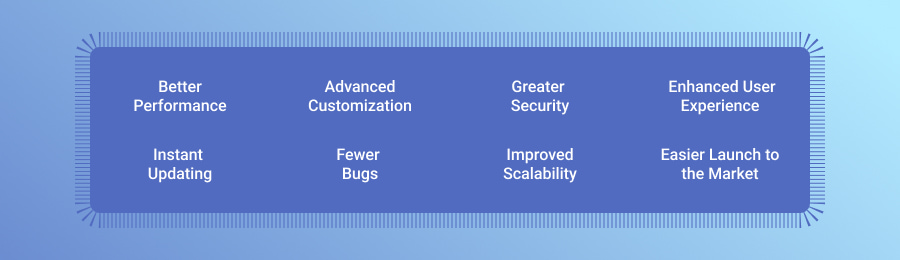
In the context of mobile solutions, there are eight main advantages of native development that usually cause the IT team and business leaders to choose this approach. Let’s take a closer look at each one.
1. Better Performance
First and foremost, native apps have better performance than cross-platform or hybrid solutions. Primarily, because the application interacts directly with native APIs and doesn’t depend on middleware.
Thus, by getting full hardware and operating system support, native apps end up being more responsive and highly efficient. Plus, the devices they’re loaded on actually store all the key data and help content load faster.
2. Advanced Customization
Since native applications make the most of the features within the operating system, they can be highly customized. With this approach, developers can access the GPS, camera, microphone, and other hardware to build a final product that is truly unique.
In short, thanks to developers not needing to combine the features of two operating systems, they have fewer limitations and can focus on creating a one-of-a-kind solution.
3. Enhanced User Experience
Every platform has its own UI/UX guidelines that developers ought to stick to. Hence, when creating a native mobile app, these standards are well adhered to, resulting in a look and feel that is consistent with the operating system.
Find out how Velvetech Redeveloped a Medical App To Enhance the UI/UX
The consistency of native mobile apps also brings a much more intuitive and interactive user experience because people are familiar with the layouts typical for their operating system. So, whenever they use your application, they feel like it’s something they are used to.
4. Greater Security
Another reason to opt for native app development is the higher security level that it offers. With data protection concerns rising, software solutions across all industries should make users feel safe when sharing digital information.
You see, cross-platform and hybrid solutions may carry with them the vulnerabilities of each platform, the browser they work on, and the universal languages they employ. Of course, this isn’t always the case, just a possibility. However, definitely one to consider before starting your project.
As we’ve already mentioned, native apps are built for a specific platform. That way, the data is encrypted within a single infrastructure, which significantly reduces security-associated risks.
5. Fewer Bugs
Since building native apps incorporates using specific and different for each platform tools, it has fewer tech dependencies and decreases the possibility for bugs to arise. In the end, keeping two apps in two independent codebases is less difficult and error-prone than implementing two apps in the same codebase.
6. Improved Scalability
The architecture of native applications allows for acquiring more user traffic and supporting a higher load. Thus, there are more opportunities for scalability and your product’s future growth.
It’s easier for native apps to scale as you need since they effectively use existing hardware, provide a better performance, and reduce the risk of the app crashing during the increased traffic.
7. Easier Launch to the Market
Another advantage of native applications is the relatively easy process of launching the app to the app stores. Both App Store and Google Play have rules and standards to follow when you publish your solution to the market.
For cross-platform apps, it can entail more bottlenecks to cope with. On the other hand, when delivering native products, mobile developers use native tech stack and align the code from the first lines to the regulations and guidelines provided by each store.
8. Instant Updating
The last benefit of native mobile app development that’s worth mentioning is the ability to receive instant updates.
The truth is, with cross-platform applications, developers aren’t immediately able to implement new features. Given the frequency with which iOS and Android release updates, this can sometimes be a problem as the delays degrade the user experience.
With native apps, everything is much simpler. When Android and iOS roll out software upgrades, IT teams can immediately implement the latest features since they’ve got quick and easy access to new SDKs that help modify the application.

Lack of Developers
Challenges in Native App Development
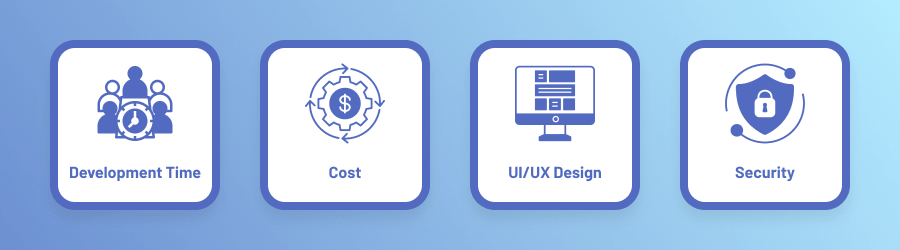
As we’ve covered the main advantages of native app development, it’s natural to mention its considerations as well. In the end, a coin always has two sides. However, you might be surprised to see security on this list since it was highlighted as one of the benefits. Don’t worry, we’ll explain it in the corresponding section.
Development Time
It might seem obvious that if you develop separate apps for two different platforms, then it, of course, requires more time to deliver them. After all, developers need to write and maintain code for each platform independently. And this makes companies that need to launch their products quickly hesitant about native apps.
Yet, all is not so sad. For example, having separate teams working on iOS and Android apps simultaneously can mitigate some of the time constraints associated with native mobile apps. This approach allows for parallel development, which can lead to faster timelines.
Cost
We have found out that native applications are considered time-consuming to build and require separate development teams and resources. So, it’s easy to tell that compared to cross-platform or hybrid strategies, developing and maintaining them can be more expensive.
It happens because, ongoing maintenance, updates, and bug fixes will require twice the effort compared to a single cross-platform codebase. As you can guess, it leads to higher long-term maintenance costs.
UI/UX Design
As we said earlier in the part with benefits, native mobile app development offers more control and customization over the user interface. On the other hand, it may require some additional UI/UX design effort to meet platform-specific guidelines.
Native app developers and designers should adhere to Human Interface Guidelines in the case of iOS and Material Design principles when delivering for Android. This means that UI/UX designers often need expertise in both iOS and Android design best practices.
Security
Even if a native approach ensures higher security than other strategies, it still remains a challenge to provide maximum safety. Securing native mobile apps is an ongoing process that requires constant vigilance and adaptation to evolving threats.
Regular security assessments, penetration testing, and code reviews can help identify vulnerabilities and weaknesses that need to be addressed. Additionally, staying informed about emerging security threats and best platform-specific practices is essential to maintaining the security of your native solution.
Should You Choose Native Mobile App Development?
Before getting started with building a native application, it’s worth taking a pause and truly evaluating if it is the right approach for you. Since this strategy entails the use of different tools, APIs, environments, and interface designs, you’ll need to find experts for each of the platforms you require. Occasionally, this can get costly and somewhat more time-consuming.
Discover the Costs of Developing a Mobile App
Additionally, you should think about whether outsourcing mobile app development is a better option for you rather than hiring an in-house team. Regardless of your choice, it’s important to carefully evaluate potential mobile app developers to determine if they are the right fit.
All in all, there are a few key considerations for you to think about prior to starting native app development:
- How quickly do you want your mobile app to be ready?
- What is your budget?
- Is top-notch performance imperative for you?
- How valuable are quick updates to you?
- Are greater customization capabilities important to you?
By answering these questions you’ll be able to determine how best to proceed. After all, there is a multitude of uses you might be building your app for.
Perhaps you want to create a consumer-facing solution like a dating app. Or, an employee-facing management tool to speed up processes. Whichever it may be, your requirements and strategies will differ.
If you are confident that native development is the right choice for you or would like to discuss your project requirements further — don’t hesitate to reach out to our team. Velvetech has years of expertise in building native and cross-platform applications that help organizations prosper in the mobile world. We’d be happy to collaborate.
About the author