
Companies across all kinds of industries rely heavily on customer relationship management to ensure lasting success and the banking sphere is no exception. After all, knowing how to establish effective communication and being able to swiftly manage interactions with leads, prospects, and loyal clients is a must in the modern business world.
So, organizations within the financial sector have long been fond of CRM software and are still actively looking for ways to better their customer management initiatives. However, if you work in banking and haven’t yet acquired a solution that fits your needs or are curious about the full potential of CRM tools — keep reading.
In today’s post, we’re diving into the subject of CRM in banking, discussing the benefits of implementing this type of software, and going over the must-have features to look out for. Without further ado, let’s get right into it.
Why Implement a CRM in Banking
First things first, let’s establish why your company should be interested in CRM software for banks.
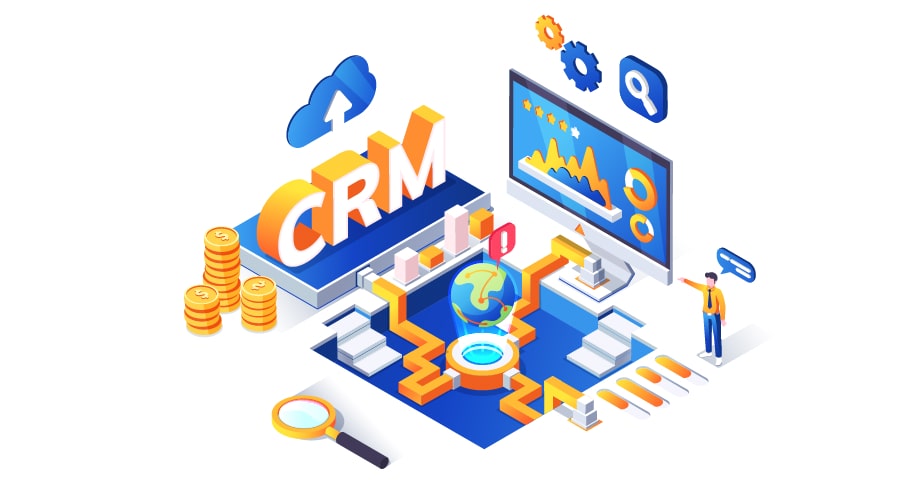
In short, because a CRM solution allows banks to seamlessly manage their sales pipeline, customer relations, and marketing initiatives, all from one place. However, if that’s not enough to convince you, let’s quickly go over some of the key benefits that make a CRM for the banking industry a worthy investment.
Find out about CRM Implementation for a Financial Service Provider
Centralized Customer Data
One of the primary reasons for implementing a software like a banking CRM is to get rid of disparate sources of information and centralize customer data and the history of all communications in one database.
You want to be able to track any and all interactions with clients whether they happen through the phone, text message, or email. A CRM helps do just that and more. Besides basic client details and communication summary, you can also integrate it with other systems and view loan history, ATM deposits, and other insights that may be relevant for providing better services.
Discover how we Integrated a CRM with QuickBooks
Personalization Capabilities
In banking, a CRM goes beyond simply being a reliable database. In fact, all of that accumulated information can actually serve as a way to personalize services. By running data analytics on the details from a CRM, you can quickly identify client preferences and offer products that may fit their needs.
Enhancing your personalization initiatives will result in higher customer satisfaction and loyalty. Naturally, this will reflect positively on your bottom line.
Customer Behavior Prediction
Another major advantage of relying on a CRM in the banking industry is that you can count on the gathered insights to forecast customer behavior. With the help of artificial intelligence and predictive analytics, people who may be a risk of churn are quickly identified. Thus, allowing you to make a timely offer that could help retain them.
Read up on The Role of AI in Banking and Finance
6 Must-Have Features of Banking CRM Software
Now that we’ve gone over the benefits of implementing a CRM in banking business, it’s time to cover the key features you should look out for when searching for the optimal solution. Most CRMs offer similar functionalities, but you should still keep these main ones in mind during your search.
1. Complete Customer View

By having all these insights centralized in a single repository and easily accessible, your specialists will be able to quickly pull up any needed information and offer the best advice.
In this context, it’s also important to mention that a banking CRM should be able to automatically update customer profiles after any interaction. For instance, if a client places a call to the contact center, any details should be immediately synced with the CRM. That is the only way to ensure that your staff always has access to the most relevant information.
2. Lead Management

Additionally, an intelligent lead management feature that is powered with machine learning algorithms can even provide recommendations for upselling or cross-selling. Thus, personalizing service delivery and contributing to higher revenue.
Find out the Top 5 Ways a CRM Improves Lead Generation
3. Workflow Automation

So, when considering CRM platforms, check that your preferred one has an automation feature. It should allow you to set up workflows that will automatically carry out an action when a certain event occurs.
For instance, if a prospect hasn’t responded to several emails, a relevant employee can be reminded to give that person a call. Thus, ensuring that no potential customer is ever forgotten about.
4. Marketing Campaign Coordination

In this case, a CRM can provide you with the relevant business intelligence by indicating the customers that may be most susceptible to downloading this kind of an app. Moreover, by incorporating a marketing dashboard, you’ll be able to track the success of a campaign and use the acquired insights to fuel future promotions.
5. Analytics and Reports

So, don’t forget to check that your CRM can provide insights on revenue levels, marketing campaign results, call center staff efficiency, and the like. Plus, it should allow for the customization of reports and dashboards so that employees can adjust the analytics they want to see.
6. Integration Support

So, if you’ve already got document management software, card processing systems, contact center solutions, or other tools in place — take the time to integrate them with your CRM. In the long run, it will help boost performance as all of the data you work with will be easily accessible across all platforms.
Learn about the Power of CRM and Document Management System Integration
Acquire the Right CRM for Your Bank
Implementing a CRM in banking is almost a non negotiable in the modern world. This solution can help businesses acquire a 360⁰ view of their customers, optimize lead management processes, and gain invaluable insights into sales and marketing performance.
So, if you’re looking to boost your customer relationship management efforts — don’t hesitate to contact Velvetech. We deliver extensive CRM development services ranging from minor customization projects to enterprise-wide implementations.