
When you close multi-million dollar property deals and operate sensitive data on contracts, you’ll inevitably face the question: how to host your application — in the cloud or use an on-premises data center? Both options are viable, however, it’s better to emanate from your business specifics and plans for the future to make the right choice.
Real estate service providers operate huge volumes of heterogeneous data, leverage all possible property metrics, build complex analytics, and generate sophisticated reports. All these can be done both in the cloud and on-prem, however, the trend is that decision-makers tend to abandon local servers, migrate their application to the cloud, or select this hosting option right away.
Of course, they do it for good reasons. Cloud providers have so many out-of-the-box tools to offer that maintaining a local data center becomes too resource- and effort-consuming. In this article, let’s figure out why the cloud is the best choice for all types of real estate solutions and discuss the limitations of the hosting option (yes, they exist!).
Making Things Clear or Why Cloud Is the Best Option for Real Estate Service Providers
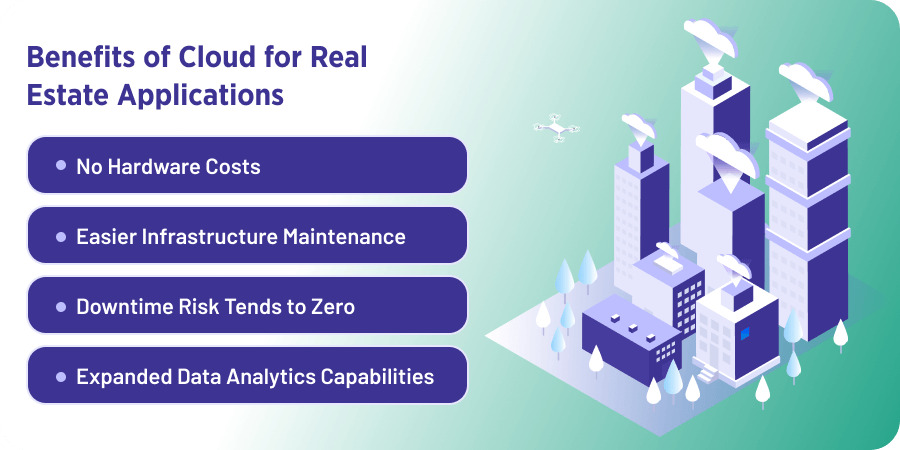
Some assume that the cloud is something completely virtual and has nothing in common with data centers in the usual sense. However, this concept is far from the truth: providers own a network of data centers scattered across different regions and take full responsibility for their maintenance.
From the previous sentence you already may capture such cloud pros as flexibility and the absence of infrastructure support-related headaches. But the list is a bit more extensive, let’s go over the most common benefits cloud computing has to offer to real estate companies.
Say No to Costly Hardware and Periphery Purchasing
Imagine, you are a proptech startup nurturing the idea of streamlining mortgage closing processes. Agree, it’s a rare case when founders command unlimited budgets for realization and are ready to wait for years until their product appears on the market.
That’s why startups begin from a PoC or MVP and allocate their resources with extreme caution. They have no clue whether their idea will work out, and investing in costly hardware and periphery is equivalent to suicide. Also, anyone who has ever dealt with on-prem infrastructure configurations knows like no one else how painful and time-consuming the process is.
However, you need significant computational powers to process huge data volumes. Aggregation of financial institutions providing mortgages, details on title companies dealing with checks on property ownership, client personal data — all this information must be stored somewhere and processed somehow. And of course, you can’t do without analytics tools to conduct property comparisons of mortgage offerings, potential borrower’s trustworthiness checks, and other reports for successful deal closure.
That’s what cloud computing for real estate can offer — you neither have to spend tens of thousands of dollars on a local data center nor bother with deployment and initial configurations. Your infrastructure is available here and now, which significantly speeds up the time to market. In our opinion, the game is worth the candle, isn’t it?
Pay for Resources You Consume. Not More, Not Less
Calculations are an integral part of any real estate business. Whether you need to proceed with investment performance analysis, calculate your tax obligations, or efficiency metrics of properties in your possession — you’ll need significant computational resources to do it quickly, and cloud computing can easily provide it for real estate business.
Most likely, you don’t proceed with complex calculations daily, which means that you’ll need server capacities only from time to time. Is it worth paying for a powerful on-prem data center and not using the available resources? Such a strategy is too wasteful, in our point of view.
The cloud allows you to pay only for computational powers you actually use. Moreover, there are periods when the capacities are cheaper (during the nighttime, for instance). And voila — you gain well-executed calculations within only several hours and pay only for the resources you’ve actually consumed.
There’s also another thing we can’t fail but mention. Cloud providers offer a variety of out-of-the-box tools that automate the lion’s share of work. Among them, there is Lambda, which helps to alleviate the load on the server despite the number of requests.
Remember, that in your local data center, there won’t be a tool like this to help you with calculations. Therefore, the load may turn out to be unbearable for your on-prem server, and you will have to wait for the result for days instead of hours like in the case of the cloud.
Application Architectural Flaws Are Not a Sentence for Cloud-Based Real Estate Software
When you design an architecture for your real estate solution, you may not envisage some functions that you may need in the future. For example, you are a startup developing an Airbnb-like platform for vacation home rentals in your city. Over the years your business has expanded significantly, and your platform includes homes not only in your city but also in other regions of your country.
Say, at the initial stages of your business journey, you decided in favor of a thorny path of an on-premises data center. You didn’t expect that your platform would grow that fast and turn out to be in high demand over time and hadn’t envisaged scalability when designing the architecture.
If your application was not initially designed for the high load and was deployed on a local server, you’ll inevitably face performance issues since your server is not capable of processing all inbound requests promptly. Therefore, here you have several options to rectify the situation: invest in more powerful servers, overhaul your architecture, or do a combo. As you may have guessed, the offered options will cost a pretty penny.
Cloud computing for real estate applications, in its turn, tends to forgive such architectural flaws exactly because of the abundance of out-of-the-box features that an on-prem server lacks. We’ve mentioned Lambda in the previous part, which helps to alleviate the load on the server and minimize performance glitches. Using the service, you may easily scale your application, and this will not affect the user experience.
Read about the Migration of a Legacy App to the Cloud
Downtime Risk Tends to Zero
Real estate agents must have sustainable access to the system to process requests, track the deals’ progress, and maintain good relationships with the clientele. In the case of using an on-prem data center, you risk losing access to your infrastructure and your mission-critical data in case of a natural disaster, fire, or any other force majeure.
As we already mentioned, the cloud is something not completely virtual, and world-known service providers, such as Amazon or Google, have multiple physical data centers distributed across different regions. As you may understand, they are also vulnerable to various incidents. But if one happens, the provider will redirect you to another healthy server quickly and almost painlessly, so you may not even notice that something has happened.
DevOps Mastery Doesn’t Mean That Much as in Case of On-Prem
Those who configured on-prem infrastructure know how painful and time-consuming the process is. That’s why if you decide in favor of on-prem servers, the mastery of your DevOps team must be on an exceptional level since tons of intricacies may affect the application performance and data security in the future.
When selecting the cloud, things are quite simple. Cloud offers multiple services that automate the work of the DevOps team. Put simply, for example, when doing backups, all that is needed from an engineer is to click several buttons, and backuping is complete. With an on-prem server, the trick won’t work. All must be done manually, and this automatically entails the high possibility of mistakes.
Analytics for Real Estate. Why Analyze Your Data in the Cloud
To have a better understanding of the role of cloud computing for the real estate industry when it comes to data analytics, let’s refer to our case study. Our customer provides consulting services to real estate companies and asked us to augment their existing solution with analytics.
The issue is that they extract data from multiple MLSs, and their amount is approximately 400. Imagine the volume of information that must be processed and visualized to become suitable for strategy elaboration and decision-making.
Explore more details on the delivered Real Estate Data Analytics Solution
Obviously, the cloud makes data analytics a breeze since provides significant computational powers on demand. However, there are some other pros we’d like to mention here.
Better Control Over Data Quality

Cloud service providers fully acknowledge the problem of data quality and strive to help their customers overcome this challenge with minimal losses. Therefore, their toolsets include services for automated control over data correctness and consistency.
Flexibility Is What We Love Cloud for the Most

Cloud platforms are much more flexible and have their own connectors, so you can afford not to write code yourself. You can easily and quickly establish hassle-free connections with open-source systems, such as Google Maps, Zoho, etc., and start extracting needed data right away.
Discover more about Real Estate Integrations and Communication Between Systems
Ok, We’re Moving. Do the Drawbacks Exist We Need to Know About?
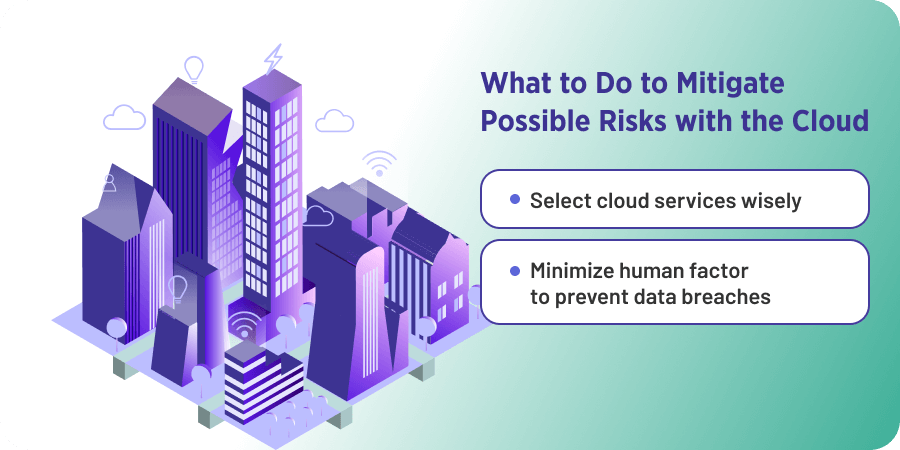
Although the cloud has many benefits to offer, there are some risks we’d like to warn you about. Let’s go over them below.
You May Splurge on Irrational Cloud Services Selection
The primary goal of companies that decide in favor of the cloud is cost-saving of course. However, it is unable to cut your expenditures by default, you have to set proper configurations and select the services you really need. Otherwise, it may cost you a pretty penny.
For instance, let’s remember the example of a real estate startup offering vacation homes for rental in one city. Believing that you work for the future, you select a database suitable for storage of immense data volumes or purchase the subscription implying huge computational capacities that you don’t actually need.
This is just fine for such giants as Booking.com or Airbnb that have impressive data flow and can’t do without significant resources and an advanced database, but it’s exactly an overkill for a modest startup.
Can you switch to another database or refuse the capacities you don’t use? Of course, cloud providers don’t prohibit doing so, but nobody will give you money back for unused resources, so it’s better to think carefully about the services you subscribe to in the very beginning.
Data Breach Is Still Possible
Yes, cloud providers guarantee the ultimate security and integrity of your data, however, the loopholes still exist. In the majority of cases, data breaches happen due to humans’ carelessness and negligence.
For instance, an engineer might store infrastructure access keys in a messenger, a Git repository, or even in a local file.
Leave the laptop unlocked, mistakenly share the keys in a group chat, or upload them to a publicly accessible server — and they can fall into the wrong hands. Since your infrastructure is deployed in the cloud, anyone with the key gains access to the server or database. That’s why it’s important to be super-careful with security configurations if you manage sensitive data.
Get the Most Out of the Cloud or Best Practices to Follow
Don’t Ignore Disaster Recovery and Backups
That’s why it’s better not to ignore disaster recovery configurations just in case. Yes, it’s quite costly to make a replication of your infrastructure, however, if a force majeure occurs, you won’t lose access to it irrevocably.
Backuping also never hurts. If you accidentally lose access to your data, say, because of a hacker attack, you can leverage your backups. Moreover, cloud providers offer automated backup services, and it’s a sin if you don’t use them.
Conduct Continuous Reviews, Updates, and Patching

That’s why it’s important to review your cloud infrastructure on a regular basis, to maintain your application in perfect working condition and exclude unnecessary vulnerabilities.
Conclusion
Deciding in favor of cloud technologies you gain the ultimate level of automation, flexibility, and security, which is especially essential for real estate companies of any scale. However, even though managing cloud-based real estate software is much easier than dealing with on-prem, it’s better to take into account its intricacies not to go broke and keep your data safe.
The best decision is to entrust your infrastructure orchestration to a reliable vendor providing cloud computing services. Our team brings extensive expertise in designing real estate systems and handling legacy migrations. Contact us, and we’ll help you optimize your operations and ensure your cloud environment is secure and cost-effective.