
Where to keep your data — at on-premises data centers (DC) or in the cloud? Both options have their supporters and opponents, and it can’t be said that one model is better or worse than another; they are just different and bring value with the right approach.
Speaking about healthcare, many decision-makers from the industry abandon the idea of storing their data on on-premises servers and select in favor of the cloud. Reasons are completely diverse — starting from lower initial costs and ending up with hassle-free infrastructure maintenance.
But what is cloud computing in healthcare? Is it safe and cost-effective to entrust your sensitive data to a cloud provider? Let’s try to sort it out and grasp if the cloud is a perfect match for your healthcare solution in all respects.
Deeper Insight Into the Role of Cloud Computing Applications in Healthcare
Cloud platforms offer a variety of services to their clients that alleviate system infrastructure maintenance and facilitate data management. But what is the impact of cloud computing on healthcare and which benefits it delivers to medical facilities? Let’s discuss it below.
Budget-Saving for Healthcare Service Providers
No Need to Purchase Costly Hardware
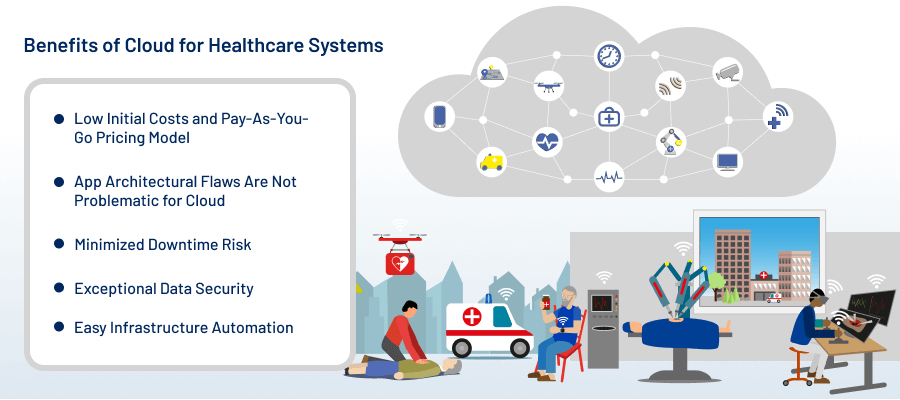
The first and most evident reason for using cloud computing in healthcare is the lower initial cost. If you select on-premises, hardware, peripherals, necessary software, and extra security provisioning effort — all these expenses lie on your shoulders even before you start using the infrastructure and gain value.
Therefore, it’s not just about money, it’s also about the time needed for local data center preparation. This is most noticeable for small and medium-sized medical facilities that have tight budgets but operate large data volumes and need quick access to their IT infrastructure.
Using cloud servers hardware-related hassles are none of your concern; they lie on your provider. Therefore, you may start leveraging your infrastructure right away, without capital investments in its deployment and configurations.
Freedom to Pay As You Go
Let’s consider the following example. You have a chain of clinics scattered across different regions of your country. Each clinic has its unique price list for medical services. And you need to update the prices for all the facilities of the chain.
Taking note of data volume, you may require huge computing capacities to do that. But you need them one time or occasionally, as it’s quite unlikely that you do such recalculations permanently. The cloud definitely wins an on-premises data center since it allows you to pay for the resources you actually consume.
Therefore, you have a chance to significantly save your money on cloud services for healthcare. Say, when you need to process a vast amount of data, you launch the virtual machine at nighttime when the price for cloud computing capacities is lower. Gain the result, record it in the database, and stop using the service.
Cloud providers also offer such a service as Lambda, that alleviates the load on the server and allows you to proceed with calculations faster, despite the amount of requests. These calculations we mentioned above can be done in quite a short time and will not affect other workflows.
The situation is completely different when you use an on-premises data center. In this case, you don’t have an out-of-the-box solution to help you with calculations — you’ll have to do it all with your own effort. As a result, you’ll gain the output in one or two days instead of several hours like in the case with the cloud.
Cloud is More Inclined to Forgive Application Architectural Flaws
Let’s continue discussing the example with price list recalculations from the previous paragraph and why using cloud computing in healthcare is much more reasonable. If, at the design phase, the function of recalculations was not stipulated in your architecture, you may gain additional headaches when using the on-premises infrastructure.
If the application architecture was designed with flaws, some critical points were omitted — most likely, you would have to fix it manually when using an on-premises data center. Architecture review and redesign will take time and additional resources, which is disappointing, but there’s no other way to fix the issue.
The cloud is much more flexible and may forgive some architectural flaws. Why? Because of the wide set of out-of-the-box solutions it offers to users. When your application lacks something, the cloud can cover this need if the feature exists, of course.
Read about the Migration of a Legacy App to the Cloud
Fault-Tolerance and Downtime Risks Minimization
The usage of cloud computing in healthcare significantly mitigates the risks of downtime. Do you remember the story about the fire at one of the European data centers?
If you are a medical facility relying only on one DC, this scenario might resemble a horror movie. You are entirely cut off from your data, which automatically means that your workflows are frozen and you can’t provide any services to your patients until the consequences are eliminated.
Yes, cataclysms and force majeure happen, or your data center may require electric wiring changes or other maintenance works. If there are several data centers at your disposal, you may easily switch to spare capacities. But if you can’t afford the luxury of maintaining several data centers, it’s better to think thrice before selecting this hosting option.
As a rule, cloud providers offer several rehab zones. This means that when something happens in one DC — they switch you to another smoothly, and you don’t lose control over the infrastructure and mission-critical data.
Exceptional Data Security
Some think that using cloud computing in healthcare is irrational from a security standpoint. Many medical companies prefer keeping their data closer to themselves and erroneously believe it’s the best way to ensure their safety. If you think so, too, let’s consider a vivid example.
You own a medical center, and your infrastructure is deployed at on-premises servers. All the hardware is located and maintained in the same building. Moreover, the clinic’s address is in public access, so a potential intruder already has the information about the location, which is already half the battle.
Have you ever seen the information about cloud providers’ data centers’ exact locations? Very unlikely, and as a rule, they take exceptional security measures, which greatly hampers unauthorized access.
However, physical intrusion is still not everything. How about potential data breaches and unauthorized access to the infrastructure, you may ask? Cloud providers have their answer for this matter.
If you select a reliable cloud platform, 99.9% that it takes robust information security and encryption measures and is compliant with HIPAA requirements. What does this mean?
When you launch the virtual machine to process your sensitive data in the cloud, they are not cached and don’t remain there. All the data you operate with, are guaranteed to be deleted from the server, and nobody, including the cloud provider, can access them.
Discover how to Safeguard Healthcare Data
In-House DevOps Skills Are of Lesser Importance Than in the Case of On-Premises
If you manage your local data center, mastery of your in-house DevOps team is of paramount importance. The on-premises infrastructure differs radically from the one offered by the cloud, and there are no out-of-the-box solutions and configurations. It means that your team has to maintain the environment manually, and that’s why using cloud computing in healthcare is much more reasonable.
For example, cloud providers offer automated backups, which guarantees data retention. In your on-premises data center, backups are your responsibility. Why is it risky?
Even if your IT specialists do backups, they may do it on the same server just by inexperience. Do you grasp the idea? If a force majeure occurs, there’s no need to think long about what happens next — your server dies, and the backup dies, too.
Best Model of Cloud Computing in the Healthcare Industry. Public, Private, or a Combo?
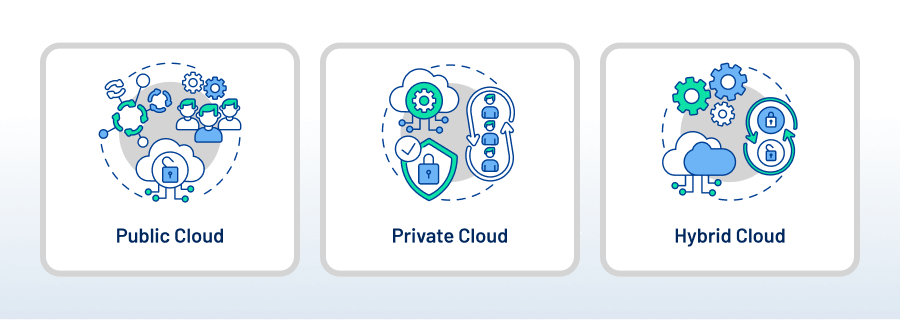
Cloud models are divided into three types — public, private, and hybrid.
|
Public Cloud
|
Private Cloud
|
Hybrid Cloud
|
|---|---|---|
| The server is publicly accessible and has access to the Internet. The model offers great scaling opportunities. | The server has Internet access only, which ensures full control over your environment and exceptional security of sensitive data. | The synergy of both models allows exceptional scalability without compromising data integrity. |
Healthcare operates huge volumes of sensitive data that obviously must be hidden from the public eye. Meanwhile, there is a need to conduct research, build predictions at state or regional levels, and educate medical students. But how can this be done without data?
Of course, the question is rhetorical, and third parties must be able to access medical data for these purposes. But with one important condition: this information must be impersonal.
You may have guessed that the most optimal model of cloud computing in healthcare selected by service providers is the hybrid one. Raw data with all patient personal details, like name, surname, birth date, and anamneses, is intended for medical staff only and must be stored on a private server. After filtering and processing, data are anonymized so they can be shared with third parties through the public model.
Challenges When Implementing Cloud Computing in the Medical Field. Do They Exist?
There are multiple benefits of cloud computing in healthcare if you want to automate your infrastructure management and cut costs without compromising data security and integrity. But are there any intricacies that must be considered when opting for the cloud? Yes, there are some worth mentioning.
Irrational Set of Configurations that May Cost a Pretty Penny

Read about How to Cut Spending with Cloud Cost Optimization
Say, you own a small specialized medical center using the cloud for data management. Without a second thought, you select a database intended for storage of colossal data volume or leverage computational capacities that you don’t really need. Such an approach could have been a great solution for an international chain of clinics, but exactly not for a small or even mid-sized medical center.
Sure thing, you may not notice that you pay a lot for unneeded services at the early stages of cloud usage. However, it can be rolled back, and you are free to reconfigure your infrastructure or select another database. But with one caveat — nobody will charge you back for unused resources.
We’ll provide the right solution to handle your data.
Strive to reduce costs for data management in the cloud without compromising its security? It’s a breeze.
Risk of Infrastructure Access Keys Leakage

Forgot to switch off a laptop, accidentally sent a message with access keys in a common chat, or downloaded them on a publicly available server — and voila, they get into the hands of third parties. Since the infrastructure is deployed in the cloud, anybody with a key can access a server or a database.
However, even this risk of using cloud computing in healthcare can be mitigated. Everything you need is to properly configure your infrastructure security within the environment.
Artificial Intelligence. Tangible Treat or the Hottest Trend in Cloud Computing for Healthcare?
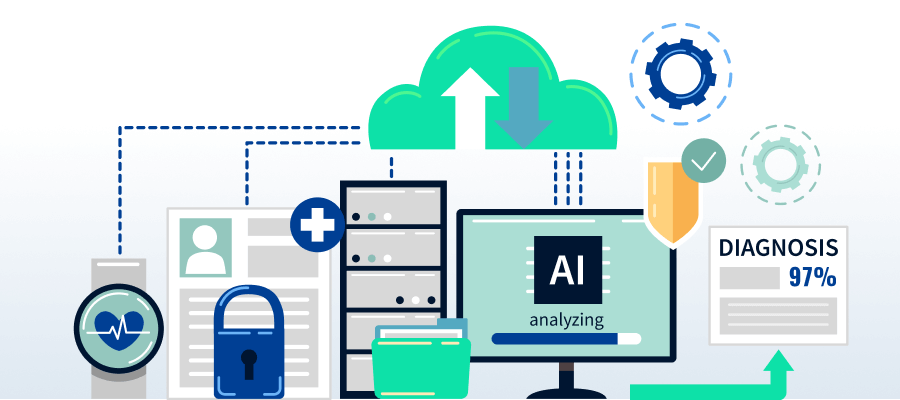
More than a decade ago, IBM created a supercomputer named Watson, and doctors from different locations could use it for diagnoses. How? The AI-powered system analyzed patients’ anamneses, medical research, and other historical data and offered possible diagnoses and treatment methods.
Another vivid example is related to the problem of reserve antibiotics, which Artificial Intelligence also helped to address. For instance, nowadays multiple bacteria are resistant to a wide range of existent antibiotics. How do you think, how much time would it require of a human to create unique ones, effective against all bacteria types?
In contrast to a human, Artificial Intelligence conducts data analysis quickly and accurately. It has already offered a variety of recipes that are now being tested.
Seemingly, cloud-based AI tools are indispensable for health workers, but it still has its limitations. First, it’s quite risky to give it access to raw patient data since they will become publicly available. Second, the technology is costly, and its usage is far from reasonable from a sustainability standpoint.
The issue is that each new generation of neural networks consumes an increasing number of tokens and requires significantly more resources. Consequently, it’s only a matter of time before it hits a power limit. Therefore, in 3-5 years, each request to the network may take not seconds or minutes, but hours or even days to process.
Learn more about Artificial Intelligence in Healthcare
Cloud Computing in Medicine: Is the Game Worth the Candle?
Cloud computing in healthcare may be a real game-changer with the right approach. In comparison with on-premises servers, it features exceptional flexibility and fault tolerance and guarantees unrivaled data security at lower costs.
However, the cloud is unable to reduce expenses by default. Irrational configuration selection and usage of unneeded resources may hit your wallet hard. To prevent this from happening, we recommend you select a reliable service provider and carefully elaborate your cloud implementation strategy.
Our team is proficient in both healthcare software development and cloud computing technology. Drop us a line, our professionals will guide you through all the steps of infrastructure orchestration — from strategy definition to its optimization.