
A variety of Blockchain technologies on the market sometimes confuses those trying to select one for their businesses. Not an easy task, taking note of the fact that each has its strengths and weaknesses and is sharpened by certain aims you may pursue.
The situation is exacerbated by the emergence of new blockchain technologies. For instance, until recently, among the most high-speed and scalable platforms, Solana was considered to be the best option in the view of many. Until 2022, when another powerful player stepped in — here we mean Aptos, of course.
Aptos has quickly garnered attention as both a secure and scalable solution, sparking discussions around its potential to surpass Solana in the near future. With its advanced consensus mechanism and unique technical foundation, many call Aptos a potential “Solana-killer”.
But why is Aptos generating so much buzz in the blockchain development world? What features make it a serious Solana competitor, capable of possibly displacing it as a leading blockchain platform? Let’s break it down, compare these two technologies, and see if Aptos truly lives up to the hype.
What’s Aptos and Solana? General Overview of the Rivals
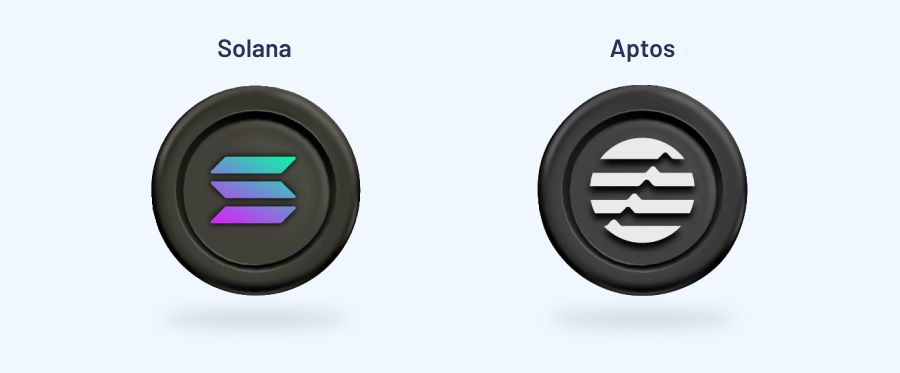
Both Aptos and Solana are 1-level blockchain platforms that claim to be highly scalable yet secure. Below, let’s review some facts related to these projects and distinguish their high-level similarities and distinctions.
|
Quick fact
|
Solana
|
Aptos
|
|---|---|---|
| Release date | 2020 | 2022 |
| Transactions per second | up to 65k | up to 130k |
| Project token | sol | apt |
| Capitalization | $8.8 billion | $2.4 billion |
| Token cost | $23 | $14 |
Solana
This blockchain platform was launched in 2020 and quickly gained huge popularity due to its capability to process up to 65,000 transactions per second, which couldn’t be offered by other competitors presented on the market at that time.
This high throughput is achieved via the combination of two consensus mechanisms, Proof of Stake (PoS) and Proof of History (PoH), which allows to process transactions at a very high speed.
In addition to speed, Solana’s low-cost transaction fees have been another upside for developers and users looking for a blockchain solution. Unlike many other competing platforms, where transaction fees rise sky-high during peak usage, Solana’s design keeps costs affordable even under heavy load.
This speed + low fees combo has made Solana especially attractive for high-demand applications, such as including decentralized finance (DeFi) platforms, non-fungible tokens (NFTs), and blockchain-based gaming, all of which rely on rapid, low-cost transactions to deliver seamless user experiences.
Check out how we created a Decentralized Exchange Development for an NFT Marketplace
Aptos
Aptos was released only two years later, in 2022, by a team of Meta ex-engineers. Founders concentrated on delivering a highly flexible, fault-tolerant, yet ultimately secure platform at the lowest possible fees.
As you can see from the table above, they succeeded, and the token price is even lower than Solana offers, which makes the platform accessible to new investors and smaller-scale developers. Also, founders learned the lessons of other blockchain platforms struggling with scalability issues and transaction speed and concentrated on the technical aspects of the project.
To deliver a technically flawless product, the Aptos team selected Move, a unique programming language originally developed by Meta. Move’s features enable Aptos to support complex, highly secure decentralized applications, minimizing the risk of errors and vulnerabilities.
This choice has resulted in a platform that is particularly appealing to developers who need advanced flexibility and robust security without compromising on user-friendliness. Due to a strong technical component, many consider Aptos as a definite Solana killer.
Check out why Blockchain in Finance Is the Next Big Thing
Determining a Front-Runner. Strengths and Weaknesses of the Blockchains
There’s no ideal one-fits-all solution, and this concept appeals to blockchain platforms as well. In this part, let’s compare Aptos vs. Solana and go over some characteristics and aspects inherent to these two rivals so you can select which one suits you best.
Transaction Commissions

Due to this, Aptos token cost is lower in comparison with Solana, which has already acquired its extensive client base since its release in 2020. However, there is another side to the coin. Although Solana is an option of choice for those seeking relatively low commissions (it’s especially attractive for such spheres as micropayments and DeFi), you should be ready for frequent delays caused by high loads.
Transactions Per Second and Fault-Tolerance

Aptos strives to reach up to 160,000 transactions per second, and at the moment, its network hasn’t undergone serious failures yet, owing to its original and innovative architectural solutions.
However, it’s worth mentioning that Aptos is still relatively new, having only launched in 2022, so it hasn’t yet achieved the widespread adoption and market recognition that Solana enjoys at the moment. Solana’s head start has given it a larger user base and a more established developer ecosystem, which Aptos is actively working on to build.
Programming Language and Smart Contracts

Such an architectural solution ensures high system performance, maintains data integrity, and minimizes the possibility of conflicts during simultaneous transaction processing. Moreover, it is worth noting that parallel processing also supports network load distribution, which gives Aptos all chances to reach its aim of high bandwidth and safeguard platform users from poor experience caused by slowed processing.
Another unquestionable advantage of Move is strict security principles, such as access control and immutable data records, which are especially critical for financial operations. Therefore, this programming language is an option of choice if there is a need to create highly secure and fault-tolerant smart contracts.
Unlike Aptos, Solana supports smart contract creation with such popular languages as Rust and C, which were not initially designed for working with blockchain. Therefore, parallel processing implementation requires more complex optimizations.
The thing is that, unlike Move, these languages do not support parallel processing at the level of smart contracts, which requires more effort from the side of software developers. Put simply, they have to structure the contracts, taking note of all the network specifics. It may be a challenging task to tackle, especially for those who lack expertise in blockchain development.
Read about Key Things to Know About Smart Contract Development
Different Consensus Mechanisms

As for Solana, this platform utilizes a combination of two mechanisms mentioned above — Proof of History and Proof of Stake, and this combo allows it to process transactions quickly and efficiently, making it a robust choice for applications requiring fast, low-cost transactions.
PoH allows inserting timestamps into each transaction to establish an exact order of events without the necessity to wait for confirmation from other nodes. This approach significantly speeds up transaction processing since there’s no need for frequent synchronizations between the nodes for correct order establishment.
PoS is another consensus mechanism utilized by Solana, which is responsible for blocks’ validation and endorsement. With PoS, network participants are selected based on the quantity of SOL tokens they “stake”, increasing their likelihood of being chosen to validate the next block. This approach not only reduces energy consumption but also enhances security by aligning validator incentives with network integrity.
Aptos took a different path. As a consensus mechanism, they selected Byzantine Fault Tolerant (BTF), which was initially developed for the Diem blockchain (as we remember, Move programming language was also selected on the same principle). This type of mechanism is aimed at network resilience improvement, which helps the system operate sustainably despite the occurrence of inadequately functioning nodes.
The system works as follows: validators agree on each stage of block addition, which allows Aptos to prevent occasional or deliberate errors and ensure ultimate security even in case of network disruption. In other words, if a conflict arises between nodes, the BTF system continues operating and reaching consensus.
Read how we delivered a Blockchain-Based Intrusion Detection System
Dispersing the Mist Over the Future. Can Aptos Be Called a Solana Killer?

Many express an opinion that this scenario is inevitable. However, it’s better not to jump to conclusions since it’s too early to judge. Yes, Solana has its performance and optimization issues. However, it’s already a well-established brand with an extensive range of users, which gives it an unquestionable competitive edge.
That’s why ultimately killing Solana is not an easy task to tackle for its rival. Undeniably, the Aptos engineers did a great job in terms of technical implementation. It’s robust, fault-tolerant, maximally secure, and Aptos token cost is lower than Solana’s. But despite that, building a strong developer community and driving adoption is essential for long-term success, and this project is still in the very beginning of this thorny path.
Obviously, Aptos engineers have delivered a platform that addresses most of the shortcomings of existing established blockchains. However, a significant user shift from Solana to Aptos will definitely require more time, substantial ecosystem growth, and perhaps an ongoing track record of reliability that proves Aptos can consistently deliver on its promises.
Are you swinning between these two options and have no idea which is better for your business? Need a proficient engineering team well-versed in blockchain development and its implementation? Don’t hesitate to contact us; we’ll guide you along this path!