
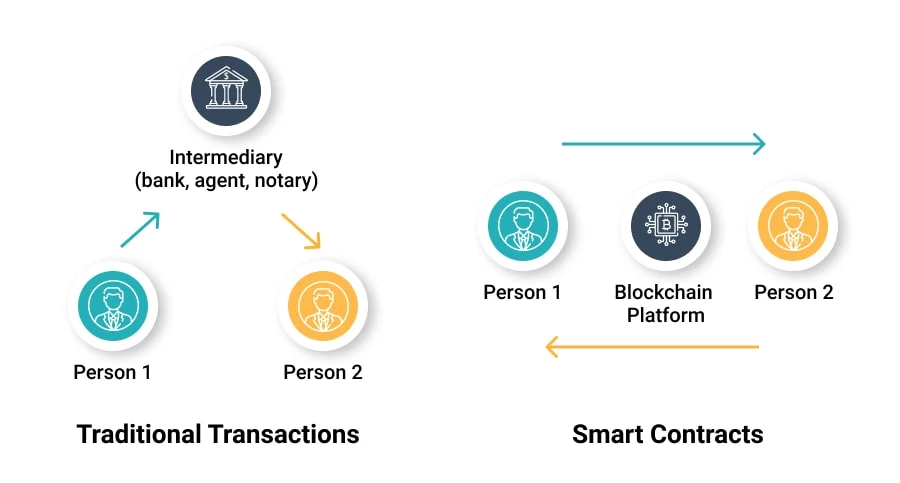
Imagine any process that requires a contract and extensive paperwork. For example, selling a house or registering a car. Such transactions between different stakeholders who don’t really know each other need an intermediary.
Middlemen can oversee the deal and facilitate its completion. However, they don’t work for free but charge a commission which can be a substantial sum. Here, smart contracts can come in and ease the entire process.

Before we get into all the details, you should know that the global smart contracts market size is set to reach $345.4 million by 2026. With rising blockchain popularity and use cases across industries, smart contracts development is certainly something that progressive companies shouldn’t overlook.
Today, we will help you understand what smart contracts are, how they work, as well as their benefits and use case examples.
What Are Blockchain-Based Smart Contracts?
In simple terms, a smart contract helps verify, control, and execute an agreement digitally. It’s a program, stored on the blockchain, that is set to run when predefined criteria are met. In essence, they help eliminate the middleman by automating the execution of an arrangement.
For example, in the case of selling a house, a smart contract can perform the tasks of an estate agent thanks to its self-executing ability. All the necessary terms are preprogrammed into the code, and if all conditions are met — the deal goes through. Just like that, there’s no longer any need to pay a commission.
How Do Smart Contracts Work?
Many smart contracts are based on Ethereum. It is a decentralized, open-source, blockchain platform with its very own cryptocurrency — Ether. Unlike Bitcoin, Ethereum was created to be more than an exchange medium. Besides helping trade cryptocurrency and digital assets, it also has program logic capabilities for smart contract transactions and building of decentralized apps. Hence, Ethereum smart contracts are what you’ll most often come across, since Bitcoin ones are less widespread.
Discover how Velvetech helped build a secure cryptocurrency mining browser
To give you a better understanding of how smart contracts actually work, we can compare them to vending machines.
With an automat, you simply feed it money, select the product, wait for the machine to verify that your bills aren’t fake, and hand you the chosen snack. It’s a simple agreement execution where the algorithms in the machine act as a middleman. If you didn’t provide viable bills — you get them back and don’t receive the product. If your cash was legitimate — it goes to the vendor while you quickly get the food you wanted.
So, how does a smart contract work? In a similar way. By following an “if/when” principle, a blockchain-based smart contract is only executed when predetermined conditions are met and verified. Moreover, you can include as many stipulations as you deem necessary to ensure the agreement satisfies both sides. Hence, it’s an excellent way of getting what you want without enlisting the help of third-parties.
Benefits of Smart Contracts
Security

Costs

Transparency

Speed

Smart Contract Examples Across Industries
Smart contracts have a lot of potential and can be sought after by players from various industries.
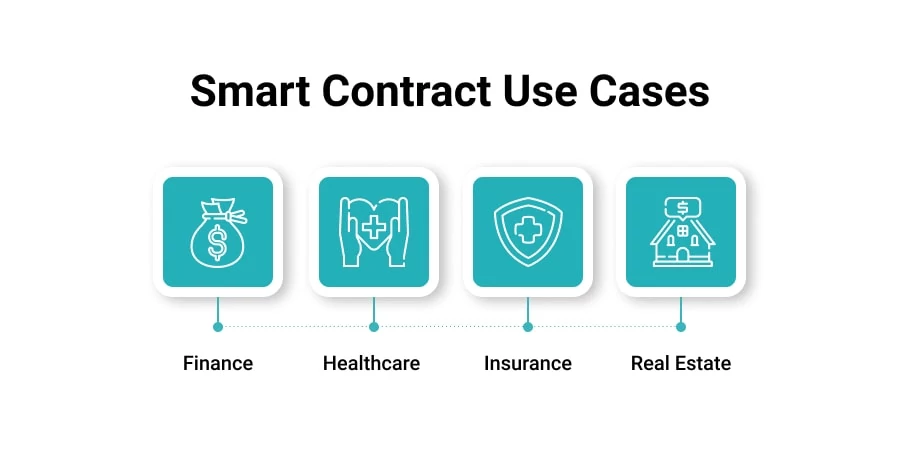
Despite caution surrounding new technologies, some industries are already embracing smart contracts development. Let’s take a deeper look at use cases in finance, healthcare, insurance, and real estate.
Finance
The financial services industry can see great value from this technology.
In investment banking, loan settlement cycles can be reduced by half thanks to the quicker processing time that smart contracts provide. As a result, clients are happy about the increased speed of the process and customer experience improves.
At the same time, investment banks themselves observe lower operational costs thanks to the boost of efficiency. It’s a win-win opportunity for everyone involved.
Healthcare
In healthcare, patient medical records are of utmost value and often become targets of cyberattacks. Thus, industry leaders continuously work on increasing security measures to protect electronic health records and sensitive data.
With blockchain and smart contracts, health records can be securely stored and encrypted with access granted to specific, predetermined individuals. Also, things like prescription fillings can be automated, leading to a decreased processing time and better patient experience.
Insurance
The insurance industry is often plagued with long claim processing times and money wasted on fraudulent claims.
By turning to smart contracts, insurance providers can see significant cost savings because of automation and reduced overheads in claim handling. Lower processing time leads to money saving opportunities which can also benefit customers.
If insurers gain a way to cut costs, they might be willing to share that “win” with clients in the form of lower premiums. It’s kind of like a domino effect on various areas of the business.
Explore 7 Essential Features of Insurance Policy Management Software
Real Estate
In real estate, smart contracts are typically used to record and transfer property ownership. A buyer usually doesn’t want to send over the money before having the property in his name. Similarly, a seller is hesitant to transmit ownership before receiving funds. Until now, third parties were a must-have to fulfill an agreement. That doesn’t have to be the case any longer.
This way you can reduce the need for intermediaries like lawyers or brokers, thus optimizing the speed of the transaction. The buyer and seller can sleep soundly knowing that they don’t risk anything by following through with their side of the arrangement.
The contract will only be executed if the seller transfers the property and the buyer hands over the money. It’s a transparent, secure, and fast way of transferring ownership.
Things to Consider When Developing a Smart Contract
You might now get excited about all the opportunities smart contracts can bring. However, we feel it’s also important to explore the constraints you could face when starting the development.
Every new technology can face roadblocks on its way to mainstream adoption. Hence, let’s take a look at the limitations of smart contracts so you can decide if they’re something you want to invest in.
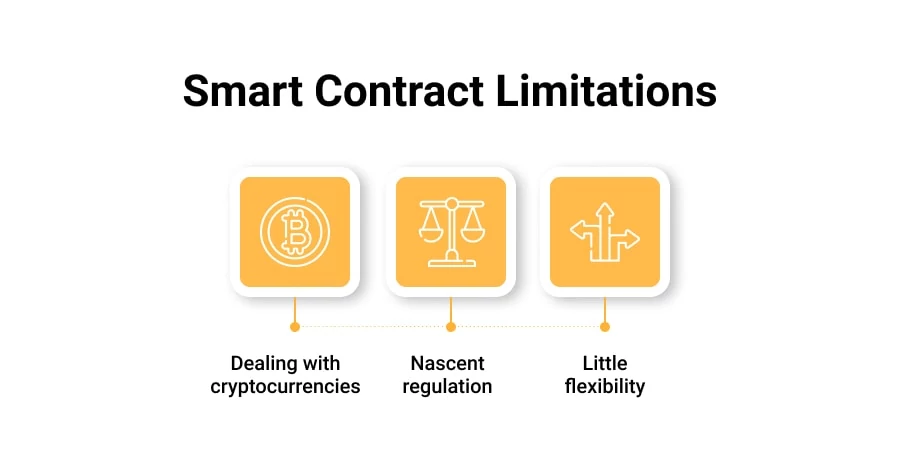
1. You have to deal with cryptocurrencies
Smart contracts are built on blockchain technology, therefore digital currencies like Ether are used for payment. If your business already has some experience with blockchain platforms or is willing to start the journey — you’ll likely not face a problem.
However, if blockchain sounds completely outside your current realm of possibilities and you have other digital initiatives to prioritize — this type of project might need to wait.
2. Regulation is still nascent
Smart contracts are executed digitally, and the blockchain system has no consistent policy as of today. It leads to a variety of questions relating to taxes and government involvement if something unexpected happens.
Regulatory concerns force some businesses to hesitate before starting smart contract development.
3. There’s little flexibility to make changes
Since smart contracts are only carried out on an “if/when” basis, there’s little space for variations. Whatever you’ve set as predetermined conditions is what will stay until the contract is automatically executed.
Moreover, a smart contract operates solely on objective facts. Hence, subjective judgments have no place here, making it a less flexible agreement method.
How to Choose the Right Company for Your Smart Contract?
Now that you know some potential smart contract use cases and are confident that it’s something worth looking into for your company, it’s time to think about how to approach the smart contract development process.
First, you should understand what you need a smart contract for. Do you want to use it to verify transactions or transfer payments? In which business area do you plan to implement it?
If you don’t have a clear idea about where to start — that’s okay. You can begin by talking to professionals about blockchain development services and learning more about how smart contracts can help with your specific needs.
Whether you need a brand new software product or enhancement of an existing system — don’t hesitate to reach out! We take a personalized approach with all our projects and look forward to helping you embrace emerging technologies for business growth