
Only several decades ago learning boiled down to just lectures and reading paper books. With the emergence of technology and its rapid development pace, the approach to education has already undergone significant changes. And obviously, it’s not the end.
Since the advent of augmented and virtual reality, studying opportunities have dramatically expanded. These technologies allow students to immerse themselves in interactive, hands-on experiences that were previously impossible. They enable learners to explore virtual environments, conduct simulations, and interact with educational content in a more engaging way.
All so, however, nothing is perfect, and the technology obviously has serious drawbacks and technical limitations. While these issues don’t negate the benefits of VR and AR in education, it’s essential to use these tools wisely, keeping potential downsides in mind. After all, being informed is the best way to ensure effective and thoughtful implementation, isn’t it?
If you have long wanted to implement AR/VR into your educational software, this blog post is just for you. In this article, let’s dive into the specifics of the technology and discuss its good and bad, so you can decide if the game is worth the candle.
Starting with Basics. What’s Augmented and Virtual Reality in Education
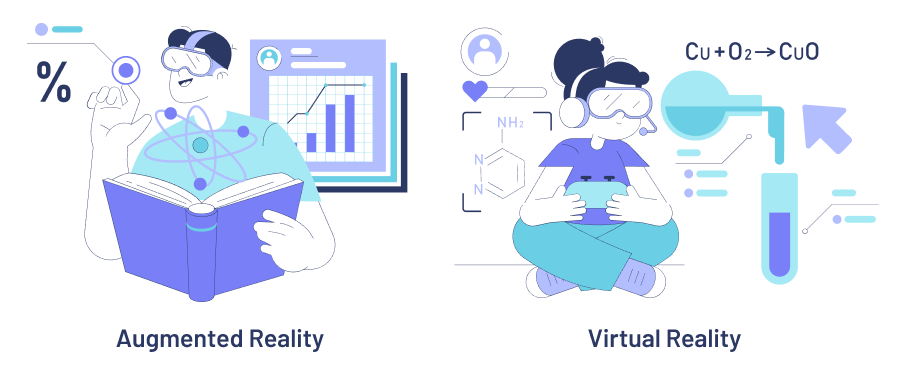
First, let’s start from a brief explanation of these two concepts and why VR and AR are being actively used in education.
Virtual Reality
The capabilities of VR technology in education allow users to fully immerse themselves in an artificially created digital environment — in other words, it’s an effect of full presence. With special equipment, such as virtual glasses or a helmet, you can change the real world around you at the snap of a finger.
A vivid example here is a flight simulator used for pilot training. Rather than risking lives and expensive equipment in real-world training, VR technology in aviation education allows pilots to safely practice controlling aircraft under different conditions, replicating complex and dangerous scenarios without real-life risks. This immersive environment helps learners build practical skills, improve decision-making, and face challenges that would be difficult or even impossible to reproduce safely in reality.
Augmented Reality
Unlike VR, augmented reality is unable to immerse you into a virtual world and provide you with a feeling of full presence. It can only add some virtual objects to the real world, saving the perception of the surrounding environment.
Let’s consider an example of using AR in school education. At the moment, we have a chemistry class and an experiment demonstration. Students sit not in the virtual reality classroom but in a real room and interact with a real teacher, while AR technology projects a 3D model of a chemical reaction right in front of them.
The use of AR for education allows learners to observe the process up close without the risks or constraints of handling actual chemicals. They can manipulate these virtual models, exploring molecular structures or seeing how compounds interact in real time, making abstract concepts much more tangible and easier to understand.
Explore Types, Benefits, and Challenges of Education App Development
Why Beneficial? How AR/VR Are Used in Education & Training
Incomprehensible Becomes Easy to Understand

Since a learner can’t behold the process with their own eyes, it is perceived to happen just like make-believe. One of the biggest advantages of VR and AR in education is that students don’t have to rely solely on their imagination. Instead, they can step into a fully immersive environment or view a 3D hologram of an atom right on their desk and observe nuclear processes in real time.
Sure thing, this option is much more engaging and captivating, and the probability that learners will really grasp the process is much higher than in the case of flipping through a book. However, it’s only one example of using augmented and virtual reality in education; just imagine how it can be applied in other subjects, such as history, geography, or biology!
Safety Comes First

One wrong move — and something irreparable may occur. That’s why it’s far safer and more practical to use a flight simulator, allowing trainees to experience real-life scenarios in a controlled, risk-free environment. The trainee can learn to handle critical situations, navigate complex maneuvers, and make decisions without any real-world dangers, which is one of the greatest benefits of virtual reality in education.
Think such hazardous situations take place only in such areas as aviation? Not really. Let’s move on to a chemistry class at school, where we have laboratory work. Not all pupils meticulously observe safety precautions. Not all pupils are careful with reagents. Ultimately, some are too curious and may pour water into acid to verify the result empirically.
With augmented or virtual reality used in the classroom, students are empowered to do whatever they want without any harm to themselves and those nearby. A teacher can demonstrate any, even dangerous experiences, so pupils can see what happens with their own eyes. And what’s more important, they themselves can repeat manipulations as much as needed to sharpen their skills.
Easy Simulation of Emergency Situations

However, agree that facing the challenge in reality is not even close to reading about it. That’s why it’s impossible to predict how a trainee will act if it really occurs.
Using virtual reality in such specialized education is a great solution here. It’s possible to envisage multiple emergency scenarios that take place rarely in real life.
One of the key profits of VR in education is that the technology provides immersive, realistic practice in handling life-threatening situations, helping trainees sharpen crucial decision-making and response skills. With VR, they can fail safely, learn from their mistakes, and be better prepared for the rare but critical moments they might come across in their careers.
Higher Learning Speed Combined with a Lower Probability of Mistakes

The experiment involved 16 post-graduate surgeons divided into two groups. The first group had standard training, while the second gained additional workshops in virtual reality.
The results of the experiment were truly impressive. Surgeons who underwent VR training managed to conduct the surgery 29% faster than those who didn’t. Moreover, the first group was nine times more likely to make mistakes, and the likelihood of damaging the gallbladder or burning non-target tissue was five times higher among students who trained without VR.
Learn about Medical Education Software, Its Specifics and Challenges
Deterrents to Common Use. Side Effects of Using AR/VR in Education
While there are a lot of benefits augmented and virtual reality can offer, there’s no good without bad. Let’s move on to the drawbacks of AR and the disadvantages of VR in education.
Risk of Excessive Gamification of the Learning Process
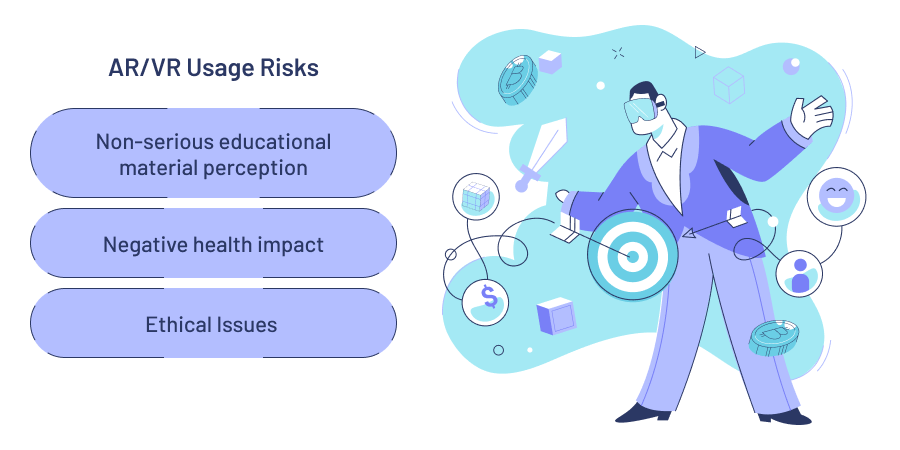
The possibility of turning a lesson into a game is usually presented as an unconditional upside of using augmented and virtual reality in education for schoolchildren. However, there’s a risk that students may start to see the educational content as mere entertainment rather than something crucial and worth their focused attention.
If the line between learning and play becomes too blurred, students may not take the lessons seriously, which leads to a lack of discipline and effort in mastering the material. Here’s why it’s essential to strike a balance between using gamification to maintain engagement and ensuring students understand the importance of what they’re learning.
Meanwhile, this principle is relevant not only for kids but for adults, too. Let’s refer to the example of firefighters who were offered to undergo VR training. Even though these emergency scenarios are maximally close to real, being aware that it’s just an illusion, learners may not take it seriously as well.
Distorted Perception of What Is Happening and Negative Health Impact
This can also work in reverse. Besides excessive gamification and non-serious perception of VR and AR in education, there’s also a danger that learners may forget that it’s just an illusion. This will inevitably have side effects and a negative impact on a learner’s health.
For example, when modeling an emergency situation, a learner can experience a panic attack. Or if interaction with VR and AR is long and takes place on a regular basis, there are risks of visual impairments or, which is way more serious, even diminished cognitive abilities.
A vivid example here may be a gamer spending days and nights playing virtual games and getting addicted to them. As a result, they are unable to break away from such an attractive and colorful world; therefore, their perception of reality changes significantly.
Ethical Question
This point is closely intertwined with the previous one, where we speak about the distorted perception of the events happening when learners use augmented and virtual reality in education. Obviously, when we model situations, we need them to be as realistic as possible. However, it’s better not to forget about the ethical side of the issue.
Let’s get back to the example of firefighters. For instance, we have a virtual program where a trainee must save people from a building on fire. If we want it to be as realistic as possible, we might want to detail it.
However, at the very beginning of their career, even firefighters who seem to have a full understanding of what they might face (for instance, severely injured people) may turn out to be too impressionable and receptive. That’s why this is the factor that must be carefully considered as well, and it’s only up to you whether to make virtual reality as accurate as possible.
Technical Side of the Issue. Challenges and Constraints of Technology Implementation
Huge Computational Powers Are Required
Are you ready to reconcile with constant interruptions, delays, and glitches when using AR and VR in education? Apparently not.
To ensure smooth streaming and gain clear pictures of subjects generated on a server, you can’t do without significant computational powers and wide bandwidth. Besides, you also shouldn’t forget about router speed, which may have an impact as well.
And here, we face the question: whether we should use on-prem or cloud for these purposes? Usually, the cloud infrastructure is a more effective, safe, and cost-efficient solution, but in this case, it can hardly be so. The issue is that if servers, where your cloud solution is deployed, are situated at a considerable distance, you’ll inevitably experience some delays. This might be critical if you strive to reach a high degree of immersion into virtual reality.
Read about Cloud Integration and How to Build Bridges Between the Elements of Your Infrastructure
Yes, local servers can be a rescue here. The closer your data center is located, the better — in this case, you will hardly experience any glitches. However, as we all know, establishing your own DC is not a cheap pleasure, that’s why, be prepared to fork out for additional hardware.
Additional Roles in Development and Interaction with Subject Matter Experts
Hardware engineering and procurement, and software development itself is still not everything. Augmented and virtual reality in education and in any other sphere is impossible without the participation of 3D artists and even scriptwriters who would think over various scenarios.
Even if the engagement of 3D artists is quite obvious (someone has to draw objects, right?), the involvement of scriptwriters or directors may seem to be an excessive and expensive whim. However, if we speak about virtual training for security forces or emergency services, close interaction with subject-matter experts is essential. Because it’s only them who know the intricacies of their jobs and may elaborate on the creation of true-to-life scenarios for virtual educational programs.
Selection of Hardware and Software Technologies
Since such solutions as virtual and augmented reality in education are quite expensive both in terms of implementation and hardware, “create and forget” can hardly be an approach to follow here. More likely, you expect this investment to be long-term and desire to use the program for many years.
Yes, the technology is still actively evolving, and you have to reckon with this fact. Keep in mind that equipment can be broken or just become obsolete, as well as technologies your solution is developed with. That’s why our advice here is to think through the infrastructure of such projects with an eye to perspective for further evolvement, improvement, and modernization both in terms of technologies and content.
User-Driven Approach
To Wrap It Up
With all the benefits of virtual and augmented reality in education, starting from offering hands-on simulations and ending up with immersing students in ways traditional methods never could — they still can’t be considered a real blessing. Implementation expensiveness, possible mental and physical health impact, and technical and content limitations are the main challenges you’ll inevitably face.
To build a comprehensive and effective augmented or virtual reality solution for education, you need a reliable partner, well-versed in modern technologies and their implementation. Our team has a proven track record of creating high-quality educational software and will gladly help you with yours. Reach out to us, and let’s get started!