
The growing popularity of low-code/no-code platforms is no surprise, given the advantages they bring to customers. By opting for these systems, businesses can achieve a fully functional product at a fraction of the cost and in just weeks, rather than the years often required for custom development.
However, in most cases, relying solely on a low-code/no-code (LC/NC) solution may not be enough. You might need access to third-party databases or require functionality that the platform doesn’t offer out of the box. But don’t worry — this doesn’t mean you have to abandon the platform right away, having faced some of its limitations.
The key lies in fine-tuning integrations. By connecting your LC/NC solution with internal or external tools and systems or third-party databases, you receive new opportunities for further growth and development.
But how to conduct integrations of systems and databases in the context of low-code/no-code development? What should you look for when evaluating the integration capabilities of different platforms to choose the best fit for your needs? And if the time comes to migrate to a new LC/NC solution, how challenging is it to carry over existing integrations?
Continue reading to find out.
Why Low-code/No-code Integration Is an Important Venture

The first thing you must keep in mind is that low-code/no-code platforms represent a closed ecosystem in contrast to custom-made ones. Building your own solution from scratch, you are free to do anything you want within it, but this trick doesn’t work with an LC/NC solution, because you are limited to its capabilities.
That’s why it’s critically important to have an opportunity to integrate it with other systems, be they internal or external. Just to cover functionality the selected platform lacks in terms of performance, speed, cost, etc.
The good news is that low-code/no-code vendors are well aware of the limitations their platforms have. Keeping this in mind, they usually strive to offer rich integration opportunities to satisfy possible customer needs.
Failing that, the majority of customers would rest against limitations hindering further development, which would become a serious trigger for abandonment. As you understand, vendors are not interested in customer churn, that’s why they do their best to keep existing customers and acquire new ones.
Ways of Implementation. Types of LC/NC Integrations to Know About
Depending on what you intend to integrate, low-code/no-code vendors offer an array of options you are free to select from. Let’s review them in this paragraph.
External Integrations via API

Backend — Backend
As a rule, LC/NC platforms include low-code and no-code APIs created on the basis of such popular low-level protocols as REST or GraphQL. On top of that, usually, there’s one more open protocol intended for data exchange. For example, it can be OData, which is supported by many LC/NC solutions.
Additionally, since vendors have a strong interest in integration, they also offer ready-made libraries. Why? Because such an approach minimizes the integration threshold, and you don’t have to write an integration layer yourself. All is needed — implement an off-the-shelf library with the required programming language and enjoy smooth data exchange with a third-party system.
Backend — Frontend
Here, let’s consider the example of Shopify, which is the basis of many online stores worldwide. Despite the fact these marketplaces were constructed through the LC/NC platform, usually, they all have a unique, absolutely custom-made frontend.
The thing is that some LC/NC platforms incorporate a no-code or low-code API but lack a client-facing part. Hence, you create your own exclusive frontend written on technologies of your choice and integrate it with the platform’s backend. This class of system is called headless, and you can create not only a browser frontend for it but a mobile as well.
Internal Integrations

But keep in mind: to do that, you use the technologies this or that vendor utilizes within the system. Some have common languages, such as C# or TypeScript, and some leverage their self-developed ones (Salesforce is a vivid example here).
These low-code and no-code integrations can be conducted for both frontend and backend. Platforms usually offer their API or libraries to supplement the LC/NC system with custom code, so it could work as its integral part.
Read if Low-Code/No-Code and Traditional Development Are Competitors or a Powerful Duo
Let’s review an example from our own experience. Our team closely cooperates with the Creatio no-code platform, which supports code writing to extend application functionality, including the visual layer.
Recently, we developed Velvetel Pulse, an AI-powered contact center solution designed for omnichannel customer communications. Currently, this product operates exclusively within the Creatio ecosystem, enhancing its capabilities with features like cloud telephony, advanced call analytics, transcripts, and intelligent call management.
To make this integration seamless, our team built a custom connector for Creatio. This connector was essential to supplement the platform with the required functionality and give it the desired look and feel.
Plugins and Add-Ons

As a rule, you subscribe to the service and pay for it on a monthly or yearly basis. Also, these plugins can implement some ready-made low-code or no-code integrations. For example, you use Salesforce and want to implement an integration allowing you to download some data to Google Spreadsheets. All you need is to purchase the needed plugin in their marketplace and fine-tune the integration in several clicks.
What’s Complex? Things to Assess Before You Start Integrating
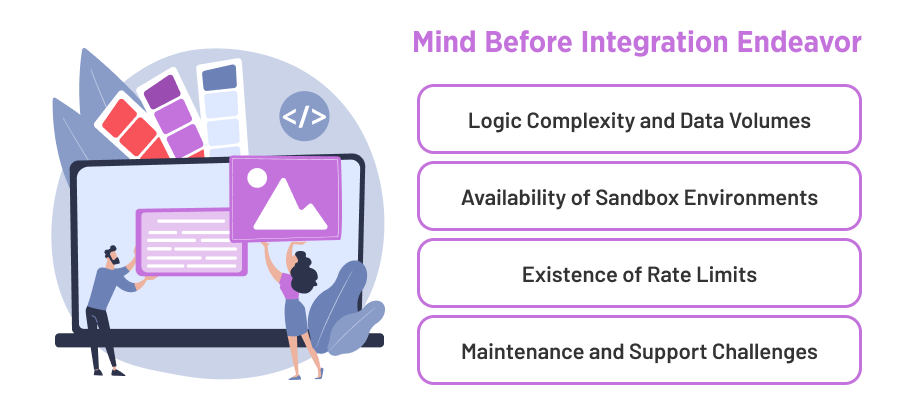
As you see, low-code/no-code platforms usually have great integration capabilities and in theory, it shouldn’t be a problem to synchronize things you need. However, it’s always easier said than done, so let’s review some aspects that may turn your integration endeavor into an adventure that’s far from simple.
Complex Integration Logic or Data Heterogeneity
Although a conditional low-code/no-code platform may provide all suitable tools, the abundance of tasks that the solution must fulfill determines the complexity of the integration. For example, at the moment, we are working on a project for an insurance broker offering health insurance services. Therefore, they have huge volumes of data coming from different systems in different formats.
The thing here is not the technical difficulty of the integration implementation. The key complexity lies in the scope of work; that’s why using low-code/no-code ETL platforms where you can conduct data mapping, processing, and cleansing can be a wise solution.
Check out how we delivered Data Automation Software for a Top Dental Insurance Consultant
Availability of Sandbox Environment at Hand
The abundance of various integration APIs is far not everything required from a good low-code/no-code platform. They may offer a huge variety of them but do not provide appropriate fine-tuning and testing tools to verify your integration.
Why is it important? Because if you have a sandbox environment, you have an opportunity to test your code without touching real data. This means that if something goes wrong, you don’t risk losing something or “breaking” the system. Agree, that this approach is much safer, so we strongly recommend you pay attention to this aspect when selecting a low-code/no-code vendor.
Set Rate Limits
This aspect can be a serious blocker for low-code and no-code integrations. For example, we have one API method to extract one record from the system. But if our aim is to read the entire database, we need to turn to the method one million times.
If your low-code/no-code platform has a rate limit of, let’s say, one request per second, you’ll need one million seconds to extract the entire database. Are you ready to wait that long?
Even though rate limits are not set or they are quite high, you still may face the restrictions. For example, you need to gain data for the previous year. If your vendor provides APIs allowing you to do batch reads, exports, or updates — these actions also would take time, but not that much. If not — you’ll have to turn to the required API one million times or even more to extract this data slice, and waiting time may be literally enormous even without any rate limits.
Maintenance and Support Challenges
Deep customization and integration with low-code/no-code platforms is impossible without vendor consultations or the help of issue resolution. Sooner or later you’ll inevitably face the situation when you won’t be able to proceed with fixes or fine-tunes yourself, without the participation of the vendor’s support team. All because the required actions may be non-obvious, and there’s always a risk of aggravating the issue even more if something is done wrong.
There are several specifics of interaction with the LC/NC platform’s support team that should be kept in mind. First, their service style may be slow and not of the highest quality. Second, to provide this or that support service, you may require some specific agreements with the vendor. Put simply, the service level may depend on the level of your existing partner agreement.
Third, certification-related issues. The majority of low-code-no-code platforms provide support services to certified developers only. Roughly speaking, you must undergo paid training to have the possibility to send inquiries to the support team.
Migration to Other LC/NC Platforms When Having a Bunch of Integrations. Is It Possible?
When you only launch your business, you strive to implement your idea as quickly as possible and with minimal expenses. Obviously, if you decide in favor of a low-code/no-code platform, you’ll pay attention to the price/quality ratio and keep in mind your future perspective not to rest against the limitations having barely started.
But there are cases when the growth is really explosive, and there comes a moment when the existing platform’s functionality is no longer enough. Meanwhile, you don’t intend to fully abandon LC/NC development. After the research, you realize that your platform’s competitor is able to provide you with everything you need and start thinking of transition. But is it possible to do it when all your processes are already tied to the existing platform and there are multiple low/code or no-code integrations that must be transferred as well?
If you expect an easy and positive scenario, we have to disappoint you. It’s impossible just to drag and drop everything you’ve accumulated in your existing system. Most likely, the migration endeavor will be comparable with the project built from the ground up. And here’s why.
Obviously, each LC/NC platform has its unique internal structure. This means that it will be impossible just to transfer your workflows and customization to another platform with the help of a conditional automated script. Put simply, the platform’s integration capabilities will allow you to extract the needed info for data migration, but won’t allow you to transfer all fine-tuned workflows automatically, and you’ll have to create them from scratch.
The good news is that vendors are interested in new clients and offer some assistance in migration. Don’t expect full support here; usually, you may count on basic services only. Unless you are a large-scale customer willing to fork out $10,000+ monthly to use the platform.
Go over our CRM Data Migration Checklist
To Wrap It Up
Integrations are essential when your business relies on a low-code/no-code platform. Fortunately, most vendors fully acknowledge this plain truth and strive to ensure that connecting tools, systems, and databases is as seamless as possible.
That said, every platform has its limitations, varying from one vendor to another. Selecting a platform that aligns with your business requirements and offers the necessary integration capabilities is crucial for long-term success.
Need help identifying the right solution or navigating integrations for your chosen low-code/no-code platform? Our team is here to guide you every step of the way. Reach out to us, and let’s make your systems work in sync!