
Business leaders are always keen to find new ways of speeding up processes, optimizing operations, and maximizing efficiencies. Hence, it’s of little surprise that the worldwide market of hyperautomation technologies is forecasted to reach $197.58 billion by 2032.
Despite the evident growth, some are still unfamiliar with what hyperautomation actually entails and how innovative artificial intelligence solutions play into it. So, today, that’s what we are going to shine some light on.
We’ll discuss automation vs. hyperautomation, top examples of the latter in business functions, and top use cases across industries. Let’s get started.
What Is Hyperautomation and How Does It Differ From Automation?
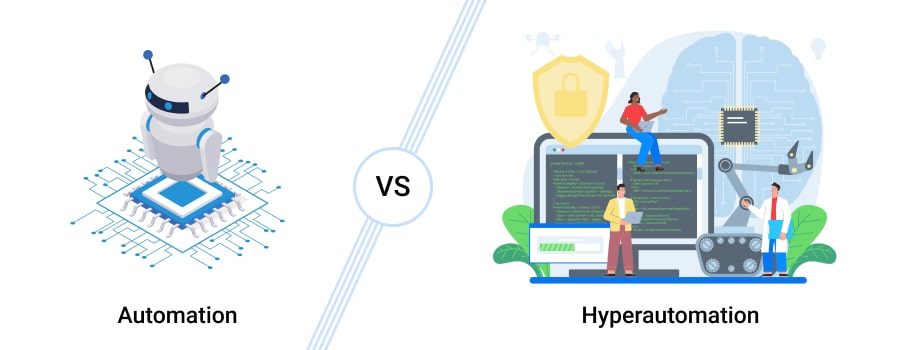
Hyperautomation is one of the top technology trends in business this year. So, it’s natural to wonder what is hyperautomation and how is it different from regular automation? Well, we are glad you asked because it’s worth making the distinction.
You see, while automation refers to the streamlining of individual tasks in separate organizational departments, hyperautomation builds on that concept. It is focused more on leveraging advanced technologies like artificial intelligence (AI), machine learning (ML), robotic process automation (RPA), and others to help optimize processes across the entire company.
Read up on the Role of AI in Business
While automation tends to occur on a smaller scale, hyperautomation relies on various tools to create an intelligent approach to the streamlining of manual labor through all areas of business. Concretely, it often involves the following technologies:
- Artificial intelligence
- Machine learning
- Data science tools
- RPA solutions
- Virtual assistants
- No-code and low-code software
Discover how a car dealer Automated Sales with a Low-Code CRM
GenAI for Business
Top Hyperautomation Use Cases in Business
Now that we’ve got the terminology out of the way, it’s time to discuss the specific benefits of hyperautomation in various business areas. First, let’s take a look at the use cases that are applicable in all kinds of industries.
Data Processing

You might be working with tons of invoices, bills, purchase orders, receipts, contracts, and other important records every single day. Some of them, if not all, might still be processed manually at your organization. Hyperautomation can get rid of that repetitive labor.
For example, important details from a document can be extracted and copied across all of your relevant databases with the help of optical character recognition (OCR) and natural language processing (NLP). Thus, avoiding the need to input information by hand into multiple platforms.
Additionally, you can leverage business intelligence tools to create easy-to-understand, interactive dashboards of the extracted insights. As you can imagine, this not only speeds up report generation but also allows you to quickly spot emerging patterns and take necessary action.
Find out how we Automated Document Processing for an Insurance Consultant
BI for Business
Customer Relationship Management

Generally, your sales staff deals with clients, prospects, and leads across a variety of touchpoints. They might fill out an online form, send an email, give you a call, message on social media, etc. Managing and centralizing all these interactions can be very time-consuming.
As a result, more and more organizations turn to low-code CRM platforms as they allow them to develop a holistic approach to customer care and don’t require advanced IT skills to set up. With a tool like Creatio CRM, you can swiftly develop automated, personalized communication efforts with clients across their entire journey with your brand.
Learn about the CRM Implementation for a FinTech Company
Further, these types of CRM solutions can be customized to fit the unique needs and challenges of your organization. Thus, allowing you to reap the rewards of automated sales, marketing, and customer service in a way that suits you best.
Besides CRMs, some businesses have found it lucrative to embrace AI-powered contact centers. Primarily because they not only deliver real-time call analytics but also help your agents close deals and resolve issues faster by relying on conversational intelligence. By guiding your staff through every call, these solutions ensure that dialogues are always fruitful and effective.
Find out more about Conversation Intelligence Software

Gaining Control of Customer Engagements
Additionally, your digital strategy can be enhanced by implementing intelligent chatbots that help solve routine client issues swiftly. After all, if a person simply asks for a status update on an order, there’s no need to have a human spend time on this request. A smart solution will simply extract the necessary information from your system and convey it to the client.
Overall, no-code and low-code tools that streamline customer-related processes and are integrated with existing enterprise software are central to a thorough hyperautomation strategy. So, definitely don’t overlook them on your digital transformation journey.
Discover how AI Call Analytics Boosted Insurance Sales
Security

After all, if your team can see all the key elements of the business’s digital footprint and IT infrastructure, it can more easily identify risks and vulnerabilities within it. Thus, empowering you to take preventative action when necessary.
Further, since hyperautomation relies on AI and ML technology, intelligent algorithms can continuously monitor threats, learn from cyberattack attempts, and automatically enact predetermined safety measures. As you can imagine, this improves the performance of your security team and safeguards any sensitive data you might be working with.
Learn how Velvetech helped Protect Clinics from Security Breaches
Human Resources Management

With hyperautomation, you can create a more speedy approach to overseeing your payroll, talent acquisition efforts, and performance management. For instance, entering payroll data like hours worked and calculating salaries can become automatic, with RPA tools fetching the needed details and uploading them to the necessary reports.
Additionally, in terms of recruitment, pre-screening of candidates, text mining of CV’s, and even analyzing the best matches for a particular job can all be done with the aid of intelligent algorithms. They can scan myriads of information swiftly and deliver digestible insights to your dashboards in seconds.
Moreover, predictive analytics can forecast how well a candidate will fit into the requirements of a specific role and rank applicants based on these insights. Thus, speeding up the hiring process for your HR team.
Find out how we helped a Recruiting Firm Automate Data Processing
Hyperautomation Examples Across Industries

Above, we have covered the hyperautomation use cases that are applicable to all kinds of industries as every one of them deals with data processing and time-consuming tasks. Now, let’s focus on hyperautomation examples that are specific to certain business sectors.
Finance
The financial services industry is riddled with enormous amounts of data that is generated from all kinds of transactions, calculations, forecasts, and the like. As a result, the sector is prime for implementing hyperautomation technologies.
One area that has always relied on inefficient processes is lending. For a bank to approve a loan application, a multitude of factors has to be considered. To speed up this undertaking, RPA and AI technologies are gaining popularity in advanced lending solutions.
You see, RPA and AI can extract relevant information from financial records of applicants seamlessly and analyze it to determine how risky it is to lend them a certain sum. Further, intelligent algorithms can distinguish between unreliable borrowers and someone who simply doesn’t have enough credit history. Thus, delivering highly accurate credit risk insights.
Learn more about the Role of AI in Finance and Banking
Healthcare
Implementation of hyperautomation technologies is definitely one of the key trends in healthcare. Especially, when it comes to embracing computer vision and ML-based tools in an area like diagnostics.
You see, intelligent technologies can scan and interpret medical imaging and swiftly deliver a likely diagnosis at a speed and accuracy that a human may not be able to match. As you can imagine, this poses immense benefits for both — patients and healthcare professionals.
Uncover the Top 12 AI Use Cases in Healthcare
However, that’s not all. Hyperautomation platforms can also aid in prescription and drug inventory management, appointment scheduling, research and development, clinical trials, and a plethora of other ways. It is certainly an innovation that no medical practitioner should overlook.
Insurance
The insurance industry is centered around processing information, forecasting claim events, and managing important documents. From underwriting to claims processing and policy administration, there is no shortage of data-heavy tasks that insurers have to perform on a daily basis.
So, how can hyperautomation software help? Well, for one, just like in finance, RPA and AI can automate the underwriting process by analyzing the client’s data to determine the associated riskiness. Thus, allowing you to offer a premium price that best corresponds to the customer’s unique circumstances and deliver a hyper-personalized experience.
Discover how we developed Underwriting Software for a HealthTech Startup
Additionally, insurance RPA tools and ML algorithms can boost efficiencies within claims settlement by unifying all related details and alerting employees to potentially fraudulent behavior. As you can imagine, this allows staff to quickly settle claims that are up to par so that suspicious-looking ones can be examined more carefully.
Logistics
The logistics and supply chain industry is also revolutionized by hyperautomation technology. Let’s see why and how.
In inventory management, connected devices enhanced with AI-powered solutions can deliver real-time insights on stock levels. Thus, helping you keep track of product availability without resorting to manual checks.
Besides that, in supply chain operations, intelligent tools can keep track of conditions under which items are being transported and alert relevant staff if there is a problem. This can be especially relevant when you have hundreds of vehicles in transit daily and the product requires maintenance of certain conditions.
Read on about a unique Cold Chain Monitoring Solution
Retail and eCommerce
Like other industries we mentioned above, retail has plenty of processes that can be hyperautomated. As a highly data-driven field, it benefits from AI, machine learning, and RPA tools. From targeted marketing campaigns and tailored product recommendations to automated customer interactions, there’s no shortage of hyperautomation uses in retail.
The technology also helps with building an omnichannel strategy. Automated eCommerce systems can track and manage customer interactions across various channels, ensuring consistency in messaging and customer service — whether a customer shops online, in-store, or via mobile apps.
Additionally, hyperautomation helps address scalability concerns. It allows retailers to scale their operations efficiently while automated workflows handle increasing transaction volumes, customer inquiries, or supply chain demands. All that without a proportional increase in labor or overhead costs.
Is Your Business Ready for Hyperautomation?

Before you get started with giving your automation initiatives an all-around boost, it’s important to be aware of the challenges you may face along the way. You see, the success depends on a variety of factors, and before you dive in, it’s best to ask yourself the following questions:
- What are the objectives you want to reach with hyperautomation?
- Are the legacy systems in the organization able to support new technologies?
- How are the dynamics between departments? Are people willing to embrace interdepartmental collaboration?
- Do you have other IT priorities that require more immediate attention?
- Is your staff motivated to change some of the internal processes?
Find out how we modernized a Legacy System for a Plants Growing Company
All of these questions should be thought about carefully before diving into development. Otherwise, you risk facing hyperautomation challenges like employee resistance, project delays, lack of strategic clarity, inability to measure success, and so on.
So, don’t rush and take the entire process step by step. That way, you’ll be able to truly reap the benefits of a comprehensive hyperautomation strategy.

Project Estimates
The Nuances of the Hyperautomation Process
What does in fact the process of implementing hyperautomation look like? You know the drill, of course: it all starts with defining automation needs, gathering data, choosing tools, and assembling a team. But what are the more specific steps, above general ones, that you can follow along the way?
- First of all, even before prioritizing goals, it’s better to establish a cross-functional leadership team. They will oversee the hyperautomation initiative, ensure alignment with strategic objectives, and manage change across the organization.
- Then, you can pinpoint high-impact areas where AI-driven decision-making can be implemented. For example, dynamic pricing, resource allocation, or operational forecasting.
- Instead of relying solely on the IT department or outsourcing your hyperautomation endeavor to an experienced tech partner, you can encourage non-technical employees to automate routine tasks using low-code platforms.
- Focus on designing automation systems that not only solve immediate problems but also scale and adapt autonomously. It will help you reduce the need for constant manual updates.
- Finally, it won’t be redundant to establish autonomous feedback loops. These can be automation solutions with self-improving mechanisms that use AI/ML models to continuously learn from real-time data and enable ongoing optimization without human intervention.
Getting Started With Hyperautomation
Companies across the world are continuously struggling with an overflow of data and not being sure how to leverage it properly. At the same time, the speed of providing goods and services is increasing, and customer demands are rising. So, it’s easy to see why hyperautomation initiatives are becoming a top priority for business leaders.
Nonetheless, it can be difficult to know where to get started, which is why Velvetech is here to help. We have spent years building custom software solutions powered by AI and ML technologies that allow our clients to speed up processes – backed by our robust QA and testing services to ensure reliability at scale, optimize operations, and even take a look into the future.
So, feel free to reach out to Velvetech’s team and schedule a consultation. We’d be happy to discuss how your company can benefit from hyperautomation.