
The manufacturing industry is undergoing change. Increasing competition, legacy systems, and the growing skilled labor shortage are all exerting pressure on corporate leaders.
As a result, some manufacturers are doubling down on their digital transformation initiatives. In fact, according to Gartner, “advanced manufacturing companies are implementing new technologies like artificial intelligence, Internet of Things, data and analytics to drive growth and profitability.”
Given the data-intensive nature of manufacturing and maritime operations more and more enterprises are turning to business intelligence software in particular. After all, there is a lot of valuable information hidden within production, supply chain, and sales-related metrics.
So, in today’s post, we’re going to dissect why manufacturers need business intelligence (BI) tools, what features they should possess, and discuss the common uses of this technology within the industry. Let’s get started.
Why Do Manufacturers Need Business Intelligence?
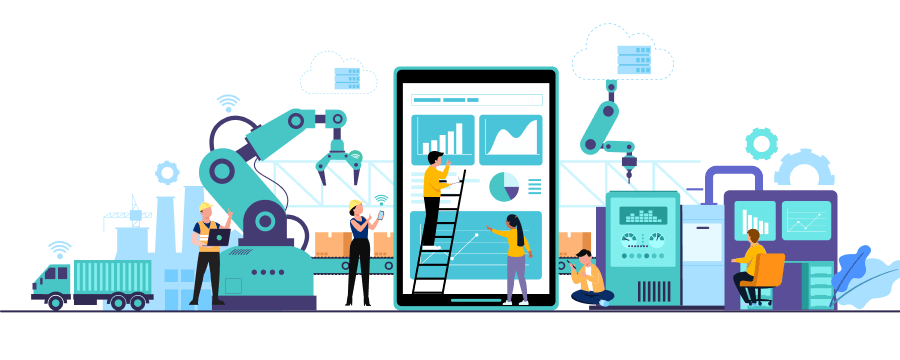
As previously mentioned, manufacturing processes are becoming more nuanced than ever. Thus, calling for intelligent decision-making that is grounded on reliable information. For this, the ability to extract meaningful insights from data is key, which is why business intelligence solutions are gaining popularity within the sector.
In short, BI tools are those that facilitate the collection, integration, and analysis of data from disparate sources. Overall, they simply exist to help your company make the most of the data you have on hand.
Usually, business intelligence software includes the following features:
- Dashboards displaying charts and graphs for quick visualization of the most important statistics and trends
- Self-service data editing for your staff to access, transform, and store digital information without the aid of an IT department
- Advanced analytics that leverages data science and artificial intelligence for predictive modeling
- Secure user administration with role-based access permissions and activity logs to ensure data safety
Since the manufacturing industry produces a lot of data, BI is a great fit for this field. Thanks to its ability to go through and analyze enormous amounts of digital information, BI can uncover inefficiencies in your operations and help improve existing workflows.

BI for Business
Difference Between ERP and BI Systems
Before we continue, it’s important to emphasize that a business intelligence solution isn’t the same as an enterprise resource planning (ERP) system you may have.
You see, ERP platforms help you avoid data silos by creating a single, centralized data architecture to collect, store, and manage digital information. They can merge data from your accounting tools, CRM platforms, supply chain monitoring solutions, and other software to help you build a truly all-encompassing data strategy.
Find out how we integrated a CRM with a Cloud Phone System for a Manufacturing Company
However, it is BI solutions that actually analyze everything that has been collected, forecast upcoming trends, and create dashboards for easy-to-interpret manufacturing insights.
Let’s look at the differences between the two in several points:
- Focus
While ERP is centered around operations and streamlines production, inventory, or supply chain, BI software has an analytical focus, helping with data analysis and decision-making based on insights. - Functionality
ERP systems aim for process automation, working with production scheduling, procurement, and logistics, but manufacturing business intelligence interprets data and transforms it into visual reports, dashboards, and analytics. - Scope
Broad system coverage is the ERP’s prerogative as it integrates multiple departments into one platform. And BI in manufacturing is more about specialized analysis; it focuses on analyzing data from ERP and other systems to improve strategic decisions. - Real-Time vs. Historical Data
If you’re looking for real-time data management, ERP is a better choice since it provides updates and tracks operations as they happen. On the other hand, manufacturing intelligence usually uses past data for forecasting and trend analysis. Of course, complex BI solutions can take into account real-time data, too. - Decision Support
ERP solutions support operational decisions centered around, for example, inventory control, production planning, and procurement. Business intelligence helps more with strategic decisions, defining market trends and laying the ground for performance optimization.
In short, an ERP tool collects enterprise data while a BI solution analyzes it and has the ability to make predictions about future performance. Plus, ERP systems integrate data between various departments, while BI software presents this combined digital information in a way that allows company leaders to quickly make informed decisions.
It may sound complicated, but the good news is there are customized business intelligence solutions that focus on manufacturing and offer functionality tied to your specific processes.
EMI: A Unique Use Case for Manufacturing BI
As the BI market progresses, more niche tools start to emerge. The manufacturing industry is not an exception. Here, we have Enterprise Manufacturing Intelligence (EMI) software, a high-tech tool that fetches data from your specific sources on the factory floor to boost productivity and make real-time decisions.
What exactly is manufacturer-oriented there?
All the standard features that you can find in the BI starter pack. Such as live monitoring closely tracks critical stats like machine performance and compliance with the latest regulations. Or proactive maintenance that predicts when machines need a check-up, so they don’t go kaput at the wrong moment.
Quality is one of the main focus points in EMI. The software may catch quality deviations, pinpoint areas for improvement, make machine check-up notifications, and more.
Another big thing is supply chain tracking. Manufacturers strongly depend on schedules, material supplies, and other operations that deal with anything needed for production and delivery to the end customer. Besides, EMI will usually perfectly (or almost perfectly) integrate with your ERP system and let you tie these two vital tools.
As for data analytics, it dishes out reports and dashboards for data-driven choices, and the in-built templates may well reflect all the nuances usually found in manufacturing.
What’s the Difference Between EMI and BI?
Now, you might wonder how enterprise manufacturing intelligence differs from BI systems? Well, the distinctions lie in their focus.
EMI is the production intelligence software designed exclusively for manufacturers. It collects, analyzes, and visualizes production data, often in real time. The goal of using these systems is to improve operational efficiency, quality control, and process optimization.
If we take BI for manufacturing, then these solutions are broader in scope. They analyze data from across the entire business, including financial, sales, and supply chain data. All of these are to support high-level decision-making and strategy formulation, not only industry-specific goals.
Discover the Secrets of Acquiring Enterprise Systems
Key Components of EMI
If you’ve decided that EMI is the right industry solution for your business, then you might be interested in learning what software components to look for. While in the case of custom tools you’re free to choose whatever you need, out-of-the-box solutions often have a limited set of features.
Without going into too much detail, as the names are self-explanatory, we’re providing a list of components that robust EMI should include:
- Data сollection
- Data integration
- Data visualization
- Analytics and reporting
- Performance monitoring
- Alarms and alerts
- Integration with ERP and BI
- Predictive maintenance
It’s important to note that the integration of EMI software with BI is one you can’t neglect since it’s the core of manufacturing intelligence. So, don’t underestimate its power. And now, let’s take a closer look at what more business intelligence can do for the industry.
Uses of Business Intelligence in Manufacturing
Now that we’ve established the role of BI within the industry, it’s time to look at some of its specific uses. Of course, as we’ve mentioned above, BI tools can help deliver meaningful insights for pretty much all areas of your organization. However, there are seven main applications that we’d like to focus on today.
Grounding Decision-Making in Data
Moreover, with the help of BI, your team can gain a better view of company performance as KPI tracking is carried out in real time. By developing a deeper understanding of why your business might be performing in one way or another, quick adjustments can be made to ensure the set-out goals are met.
Driving Production Management

By leveraging machine learning algorithms, your BI software can predict machine failure before it occurs and recommend maintenance tasks in order to avoid issues altogether. Moreover, if you combine the powers of ML with the Internet of Things, you’ll further improve predictive maintenance accuracy thanks to the ability of connected devices to collect data on your equipment’s performance.
Discover how Velvetech built an IIoT System for Monitoring Anchor Installation
So, if you’re looking to optimize your production, consider investing in a business intelligence solution and perhaps combining it with IoT technology in manufacturing. It could be the game-changer you need to protect your business from errors, delays, and other inefficiencies.
Enhancing Inventory Control

By helping you monitor inventory turnover rates and product defects across locations, BI tools will significantly ease the process of stock management. Moreover, if you decide to leverage predictive analytics, you’ll be able to anticipate demand levels and avoid overstocks as well as out-of-stocks. Thus, boosting profitability by maximizing all of your sales opportunities and avoiding having unnecessary products in storage.
Read up on how we developed Inventory Management Software for an Energy Company
Boosting Supply Chain Monitoring
Find out how we built a Cold Chain Monitoring Solution
Business intelligence can organize data from various areas of your supply chain and deliver granular insight into its entire operations. Thus, establishing end-to-end supply chain visibility and helping prioritize shipments in the most efficient manner.
Moreover, BI tools can help visualize your distribution by monitoring the movement of goods and alerting you to potential disruptions in the supply chain so that you can take preventative action as quickly as possible.
Improving Finance Management

Specifically, it can perform various types of analyses like profit and loss, cost-benefit, raw materials usage, and so on. This helps you monitor the relevant financial information to develop accurate budgets and identify areas where costs can be reduced.
Moreover, with the aid of BI and intelligent algorithms, you’ll get the chance to create profitability forecasts that incorporate entire manufacturing operations. Hence, leaving you prepared for what has yet to come.
Streamlining Workforce Operations

These tools also monitor performance metrics, such as productivity, quality, and safety, enabling managers to spot areas for improvement and launch targeted training programs to boost employee skills. This isn’t just about dollars and cents; it’s about cultivating a workforce that drives production and excellence.
Driving Green Manufacturing with Energy Optimization

Resource efficiency is another big thing, and BI aids in optimizing resource use, including water and raw materials. Manufacturers also depend on these tools for regulatory compliance, as they provide real-time reporting and data that satisfies environmental regulations and ensures a sustainable future.
Explore how to Promote Sustainability with Industrial IoT
Develop Business Intelligence Software for Better Manufacturing
Players within the manufacturing industry are increasingly relying on business intelligence to boost their performance. Thanks to the technology’s ability to facilitate data-driven decision-making and optimize production, supply chain, and inventory operations — it is slowly but surely becoming a highly demanded software to acquire.
At Velvetech, we know how important it is for manufacturers to have a deep understanding of their performance and areas that can be improved. For that reason, we are glad to offer business intelligence development services. So, whether you are ready to get started with your project or would simply like to have a chat and discuss your options — don’t hesitate to reach out.