
Without a well-functioning supply chain, consumers and companies across the world would struggle to receive their orders and send their shipments. A lot of stakeholders would feel the impact of a disruption, and that’s precisely why transportation and logistics businesses constantly perform risk management to help minimize damage from issues.
Yet, how exactly can risks be avoided? Well, there are various practices, but in the modern day one of the most impactful ones is implementing innovative technologies that aid supply chain risk analysis. That’s precisely what we’re going to discuss today.
So, keep on reading to find out which software technologies help with supply chain risk management (SCRM) and begin implementing the best practices today.
Top Supply Chain Management Risks
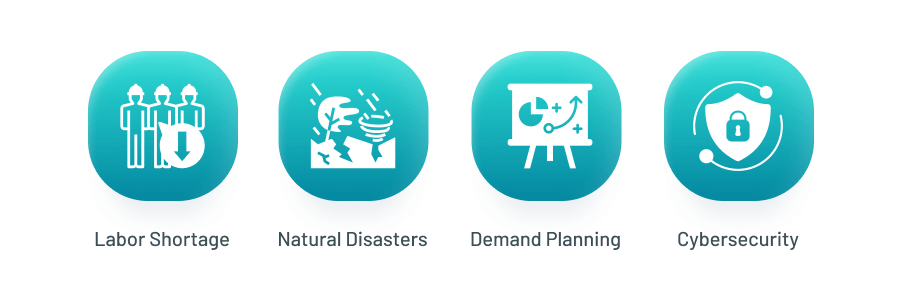
First, let’s take a look at the primary risks that can affect a supply chain. Of course, there are more than the four we outline below. However, these might be the most prevalent today and are the ones that modern technological innovations can help manage.
Labor Shortage
Following COVID-19, worker shortages across the supply chain have been increasingly prevalent. The higher level of competition for qualified staff puts organizations at risk of error-making, delays, overworking of remaining employees, and more. Naturally, this poses an enormous risk to businesses that are literally centered around efficiency and reliability.
Natural Disaster Risk
Natural disasters can also be significant supply chain disruptors. Things like volcanic eruptions, earthquakes, and other catastrophes can truly uproot logistical plans and result in enormous costs. In fact, DHL estimates that the annual global economic impact of these kinds of events could reach €328 billion.
Difficulty Estimating Demand
Demand patterns have changed immensely during the pandemic and continue to evolve constantly. As such, it has become very difficult for organizations to perform accurate demand planning. Of course, this poses a risk to supply chain firms as understocks and overstocks lead to missed opportunities and wasteful operations.
Cybersecurity
Finally, companies across industries are facing a major threat of cyberattacks in the increasingly digital modern world. Supply chain businesses are of course no exception. Phishing, malware, social engineering attacks, and other malicious activities are frequent. So, it’s crucial for supply chain leaders to prioritize cyber risk assessment and security initiatives within their firms.
Technologies for Better Supply Chain Risk Management
Now that we’ve covered the frequent challenges that can put a supply chain under risk, it’s time to discuss the various technologies and software solutions that can help tackle them and ease the stress of the management team.
Data Management Tools
Moreover, integrating data across disparate systems and implementing tools like data warehouses to centralize everything sets you up for easier deployment of innovative technologies down the road.
Read up on the Key Elements of a Data Management Strategy
By having an organized data infrastructure, you’ll be able to automate various repetitive processes and be able to spend more time on risk assessment. Plus, by eliminating data silos, any threat that arises will be easier to spot since your software will be working with up-to-date information.
Find out Velvetech’s robust IT infrastructure services
Data Analytics
You see, data science-powered software can leverage the Big Data from your vast operations and run data models that forecast potential risk scenarios. For example, they can predict machinery failure, supply-demand discrepancies that can impact inventory levels, and more.
Discover how we developed an Inventory Management Solution
Additionally, thanks to prescriptive analytics, modern solutions can even suggest optimal ways for dealing with an issue or avoiding it altogether. Thus, helping you establish thorough contingency plans and be well-prepared if any trouble, including natural disasters, arises. So, definitely don’t underestimate the power of data analytics in supply chain operations.
Internet of Things
By embedding your trucks, warehouses, machinery, and other assets with smart sensors, you can always keep an eye on them and notice whenever a risk of an issue arises. For example, if your company is in charge of transporting condition-sensitive products, the risk of a problem occurring is higher since cargo can go bad if even a minor distortion occurs.
Take a look at Cold Chain Monitoring Tool Development
Yet, with the Internet of Things, you can minimize this risk by installing intelligent devices inside the vehicles to monitor the conditions. Then, if anything goes wrong, the driver can be immediately alerted and handle the issue, or the installed system might even automatically adjust conditions so that they return to suitable levels.
As you can imagine, this can truly minimize risks for your supply chain organization.
Dive deeper into IoT in Transportation and Logistics
Artificial Intelligence
First and foremost, AI and machine learning algorithms can be used to automate and simplify parts of the recruitment process. They can automatically screen thousands of resumes in seconds. Thus, reducing the amount of manual tasks that your HR team has to do and helping them find the right candidates faster.
Labor shortage poses a large risk to supply chain companies because lack of skilled personnel can lead to delays and a negative impact on the bottom line. So, if AI-powered software can speed up the recruitment process — this kind of risk is naturally diminished.
Additionally, artificial intelligence can boost your staff training efforts. After all, once someone is hired, it is in your best interest to get them into top productivity as soon as possible. Well, with AI, this all becomes simpler.
You see, AI tools can quickly analyze performance data and identify if someone is falling behind with their onboarding program and not performing on par with the standards. Then, it can even create a personalized training plan for the employee in question to ensure that any missing skills are swiftly developed.
Once again, this kind of intelligent help not only speeds up HR efforts but also helps reduce labor shortage challenges since you can even utilize personalized training programs for upskilling existing team members.
Of course, AI plays a large role in helping supply chain organizations to manage other kinds of risk too. After all, algorithms can be deployed in various contexts and speed up data analysis immensely. However, since labor shortage is one of the major challenges the industry is facing — we thought it’d be important to discuss it in this context.
Discover more AI in Supply Chain Use Cases
Blockchain
So, it is important to strengthen your cybersecurity by setting up permission controls, implementing data stewardship standards, adding firewalls, and continuously monitoring the safety of your IT infrastructure.
However, besides these practices, it’s also a good idea to consider implementing blockchain tools. Primarily because their decentralization, encryption, and data immutability capabilities can significantly improve your digital security and make it harder for hackers, or even impossible, to damage your IT systems.
Uncover how we developed a Blockchain-Based Intrusion Detection Tool
Implement SCRM Software
As we have seen, managing risk in the supply chain can be overwhelming, but the good news is — innovative technologies and software are here to help. Whether you want to predict issues, have better visibility of operations, or stay safe from cybersecurity attacks, implementing modern solutions is a logical next step.
If you’d like help identifying which IT solution is worth pursuing for better risk management in your unique case, don’t hesitate to reach out to Velvetech. Our specialists have spent years delivering state-of-the-art supply chain software development services. So, we will be able to quickly get on board and help you with your project.