Suppose a few decades ago someone told you that you could assign in-warehouse transportation of goods to robots, predict demand with high accuracy, and optimize delivery routes with real-time insights. Most likely, you’d hardly believe it, right?
Meanwhile, today, all of this and even more has become possible. You’ll probably agree that logistics today is totally different from what we were dealing with just a couple of years ago. And these advanced changes are only the beginning.
Key Highlights
- Warehouse robotics work with minimal human supervision and handle tough and time-consuming tasks like goods retrieving, storing, packing, etc.
- All logistics parties can access a shared cloud system from anywhere, using a single source of truth to exchange information and updates.
- Blockchain technologies may identify any fraudulent activities in the logistics system, thus doubling down on transaction and data security.
- 5G connectivity ensures fast and reliable real-time data transmission, therefore streamlining communication across the entire supply chain.
But how has such a paradigm shift in this niche become possible? Well, at the heart of these changes are advanced technologies. You see, the logistics market worldwide is expected to reach $5.9 trillion by 2030. Meaning, you risk dropping the ball unless you utilize the latest innovations in your logistics solution.
Hence, let’s jump right in and explore the latest trends in logistics you definitely need to keep an eye on:
Artificial Intelligence and Machine Learning
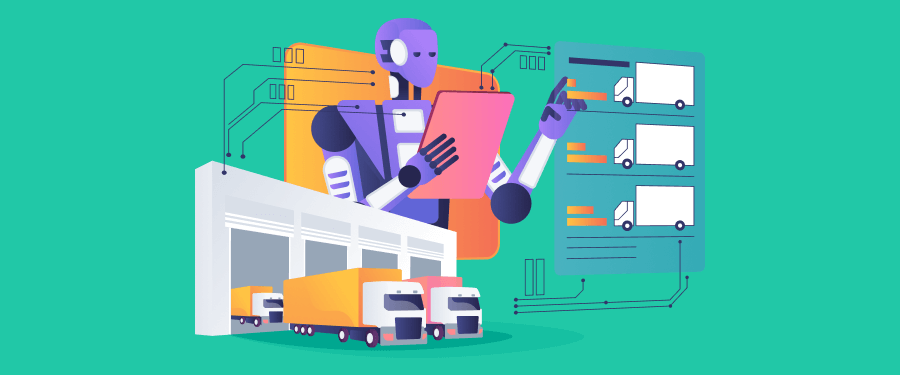
Probably, you are not surprised to find AI and ML at the top of our logistics trends. Sure thing, it’s hard to name a niche that hasn’t undergone enormous changes by employing artificial intelligence and machine learning. Though these technologies offer a vast pool of benefits for logistics, let’s shortlist the core ones:
Elevated Predictive Analytics
What do you need for robust inventory management? First and foremost, you require accurate supply chain demand planning and forecasting. And nothing will work here better than predictive analytics.
To get there, ML algorithms process historical data and identify the exact stock level of the given products. With this insight in place, you will never run out of in-demand products and won’t end up with overstock.
Check out how to succeed in Demand Planning and Forecasting
Moreover, AI can be incredibly useful in providing real-time data analytics on crucial factors like weather conditions, economic trends, and market changes. These insights indeed can significantly affect consumer preferences. You see, AI covers you with timely insight to adjust your inventory.
AI and ML algorithms can be extremely useful in processing historical sales data and establishing accurate demand planning and forecasting. Moreover, AI tools are capable of providing real-time analytics on crucial factors like weather conditions, economic trends, and market changes, which can notably affect customer shopping habits. With such insights in place, businesses can better optimize inventory management.
Automated Workflow
Another reason to employ AI in the logistics industry is to automate business processes. Generally speaking, there are many time-consuming tasks to make hands-free, from data entry and order processing to data analysis and reporting. As a result, you may elevate the accuracy of your business operations and significantly speed them up.
Discover more Benefits of Business Process Automation
Exceptional Customer Support
Let’s face it, customer support, which used to be one of the most challenging tasks for any industry, has never been so efficient. Today, with the help of AI-powered chatbots, businesses are capable of providing round-the-clock services. So, whether it’s checking shipment status or just getting answers to other queries, chatbots promptly assist clients.
Moreover, nowadays, most companies actively utilize AI to streamline their call center services as well. Specifically, AI-powered contact centers analyze calls and offer suggestions to agents for the best possible answers in real time. Therefore, elevating customer satisfaction. And the happier the client, the better the business outcomes will be.

Gaining Control of Customer Engagements
BI Tools
Whether improving supply chain management, establishing accurate route planning, or optimizing inventory control, you need to process huge amounts of data. As we’ve mentioned earlier, AI and ML algorithms can streamline overall data collection and analysis. Yet, you may still struggle with making complex datasets understandable.
That is to say, having the data is one thing, making sense of it is another. So how do you make your data truly meaningful? Well, you can simply sort things out by employing BI technology. Overall, BI tools assist in many ways, from data integration and centralization to data visualization and reporting.
On top of that, BI tools are pretty simple to use, thanks to their intuitive drag-and-drop interfaces. Meaning your staff can efficiently work with variables without having robust technical skills.
Find out how to Elevate Data Analytics with BI

BI for Business
Warehouse Robotics
Technologies also redefine the way warehouses used to operate. You see, today we have smart warehouses, where many tough and time-consuming processes can be done with minimal human supervision.
Read the case study where we developed a Warehouse Management App
It mostly became possible thanks to warehouse robotics, which is a relatively new technology in logistics. Though there are plenty of robotics you may utilize to improve warehouse operations, let’s zoom in on the core ones with their key capabilities.
| Robot Type | Capabilities |
| Picking and Packing Robots | Use robotic arms or grippers to take items from storage and package them accordingly |
| Autonomous Mobile Robots | Can independently navigate and adjust their routes in real time to ensure smooth transportation between the warehouse |
| Automated Guided Vehicles | Follow fixed, predefined routes to transport goods in warehouses |
| Automated Storage and Retrieval Systems | Safely store and retrieve goods from high shelves, thus helping optimize space and minimize the risk of human injuries |
| Cobots | Work alongside humans to handle repetitive and tough tasks in warehouses, like lifting, sorting, and packing goods |
Internet of Things
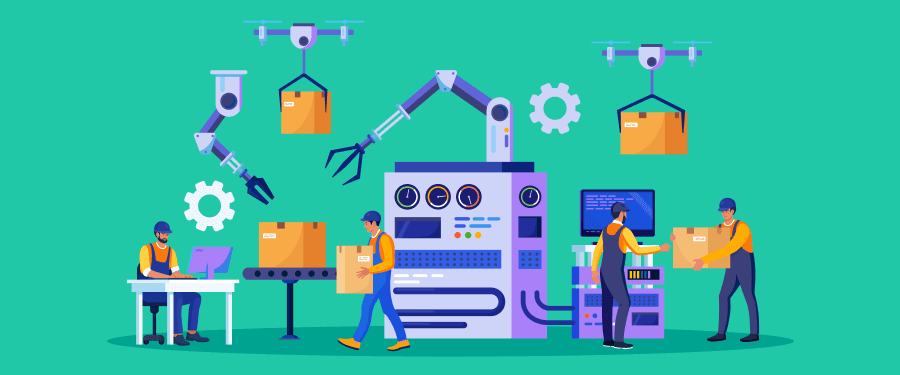
Moving on with our list of logistics industry trends, let’s have a look at IoT. The main value the Internet of Things brings to transportation and logistics is probably the ability to provide real-time visibility and control over every stage of the supply chain. Below are the fundamental advantages to reap from IoT implementation.
Live Shipment Tracking
Once you pick and pack the freight, your job isn’t done yet. Next up, you must ensure the goods are safely transported. To maintain robust transportation from beginning to end, real-time monitoring becomes paramount.
See how we helped the client establish Smooth Shipment from Beginning to End
Overall, live shipment tracking offers plenty of opportunities. Primarily, it ensures that deliveries won’t be lost halfway through. You and your clients can always see where the packages are at the moment.
Secondly, IoT sensors provide live tracking of conditions for perishable foods. Specifically, they can measure the temperature inside the container and send alerts when conditions change, allowing you to establish the right environment for in-transit goods.
Discover the project where we boosted Cold Chain Monitoring
Predictive Maintenance
IoT sensors go beyond monitoring environmental conditions to ensure efficient deliveries. This technology also keeps a close watch on vehicle health, boosting transportation safety on every route.
For example, IoT sensors may track factors like tire pressure, engine health, battery status,
and inform drivers of possible breakdowns. Thus, minimizing the risk of accidents.
Tap on our case study on Next Generation Smart Tires
Theft Prevention
Generally, IoT sensors assist in theft prevention in many ways. For example, sensors can detect unauthorized container openings and promptly alert you. But the cherry on top is probably the ability of IoT to react automatically.
So, besides merely notifying you about possible threats, IoT systems are capable of immediately locking the container doors or triggering an alarm, leaving no chance for thieves to succeed.
Better Sustainability
Just think about how many emission sources exist across logistics and transportation: maritime shipping, air freight, cargo delivery, warehouse operations — the list goes on. However, the logistics of the future are promising to become significantly greener.
Overall, the green logistics market is projected to reach $2.34 trillion by 2030, while in 2024, it cost $1.5 trillion. That is to say, businesses in this sector have become environmentally conscious and are putting significant efforts into promoting sustainability.
And here, IoT technology plays a big role. Specifically, IoT sensors monitor crucial factors like equipment performance in factories to prevent breakdowns, which can lead to pollution, or assess fuel consumption levels of deliveries. Thus, truly assisting business owners in minimizing pollution and operating more sustainably.
Learn more about how to Improve your Sustainability Efforts
Cloud-Based Systems

The next tech trend in logistics and supply chain management that deserves your attention is cloud-based systems. Overall, they have proven themselves to be an effective asset for businesses of different sizes and niches. Let’s briefly touch upon the core capabilities of cloud solutions that make them so valuable for logistics:
- Access real-time data: Cloud platforms allow you to store and update critical data in real time, such as shipment status, inventory levels, delivery times, and vehicle locations.
- Centralized data: All parties involved in logistics operations, like suppliers, manufacturers, carriers, and distributors, can access the cloud system from anywhere to share data and view updates. As such, they have a single source of the truth.
- Cut costs: Compared with on-premise infrastructure, cloud systems are far more cost-effective and can be deployed pretty fast.
- Scalability: Cloud systems simply scale to meet your business’s growing demand.
Find out tips for effective Cloud Integration
Misconfigurations, data breaches, and unauthorized access are among the top security concerns of cloud-based logistics systems. Typically, cloud services become attractive targets for hackers because of their remote access capabilities. And just picture how much crucial information could end up in the wrong hands, from customers’ data to IoT sensor data, putting both your assets and your entire logistics network at risk.
Digital Twins

“Failure is simply the opportunity to begin again, this time more intelligently.” Probably no businessman will argue with this wisdom of Henry Ford. And really, we can’t name a thriving business that didn’t have bad days.
But today, thanks to advanced technologies, you can first try risky projects, assess outcomes, identify areas of improvement, and then implement them into real life. This has especially become possible thanks to digital twins.
Let’s get a tad more specific and discuss an example to make sense. Consider, you are designing a new warehouse to store perishable goods. First and foremost, you must ensure the right temperature and suitable storage layout to prevent product damage. You create a digital twin of this warehouse and simulate temperature conditions and layouts for the specific goods you plan to keep there.
This will help you identify whether your designed environment meets your needs or requires adjustments. As such, you can make the necessary changes in advance and create a warehouse that best suits your business objectives.
Blockchain

Talking about logistics trends, we couldn’t let blockchain technologies slip away unnoticed from our list. Generally speaking, blockchain is primarily associated with safety and security. Perhaps these critical factors alone are enough to state that blockchain is a must for your logistics and transportation services.
For example, a blockchain-based intrusion detection solution helps promptly identify any fraudulent activities in your system, keeping your transactions and data secure.
On the other hand, you can streamline order approvals and payments with smart contracts in place. This way, you not only cut down on paperwork and simplify processes, but also reduce the need for intermediaries. Thus, making the entire workflow far more cost-effective, transparent, and reliable.
Find out more interesting things about Blockchain-Based Smart Contracts
Data recorded on the blockchain can’t be deleted or changed. This ensures an immutable record of all transactions. Furthermore, blockchain offers a shared, tamper-resistant record of product movement across the supply chain. Therefore, significantly improving accountability and traceability.
Cybersecurity

It’s hard to imagine how much sensitive data logistics systems handle daily. They collect information from various sources such as IoT sensors, autonomous vehicles, transportation management systems, GPS, and more. Keeping all this data secure is far from straightforward.
And although we’ve highlighted the role of blockchain in assisting with intrusion detection, it’s equally important to consider the following comprehensive cybersecurity measures in your overall tech strategy:
- Authentication and access controls: This notably minimizes the possibility of unauthorized access.
- Data encryption: By encrypting data, you can keep it safe even in the case of a cyberattack.
- Regular updates: To align your solution with the latest security patches, update it regularly.
- Backups and incident response plan: Even with all the efforts in place, it’s always wise to have a plan B in case something goes wrong. And of course, back up your data so you can restore it after downtime.
Need cybersecurity consulting services?
5G Connectivity

Listing cutting-edge technologies that can elevate the future of logistics, we can’t overlook 5G connectivity. Well, what makes 5G so valuable?
No matter how many smart sensors you employ in your warehouse or across your fleet, you won’t receive data on time with an unreliable connection. Fortunately, 5G steps in to prevent that. Specifically, it enables fast and reliable real-time data transmission, which streamlines communication across the entire supply chain, leading to better decision-making.
Though a couple of years ago, 5G connectivity may have seemed like a dream, today businesses reap plenty of benefits from it. However, this technology does not rest on its laurels. Being in its early stage, 5G-Advanced (5GA) promises to double down on 5G capabilities.
Specifically, it will enhance data speeds and reduce latency even further. Moreover, 5GA is predicted to be a precious asset for technologies like AI, digital twins, and IoT to reach their full potential and improve performance across industries.
And again, that is not the end. In the near future, 6G is promising to operate smoothly in higher radio frequencies, providing connectivity at microsecond speeds. You see, your logistics operations will become far more productive with such a mind-blowing internet.
3PL Automation

The last point on our list can be considered more of a business approach than a tech trend. However, we truly believe that you should definitely keep an eye on it if you aim to streamline your logistics services. We’re talking about 3PL automation.
Overall, 3PL encompasses a wide range of technologies to streamline every aspect of logistics and make plenty of time-consuming and complex supply chain tasks hands-free, from order processing and transportation management to reverse logistics.
Discover more Opportunities 3PL Automation Can Bring to Your Business
By the way, there are also other robust logistics automation strategies to consider, like 4PL and even 5PL. You can check our guide to see which logistics model will work best for your business needs.
It’s Time to Elevate Your Logistics
We’ve unpacked the core tech trends in logistics that can propel your business forward in 2026. However, excelling at implementing technologies such as AI and ML, blockchain, IoT, and the like is no easy feat. Yet, it’s the only way to create a robust and competitive logistics solution today.
That means you need a team well-versed in transportation and logistics development. And, ideally, your vendor should demonstrate solid experience working with the advanced technologies we’ve highlighted.
If you’re currently looking for a trustworthy vendor, Velvetech can become a helping hand. Our experts will do their best to bring your project to life. Contact us for more.
About the author