
Modern laboratories can’t do without reliable Laboratory Information Management Systems (LIMS) due to a set of reasons. Continuous data flow, data heterogeneity, complex lab workflows, and an intricate ecosystem — all these components must work in sync so that a lab can keep the bar of high standards set by the healthcare industry.
LIMS software helps to orchestrate all the elements of a lab into a well-coordinated mechanism. It streamlines inner workflows, alleviates laboratory data management and exchange, sample handling, and many more. For these purposes, laboratories have two options: whether to purchase an out-of-the-box cloud-based LIMS solution or invest in custom development.
In comparison with SaaS software, bespoke Laboratory Information Management Systems are more flexible, adjustable, and scalable — all these matters we discussed in our previous article. But how to build a brand-new healthtech solution that would be tailored to the specific needs of your laboratory? What are the main obstacles you’ll unavoidably face during development and implementation? Let’s take a closer look at these issues in this blog post.
Steps in Custom LIMS Development
One does not simply develop a tailor-made LIMS application in an instant. In contrast to SaaS software, where you purchase a license and start using it right away, bespoke system building is a time-consuming multi-stage process. Below, let’s go over each phase of LIMS software development briefly.
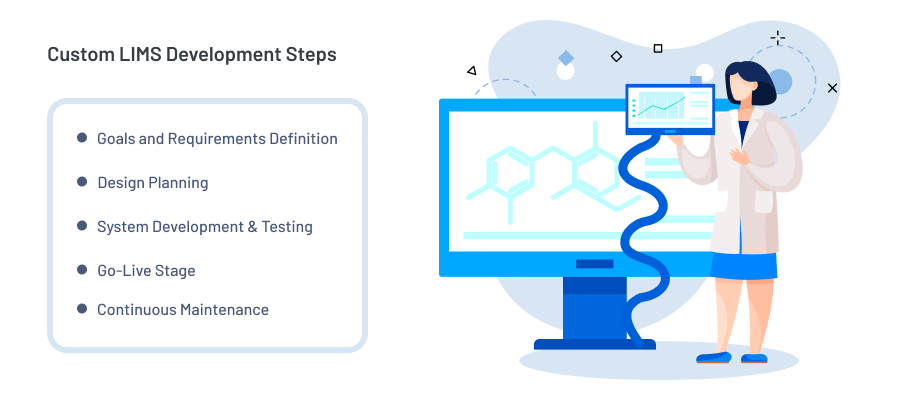
Define Goals and Requirements for Your LIMS
First, you need to create a LIMS implementation project plan, where you shape the requirements for the system, evaluate the complexity of your workflows, and understand which aspects must be covered by lab software. Usually, labs anticipate process automation, exceptional level of security, and adherence to regulatory requirements.
However, to gain it all, it’s crucial to evaluate a bunch of intricacies, some of which are:
- Presence of unique workflows and equipment
- Specific regulatory requirements your lab must be compliant with
- Desired system scalability and flexibility
- Preferred level of data security and control over lab workflows
- The number of systems and equipment your lab software must be integrated with
Design Planning
After the goals and requirements are clear, your team can transfer to the overall system design. Depending on the desired functionality, integrations, scalability, and system layout, you can proceed with:
- System architecture, including database structure and application modules
- Technical stack selection
- UI/UX design
Learn more about Healthcare UI/UX Design
System Development and Testing
When all planning-related matters are resolved and you have a clear roadmap, it’s time to get down to its implementation. This step implies:
- Main system modules development, such as sample and inventory management, quality control, data analysis and reporting, and more
- Building LIMS integrations with lab equipment, existing information systems
- Access configurations to ensure the utmost security of sensitive lab data
- Comprehensive system testing
Go-Live Stage
After the system is ready and thoroughly tested, it’s time to roll it out. At this step, your LIMS developer’s mission is to:
- Securely migrate essential lab and patient data from legacy systems to the brand-new lab software
- Deploy the system in the cloud or on-premises
- Conduct training sessions for lab staff
Continuous System Maintenance & Support
Developing a bespoke laboratory application and safely leaving it without any maintenance is inconceivable. Your lab may purchase new equipment, start conducting new specific laboratory tests, or regulatory requirements may change over time. Here’s what your LIMS developer does during this stage:
- Tech support to detect and fix flaws that hadn’t been identified at the testing stage
- System updates and continuous improvement to implement new features and enhancements according to user feedback
- Performance monitoring to track system reliability and compliance with the healthcare industry standards and regulations
Challenges and Considerations When Developing LIMS: What to Bear in Mind
Building a top-notch LIMS for laboratories requires time and tremendous effort. Healthcare is not the sphere where even minor mistakes are permissible, so the development of such specific software implies consideration of multiple details and intricacies inherent to the domain itself.
Below, we highlight the most pressing challenges that are truly inevitable during LIMS implementation.
Ensuring Multi-Layer Data Security & Protection

However, even this option might be unacceptable for some laboratories. But if patient info gets in the hands of unauthorized people as it is, that’s an ugly story and bears huge reputational and financial risks for the lab.
Here’s why such a valuable asset as health data needs the highest level of protection, and ensuring bulletproof security requires a meticulous approach. For example, in the case of LIMS, full transparency and traceability is a must. It’s essential for lab staff to monitor who and when accessed, edited, imported, or exported data, and this info must be saved as access and audit logs.
Why is ensuring access and audit logging a painful challenge? Because implementation requires consideration of a bunch of aspects. One of the most common issues is the risk of system performance overhead since logs consume a lot of CPU, memory, and storage resources. This automatically entails poor user experience because of irritating delays while using the system.
Discover how to Safeguard Healthcare Data
Implementation Challenges Due to Lab Processes’ Heterogeneity

Keep in mind that all these systems are different in terms of relevance, maintenance, and integration capabilities. And you need to add one more component to this ecosystem without disrupting it.
Another pain point is represented by multiple stakeholders, whose interests and preferences must be taken into account. Heads of lab departments, hospital managers, IT units — all the implementation intricacies must be coordinated with a huge range of people with their interests, requirements, and concerns. And most likely all decision-makers will not have a technical background, which complicates the task even more.
Learn more about Hospital Management Systems
Regulatory Requirements Adherence

For example, HL7 is a data exchange standard that covers all aspects of healthcare — billing information, diagnoses, surgical interventions, lab data, and more. Therefore, all the systems used in the laboratory must be HL7-compatible and support data interchange in the needed format.
However, the caveat is that the equipment and information systems may be absolutely different. And options for maintaining the HL7 format may vary, too. As a result, we receive a pool of systems that initially don’t dock with each other in terms of standard support, which requires extra integration effort.
There’s No Way to Bail on LIMS Maintenance
The reason for some improvements may also be inconveniences in system utilization or flaws you may have detected only after integration with other software. Obviously, these things will not be fixed by themselves — some efforts from your LIMS developer will be required for sure. Or, say, you noticed that the system lacked critical functionality, and there arose the need for LIMS customization.
What to Expect: Trends in LIMS Development
Where next? Striving to improve accuracy, alleviate staff workflows, and provide a first-class user experience, laboratories continuously reconsider their processes, test new solutions, and proceed with LIMS customization. Below, let’s review some aspects healthcare facilities and labs tend to move towards.
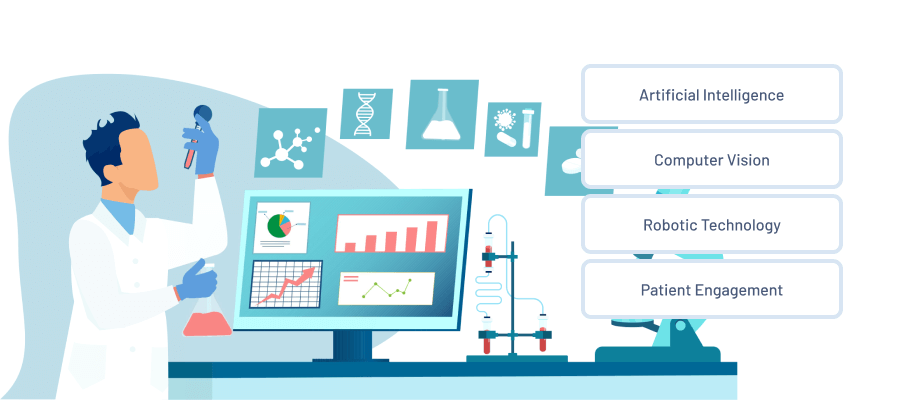
Artificial Intelligence
The necessity of handling masses of healthcare data obliges laboratories to find ways of doing it fast and qualitatively. A human is physically unable to process thousands of data rows swiftly and flawlessly. In contrast with Artificial Intelligence, of course, which not only can handle large volumes of information within minutes but also conduct thorough data analysis and build predictions.
Read about Artificial Intelligence in Healthcare
Computer Vision
To level up control over lab operations, laboratories may also use Computer Vision integrated with their software. Just imagine, even one lab test implies the entire chain of actions — material sampling, reagent mixing, centrifugation, storage, utilization, and more. Each step may be performed by different people, and all of them are not immune from mistakes.
Computer vision will control each step of laboratory testing, and if something goes on an atypical scenario — the system will give notification, and the staff will be able to take measures promptly.
Robotic Technology
Laboratory workflow automation is another aim besides quality enhancement labs strive to achieve. Some of them already use robotic technology in their daily operations, which allows lab staff to abandon some routine processes and concentrate on more value-added tasks. Integrated with LIMS, robotic process automation can easily streamline lab workflows without compromising the quality of laboratory tests.
Resolute Steps Towards Patient Engagement
And last but not least is the desire of laboratories and medical facilities to be closer to patients and boost their engagement. It’s hard to find a person who doesn’t have a smartphone, and the majority actively use medical wearables and different health apps.
But the thing is that you can’t surprise anyone by the possibility of storing common vitals in a healthcare app, such as blood pressure, heartbeat rate, and body temperature. No, today patients’ expectations are far beyond that, and they anticipate more ample capabilities from their devices.
Let’s consider Apple Healthkit, which is a case in point here. With the current app version, you can store your lab results, and access your health and medical records, immunizations, and many other things that were unavailable just several years ago.
Discover more about the Consumerization of Healthcare
Make the Best Out of Custom LIMS
Selecting in favor of a custom lab software, be prepared that the implementation path is not that fast and easy and requires substantial resources and effort. However, as a result, you’ll gain a powerful tool able to greatly improve the quality of lab operations, alleviate the workload of your staff, and enhance patient engagement.
Of course, keep in mind that for Laboratory Information Management System development, you’ll need a reliable provider proficient in healthcare software development and well-versed in the latest technologies. Our team has a proven track record of healthcare projects and will gladly assist you with yours. Drop us a line, we’ll help you bring your idea to life!