
Having the right tools to analyze and plan strategically prevents us from turning to business evil, such as micromanagement, operational chaos, or complete software project failures. We’ve compiled a list of some of the best strategic business analysis techniques that will help you cut through the noise, make informed decisions, and stay on the side of good.
Curious how these give tangible help? Read first about the pros of using generic business analysis techniques and how they help avoid deadly consequences for software projects.
Pros of Business Analysis
A software project without proper business analysis is like sending a group of travelers into the wild with no map and no GPS. Here are the not-so-hilarious if not considered pros of using these business analysis techniques in the software realm.
Banishing Bugs
When you analyze user requirements and system constraints, you’re sniffing out bugs before they even know they exist. Without proper analysis, these sneaky creatures can cause development project delays and customer frustration, and in extreme cases, you might end up with far from user-centric software that crashes more often than a rookie pilot trying to land a spaceship.
Example: A famous software company releasing a new operating system without rigorous user analysis. The result? A nightmare for users with compatibility issues, crashes, and too many patches to support the disaster infrastructure.
Cost Control
Business analysis helps you draw a roadmap of the software development costs. This means you’re less likely to find yourself in the awkward position of explaining why your software project ballooned into a budget black hole.
Example: A small startup wanted a simple mobile app but decided to skip proper analysis. They ended up blowing their entire budget on unnecessary features and had nothing left for marketing. Their app? Lost in the app store wilderness, never to be seen.
User Satisfaction
Your users are the true rulers of the software kingdom. With different types of business analysis, you can match your software with their needs, leading to happier customers who won’t storm your virtual castle with pitchforks.
Example: A software company decided to upgrade its flagship product without talking to users first. Result? A revolt. The ‘improved’ software was a maze of confusion. Users migrated to a competitor, leaving the company’s support team with empty inboxes and sad faces.
So, there you have it! Embrace these business analysis methods in your custom software endeavors, and you’ll dodge the bugs, keep your budget intact, and have users singing your praises. It’s a win-win for both you and your customers.

Business Analysis in IT
Best 19 Business Analysis Techniques for Software Projects
Here’s what you have in the arsenal to perform hands-on business analysis for software projects and go all the way down from strategy to processes.
1. Software Business Analysis
Software business analysis refers to the initial stages of the product development cycle. While we will give you plenty of techniques to help with the software project business side, this first type purely focuses on the upcoming development process.
At Velvetech, we follow these steps of software business analysis:
- Discovery
- Functional requirements
- Non-functional requirements
- Project cost and budget estimate
- Prototyping
- Functional design specification
- Project implementation and support
So, first, we get inside the client’s brain to understand their software concept. Skip this part, and you might end up building software that’s as confusing as an online store without a shopping cart — it just won’t work out.
Then, we jot down all the must-haves for the software based on what we’ve learned and add our expertise to the mix. Such as applying a mobile business analysis requires good knowledge of iOS and Android differences, which is nourished internally.
Non-functional requirements set the software’s limits, like screen sizes or user capacity.
Budget estimates avoid financial constraints, ensuring the budget isn’t as tight as post-Thanksgiving jeans.
Our BAs guide UX/UI design, too, crafting prototypes and key artifacts, such as storyboards and screen flow, before going all-in with full-scale development.
On the way, everything is meticulously documented for clarity and future reference.
Finally, we troubleshoot and align teams because software business analysis is an ongoing journey.
2. PESTLE Analysis
PESTLE stands for Political, Economic, Social, Technological, Legal, and Environmental analysis. It shows you the bigger picture by thoroughly examining external factors and potential development challenges that could impact your software.
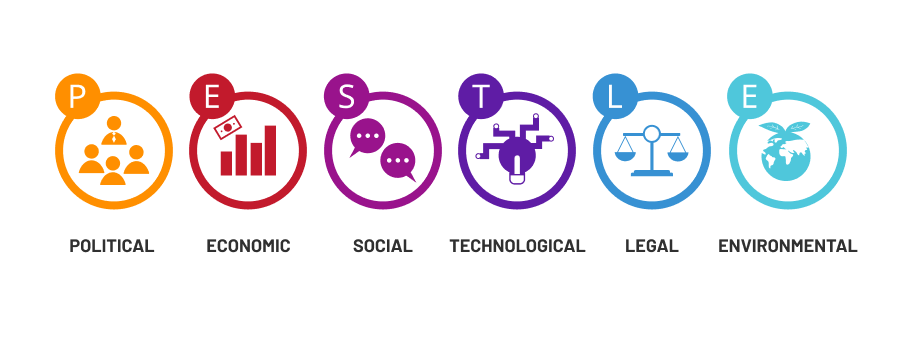
Say you’re running a tech startup. You’d look at the political landscape (government regulations), the economic climate (market trends), social factors (changing consumer behavior), technology (innovations), legal issues (compliance), and environmental concerns (sustainability).
Example: You’re the cool cast behind a popular dating app. In a PESTLE analysis, you discover that new data privacy laws (P) are swiping right into town. Meanwhile, AI technology (T) is flirting with the idea of changing the dating game.
With this intel, you decide to beef up your app’s privacy features, so user data stays as private as a squirrel’s stash. At the same time, you introduce an AI wingman, making your app as helpful as a best friend with great dating advice.
Result? Your app not only complies with the latest privacy regulations but also turns into the matchmaking maestro. Lovebirds everywhere thank you for making the dating scene smoother than a perfectly frothed latte.
3. Heptalysis
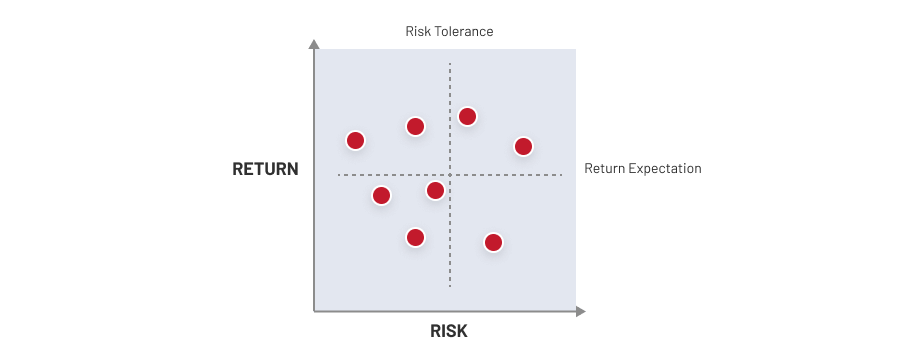
Heptalysis takes you beyond the usual aspects and into the seven spheres of marketing. These include market, product, methods, money, people, measurement, and risks. It helps you dissect your strategy at a granular level.
While primarily the method teaches to break spheres down and analyze them separately, it’s linked to the business idea’s investment potential, too. Each sphere may be looked at as an investment opportunity, which is more attractive if less risky, and, thus, more prone to reward.
Heptalysis is perfect for fine-tuning your marketing plan. For each sphere, ask yourself questions like:
- What’s the market size?
- How are we making money?
- What’s our motive for this strategy?
- How are we getting our message across?
Example: You’re launching a fitness app, promising to turn couch potatoes into gym enthusiasts. You break your methods down, and, whoops, your Heptalysis uncovers a glaring issue — your advertising messages are about as clear as muddy water to your target audience. They’re not worth the investments, as they are like trying to teach calculus to a toddler — a lost cause.
So, you hit the gym (metaphorically) and change up your advertising. You craft a message that practically screams, ‘Get ripped without leaving your living room!’ The result? Your app doesn’t just attract users; it gains a cult following faster than you can say ‘six-pack abs’.
4. STEER Analysis
STEER stands for Socio-cultural, Technological, Economic, Ecological, and Regulatory. It’s like PESTLE’s close cousin, with a slight twist. STEER analysis focuses on the external factors that affect your business’s performance.
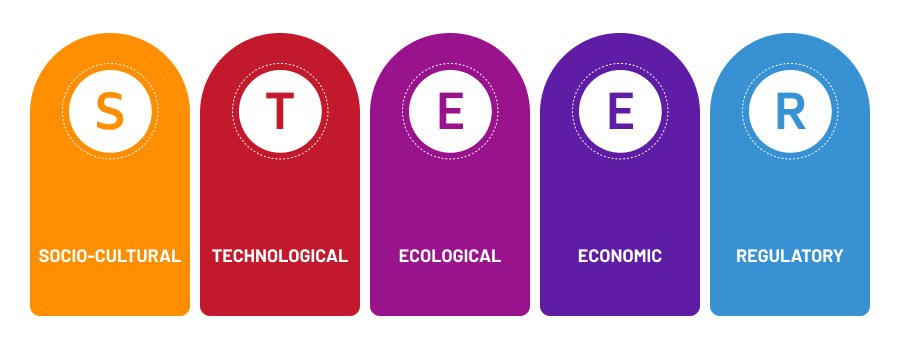
Use STEER analysis in tandem with your PESTLE. By focusing on these five areas, you can delve deeper into the specifics of your market, helping you better understand how each factor impacts your software development methodology.
Example: You’re about to launch the ultimate project management tool. But your analysis uncovers an unexpected twist — your users are now as eco-conscious as a herd of vegan mountain goats!
In a coding caper, you prioritize features with more sustainability grade. The result? Your software doesn’t just help manage projects; it helps save the planet, one byte at a time. Your competition? They’re still stuck in the digital dark ages, while you’re the green guru of project management. Your users don’t just plan projects; they plan to save the Earth.
5. Stakeholder Map
Stakeholder mapping is all about knowing who’s who in your business’s ecosystem. It’s like creating a “relationship GPS” to navigate your way to success.
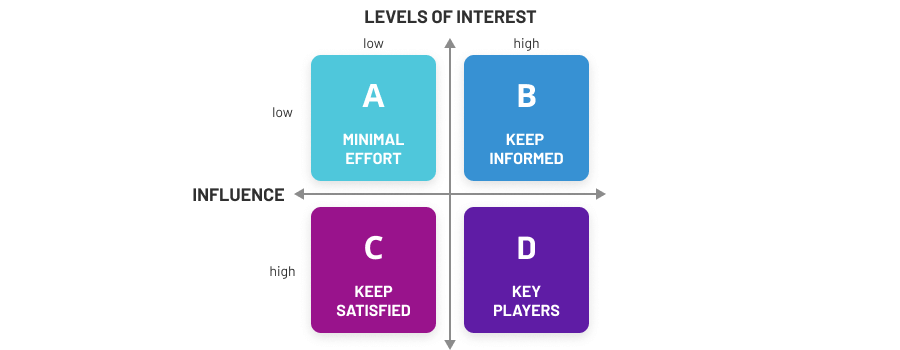
Identify your stakeholders — the people or groups that influence or are influenced by your business. Map their interests, influence, and engagement with your company. This helps you prioritize your interactions and allocate resources effectively.
Example: You’re running a web development project, starring developers, customers, and investors. Your stakeholder map is like this — developers are silent but sturdy (high influence, low interest), while customers are eager fans (high interest, lower influence).
So, you wrangle up your communication skills accordingly. With developers, you explain a business idea to the team and let them roam the software range. For the fans, you put on a show, keeping them in the front row with updates and excitement.
6. SMART Goals
SMART is not just a word; it’s an acronym for Specific, Measurable, Achievable, Relevant, and Time-bound goals. This technique ensures your goals are clear, realistic, and anchored to a timeline.
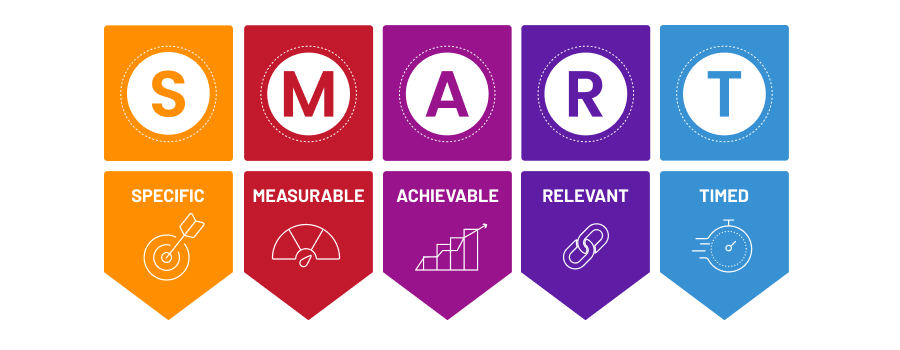
For every goal you set, run it through the SMART filter:
- Is the goal specific and easy to understand?
- Can you measure progress?
- Is it attainable?
- Is it relevant to your overall strategy?
- And perhaps most importantly, does it have a deadline?
Example: You’re launching a cross-platform app. Your destination: increased traffic from the App Store and Google Play. A SMART goal becomes your treasure map: ‘Optimize App Store and Google Play and increase traffic by 15% in the next six months.’
This goal isn’t some vague notion; it’s a lighthouse in the dark. With every passing month, you’re not just hoping for the best; you’re measuring your progress.
7. Product Vision Board
A product vision board is a roadmap for your product’s future. It’s a visual representation of where you want your product to go and what you aim to achieve.
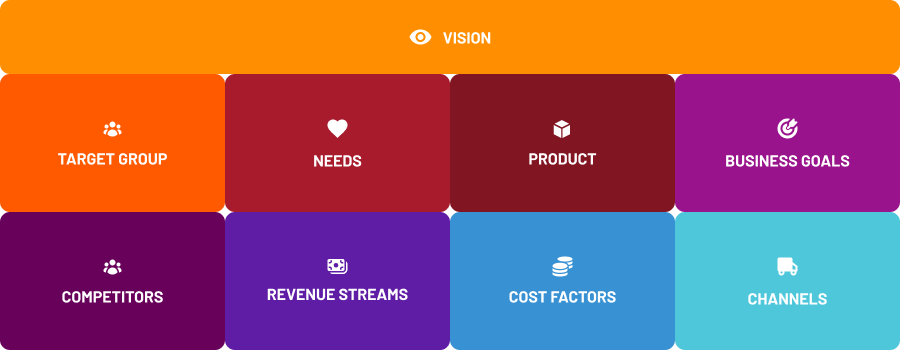
Gather your team and fill out the board with details like your product’s purpose, target audience, features, and the problems it solves. It’s a dynamic tool that keeps everyone aligned with a single product vision.
Example: You’re cooking up a new recipe app. Your mobile product vision board is like the chef’s master plan, spelling out your goal — to help users become culinary wizards by providing mouthwatering recipes, cooking tips hotter than a habanero, and a mobile grocery list feature that’s more organized than a Michelin-star kitchen.
8. 4P Marketing Mix
The 4P Marketing Mix is a classic marketing framework. It stands for Product, Price, Place, and Promotion — the four elements you need to balance for marketing success.
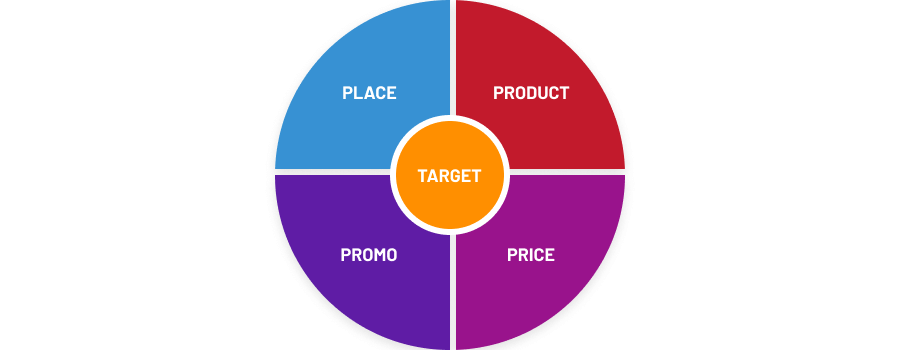
Analyze each “P” in detail:
- What’s your product like?
- How should you price it?
- Where and how will you distribute it?
- How will you promote it?
Balancing these elements is crucial for a successful marketing strategy.
Example: You’re about to launch a new SaaS with a premium subscription. A 4P analysis is what you choose. First, you uncover a competitive price to consider. You know, charging the price of a spaceship won’t fly with your earth-bound customers.
Next, you realize that exclusive distribution through select YouTube bloggers is key. It’s like throwing an A-list party, and everyone wants to be on the guest list.
Finally, you decide on a promotional campaign emphasizing the product’s features that are the best match for the chosen place, price, and product. You show off your premium personal area’s sleek design, crystal-clear benefits, and lightning-fast SaaS performance — all while your rivals are busy trying to make a click on their outdated platforms.
9. Business Model Canvas
The Business Model Canvas is your blueprint for a successful business model. It breaks down your business into nine key building blocks, including customer segments, value propositions, channels, and revenue streams.
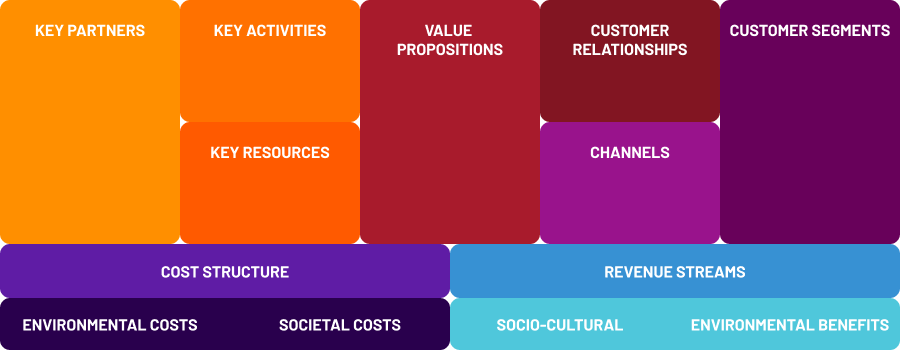
Fill out each block with specific details about your business. This canvas offers a comprehensive view of your business model, helping in analytical tasks and identifying areas for improvement.
Example: You join the world of streaming and are ready to offer exclusive content through a subscription service. You use the Business Model Canvas to plan things out.
First, you’re not just casting a net; you’re aiming for a bullseye. After all, you don’t want to be offering Shakespearean dramas to folks who live and breathe sci-fi.
Next, in a world of streaming giants, you need to be someone who can do backflips. What will be that unique thing that attract those who never streamed or those who already do it with their favorite platforms?
Finally, you determine what the pricing models are and how often users will receive fresh, relevant content. Daily, weekly, monthly, or once in a blue moon? You call the shots.
10. Strategy Diamond
The Strategy Diamond is a diamond-shaped framework that encapsulates your strategic choices. It comprises five key elements: Arenas, Differentiators, Vehicles, Staging, and Economic Logic.
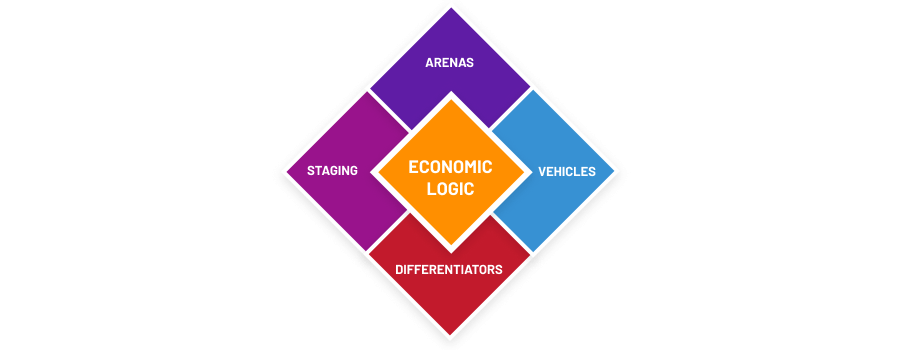
Use this framework to crystallize your strategy. It’s an excellent tool for aligning your team and stakeholders around the core elements of your business strategy.
Example: Let’s say you’re managing a retail business. Your Strategy Diamond might show that your primary arena is a specific geographical market, your differentiator is unmatched customer service, your vehicles include physical stores and an e-commerce platform, your staging plan spans five years, and your economic logic relies on cost leadership. With this clarity, you can guide your business effectively.
11. Porter’s Five Forces
Porter’s Five Forces is your secret weapon for understanding your industry’s competitive forces. It examines five areas: threat of new entrants, bargaining power of suppliers, bargaining power of buyers, threat of substitute products, and rivalry among existing competitors.
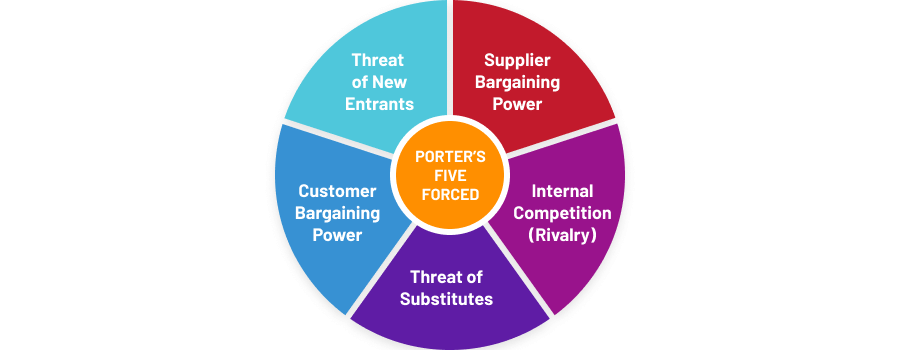
Analyze each force to assess the level of competition and market dynamics. This can help you identify strategic opportunities and threats.
Example: You’re making up the next big fintech app. Porter’s Five Forces analysis is your squad to tackle market dynamics.
First, it uncovers the high threat of new entrants — new blockchain-based apps trying to break into the scene.
Then, it points out moderate supplier power. You’ve got choices galore when it comes to picking your tech partners and they surely have some good success stories to share. It’s like a buffet of options.
High buyer power means your users have options, which is great because it’s like a digital smorgasbord for them.
There’s also a moderate threat of substitutes. Alternative apps, they’re like a party crasher, but you’ve got your security in place as they are slower and less user-friendly.
Lastly, the intense rivalry among fintech apps is like a battlefield in the digital arena. With this insight, you’re not just crafting an app; you’re forging a software strategy that’s more solid than a line of code.
12. Go-to-Market Strategy
Your product is ready, but how do you take it to market? The go-to-market strategy defines the tactics you’ll use to reach your target audience and achieve success.
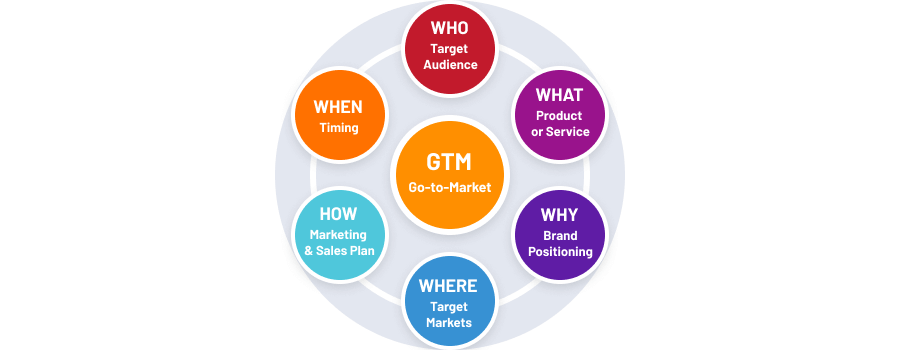
Outline your approach for launching your product, covering aspects like product positioning, target audience, marketing channels, and sales strategies.
Example: Suppose you’ve developed a new engaging mobile app for productivity.
Your target audience might correlate with early-morning coffee fans who track every minute of their lives (thus, potentially needing your app). By partnering with small coffee shops and placing the QR to your app download on the spot, you could reach the guys with the relevant message.
These two statements alone already cover the idea of the vital who, where, when, what, why, and how. By further elaborating on all the aspects you can build a robust go-to-market strategy.
Learn more about the Best Approaches for Your Mobile Go-to-Market Strategy
13. 3 Horizons of Growth
The 3 Horizons of Growth model helps you manage your growth strategies over different timeframes. Horizon 1 focuses on your core business, Horizon 2 on emerging opportunities, and Horizon 3 on entirely new ventures.
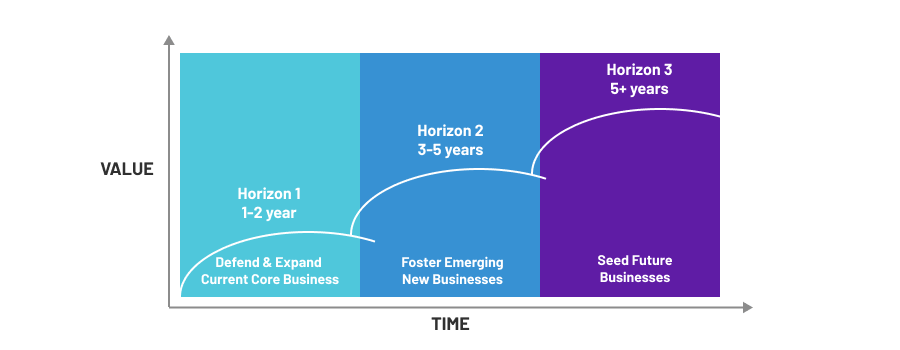
Balance your resources and investments across these horizons to ensure your business thrives both in the short and long term.
Example: You’re an iOS app developer in banking with a mission. You have three horizons to explore.
In Horizon 1, you’re all about improving your current software.
Horizon 2? You’re on a quest for new mobile banking features and ideas, exploring the world of financial products to see what can be added next.
Now, Horizon 3 is where things get exciting. You’re like an inventor, exploring new frontiers in tech, such as blockchain in banking or what Apple has to offer, looking for the next big breakthrough.
With this approach, you’re not just a software developer; you’re a tech explorer, always on the lookout for ways to make your software even better.
14. MOST Analysis
MOST, or Mission, Objectives, Strategies, and Tactics, helps you clarify your business’s mission, set objectives, devise strategies, and outline specific tactics to achieve your goals.
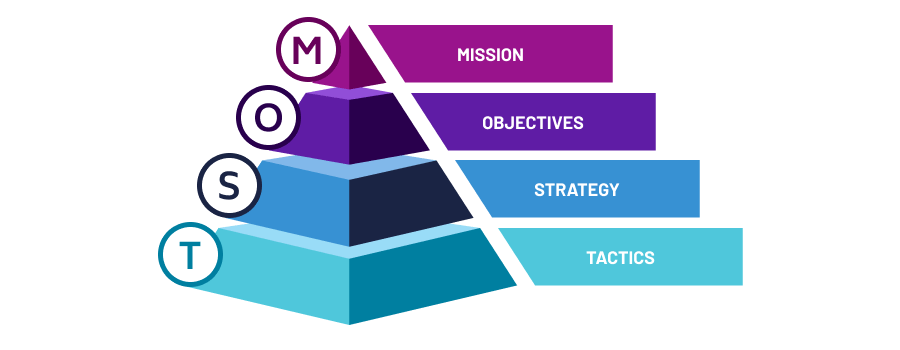
Start with the mission — your overarching purpose. Then, set objectives, determine strategies to meet those objectives, and detail the specific tactics to execute your strategies.
Example: You’re in charge of a new board game Android app. You’ve got a MOST analysis in your toolkit.
- Market: It’s like being a matchmaker for board game lovers. You want to ensure your app is a perfect match for those who love a good game night and Android OS but can’t find their dice.
- Operations: This is all about making your app as glitch-free as a board game with no missing pieces. It’s a ‘no frustration’ zone.
- Strategy: Think of it as plotting to conquer the virtual board game realm, and build a community of YouTube bloggers making conspiracy theories about it.
- Tactics: These are your daily missions, like upgrading your Android app’s features or engaging with the board game fanatics, who are your potential virtual opponents and allies.
Your competition is still fumbling through rulebooks while you’ve already set up your virtual game nights.
15. SWOT Analysis
SWOT analysis is like an X-ray of your business. It evaluates your Strengths, Weaknesses, Opportunities, and Threats. It’s a straightforward way to assess your business’s internal and external factors.
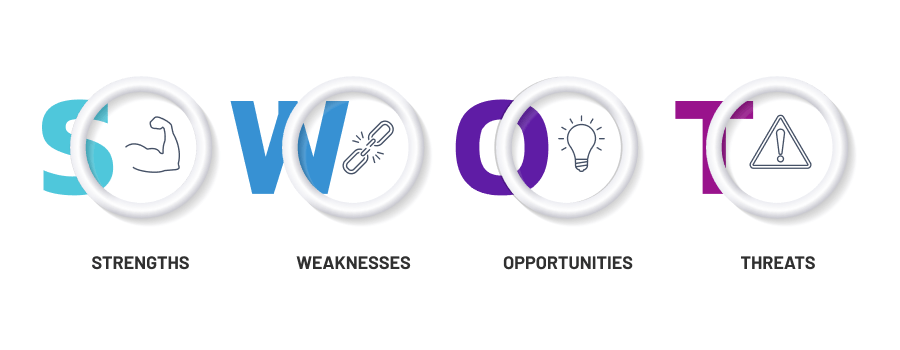
List your strengths and weaknesses (internal) and opportunities and threats (external). This analysis provides a clear snapshot of where your business stands.
Example: let’s take a sip of SWOT analysis for a coffee shop app.
- Strengths: Our coffee shop app has a personal barista in your pocket, ready to brew up your favorite caffeine concoctions.
- Weaknesses: But we’re not perfect. Sometimes, our app gets a bit too excited with notifications, bombarding you like that overenthusiastic barista who insists on spelling your name with a ‘z’ instead of an ‘s.’
- Opportunities: With the coffee addiction on the rise, our app could become the official mascot of Monday mornings. We’re talking about being as essential as that first cup of coffee for countless early risers. A caffeine-based cult again, if you will!
- Threats: Then, we’re in a world full of coffee competition. If we don’t stay perky and innovative, we might end up as forgotten as last week’s cold brew in the office fridge. And nobody wants that!
That’s how simple SWOT business analysis for mobile apps shows you what to do next to thrive and shine.
16. CATWOE Analysis
CATWOE is an acronym for Customers, Actors, Transformation, Worldview, Owner, and Environmental Constraints. It’s a versatile methodology for analysis of the perspectives and constraints in a business scenario.
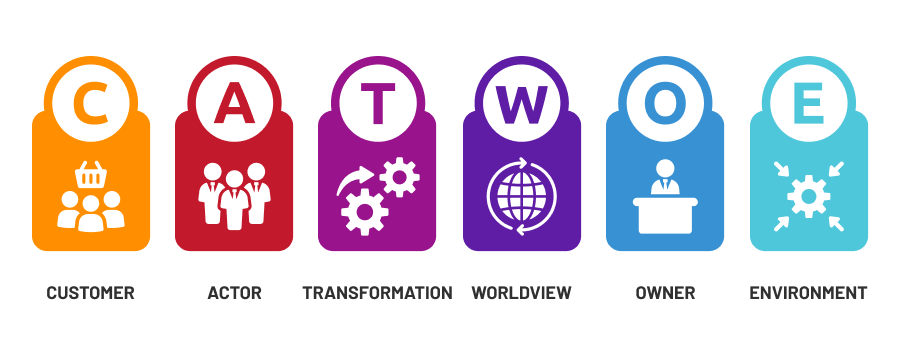
Analyze each component to better understand a business problem or project. Consider the viewpoints of different stakeholders and the constraints of the environment.
Example: We’re doing a CATWOE analysis of how to better translate healthcare client needs into functional requirements.
- Customers: Picture a healthcare guru who needs unique software.
- Actors: Our band includes developers, designers, analysts, and project managers.
- Transformation: Our goal is to turn the customer’s complex healthcare needs into software solutions that run as smoothly as a high-speed roller coaster.
- Worldview: We see the healthcare software world as a jungle of rules and regulations.
- Owner: The project manager is making sure the software aligns with the customer’s wishes and industry rules. And, of course, they’re the voice of the patient, the ultimate VIP.
In a nutshell, this CATWOE analysis is about assembling a dream team to create the perfect healthcare software roadmap. A decomposition like this will clearly outline the gaps in expertise, shortage of developers and resources, or other problems to solve.
17. De Bono’s Six Thinking Hats
De Bono’s Six Thinking Hats is a structured brainstorming technique that assigns specific roles to participants. Each ‘hat’ represents a different thinking style, from logical and factual (white hat) to emotional and intuitive (red hat). It fosters analytical thinking and illustrates what model roles you usually encounter in business.
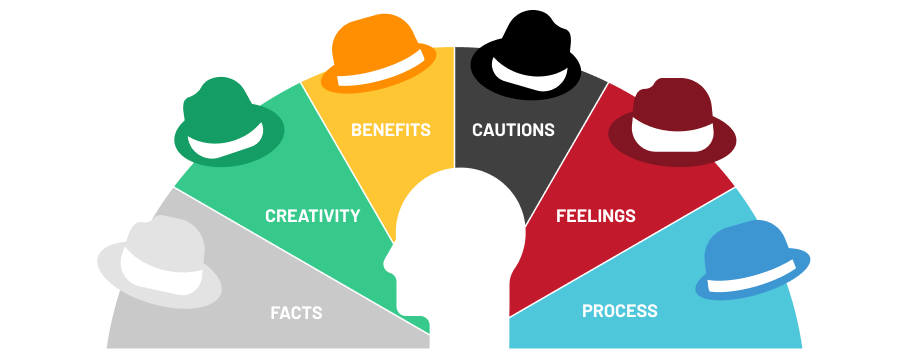
During a brainstorming session, participants ‘wear’ different hats at specific times to encourage diverse thinking and problem-solving.
Example: Here’s our enterprise product development meeting.
- White Hat (Data Analyst): John, our business data expert, uses methodologies and presents the analytics reports with cold, hard facts. He doesn’t miss a digit.
- Red Hat (Emotion Express): Emily expresses her feelings about the new system’s features and how annoyed she is with the time-tracking.
- Black Hat (Critic in Chief): Dave takes the role of a critical thinker. He meticulously points out that he keeps tapping the fake button because it looks like a button.
- Yellow Hat (Optimism Overload): Olivia is our eternal optimist. She sees potential in every feature and solution, no matter how complex.
- Green Hat (Innovation Guru): Irene is the idea generator, brainstorming innovative integrations to enhance our system and always looking to push boundaries.
- Blue Hat (Meeting Master): Mark, our meeting organizer, ensures everyone stays on topic, focusing on the enterprise system development’s primary goals and objectives.
With De Bono’s Six Thinking Hats, our enterprise system development meeting covers all bases. We analyze data, express emotions, critique, remain optimistic, innovate, and keep the meeting organized. It’s all business, no funny hats are required!
18. Five Whys
The Five Whys technique is all about getting to the root of a problem. You ask ‘Why?’ five times in a row to dig deeper into the causes of an issue.
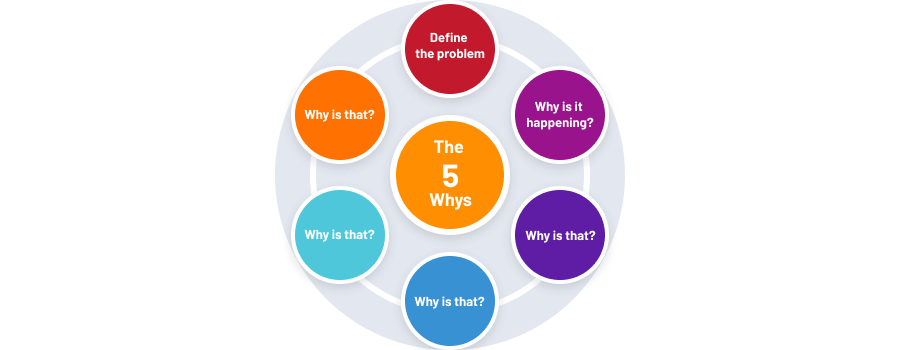
When faced with a problem, start by asking ‘Why?’ Once you have an answer, ask ‘Why?’ again, and so on. By the fifth ‘Why,’ you should reach the underlying cause.
Example: Let’s say your company has implemented team hiring automation.
Why 1: Why did our HR department decide to automate the team hiring process?
Answer 1: Because our HR team was drowning in resumes.
Why 2: Why were they drowning in resumes?
Answer 2: Because our job posting went viral on social media. Apparently, everyone thought we were giving away free ice cream with every job offer.
Why 3: Why did the job posting go viral?
Answer 3: Because someone in marketing accidentally posted it on the company’s official social media page instead of the ice cream shop’s page.
Why 4: Why did marketing make that mistake?
Answer 4: Because our marketing manager was multitasking — juggling a phone call with an ice cream vendor and a ping-pong tournament in the office.
Why 5: Why was the marketing manager playing ping-pong during work hours?
Answer 5: Because we just got a brand new ping-pong table in the office, and no one can resist the siren call of a ping-pong tournament!
So, the Five Whys analysis revealed that our HR department decided to automate hiring because of a viral job posting gone wrong, which was caused by a ping-pong table distraction. Sometimes, the answer is just as wacky as the question!
19. Business Process Analysis
Business process analysis techniques focus on the systematic examination of workflows, identifying areas for improvement, and streamlining operations. They’re an integral part of agile software development.
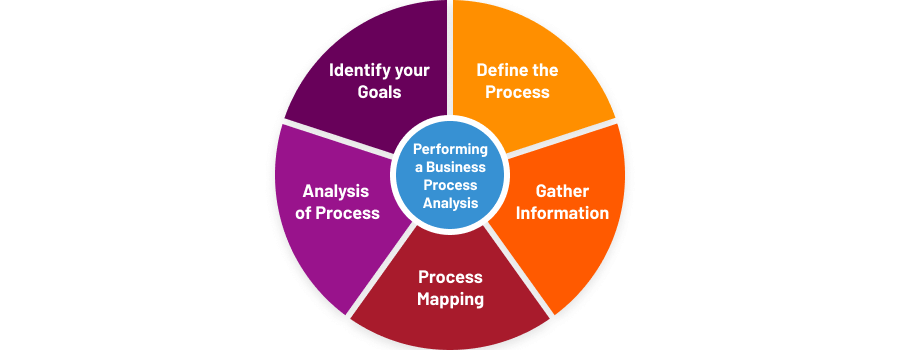
Analyze your current processes, identify bottlenecks, and propose improvements. Agile businesses embrace change, and business process analysis is a key enabler of that change.
Example: What’s with the processes in our B2B marketplace?
Process 1: Vendor Registration
- Vendors fill out a registration form with their company info.
- Our team reviews the application, cross-referencing it with our ‘Who’s Who in the Business World’ encyclopedia.
- If they pass, we send a welcome email. If not, we send them a ‘Sorry, You’re Not Famous Enough’ gif.
Process 2: Product Listing
- Vendors add their products to our marketplace. If they can’t decide what to list, we suggest adding a ‘Llama Pillowcase’ category.
- Our team checks product listings. If they find a ‘Llama Pillowcase’ in the automotive section, we share it in our ‘Epic Product Fail of the Month’ newsletter.
Process 3: Customer Orders
Customers place orders, but they have to answer a riddle first. If they get it wrong, we send them a riddle-themed rejection email.
Process 4: Shipping
Vendors ship products. If they’re late, we send them a ‘Time Traveling Delivery’ award.
Process 5: Payment
Customers pay. If they pay in under a minute, we send them a ‘Speedy Shopper’ badge.
In our B2B marketplace, we take business seriously, but we never forget to have a little fun!
Embrace Strategic Decision-Making
They are not all business analysis techniques out there, but they’re some of the best examples of how to complement advanced analytics and tackle the complex world of strategic decision-making with confidence, creativity, and fun methods. Remember, the key is to adapt and evolve, just as your business does. By combining these tools and the right business analysis model with your expertise, you’re well-equipped to steer your business toward success.
Business Analysis in IT
Now that you have an extensive toolkit at your disposal, the future of your business looks brighter than ever. Once you start, you’ll never stop analyzing and will soon find yourself implementing business analysis everywhere the project goes.
Still stuck with the business planning for software products? Don’t hesitate to contact us and collaborate on your product vision!