
In recent years, the popularity of the Internet of Things (IoT) has been steadily rising, particularly within the industrial sector. This is evident by the fact that the market stood at over $221 billion in 2022 and is forecasted to reach $516.6 billion by 2028.
With so many smart devices and sensors operating within this business sector, the amount of data that needs to be processed is also steadily increasing. Thus, contributing to a rise in demand for industrial IoT (IIoT) gateways that can help deal with the influx of digital information to the cloud and various data centers.
If you aren’t sure what these gateways are — don’t worry, we are here to help. In this article, we’re going to dive into the subject of industrial IoT software, edge computing, and the use of gateways for connectivity and data processing. So, by the end of the post, you’ll know exactly how useful these tools can be.
What are Industrial IoT Gateways?
Let’s start by getting a better understanding of what IIoT gateways are and how they are connected with edge computing, smart hardware devices, and the like.
You may have heard of the term edge computing before. It has been gaining a lot of traction, particularly as a key trend in IoT for manufacturing, but also across other industrial spheres. According to Gartner, it is a “distributed computing topology” that allows for information processing to happen closer to “the edge, where things and people produce or consume that information”.
In simpler terms, it is a concept that allows for data storage and analysis to occur closer to the data-generating devices. Thus, reducing latency and boosting efficiency as digital information no longer needs to travel to a central server for data analytics to be implemented.
Discover the Types of Data Analysis in Business
So, in this context, industrial IoT gateways are the “bridges” that connect edge devices and the cloud by collecting and processing digital information from sensors prior to transferring it to the cloud.
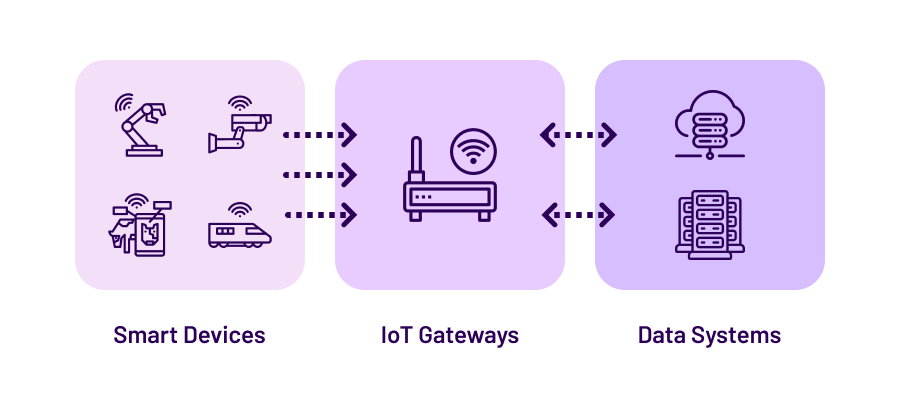
Visually, these gateways resemble routers that most of us have at home. However, it is the software within the hardware that is most valuable as it helps alleviate the data processing burden placed on the cloud and data centers.
In short, an effective industrial IoT gateway standardizes collected digital information, transforms disparate data streams into a single format, and allows for real-time processing so that immediate action can be taken when needed.
Types of IIoT Gateways
There are two main types of gateways out there — fanless and rugged. Overall, the goals of both are the same, the difference lies in the durability of each.
A fanless IIoT gateway is like a compact computer that is easily deployed in unstable environments. For example, in locations with extreme temperature levels, a lot of dust or debris, and with risk of extreme vibrations.
On the other hand, rugged gateways are designed to withstand even more adverse conditions. As such, they tend to have additional durable layers or enclosures that enhance reliability.
Key Functions of Industrial IoT Gateways
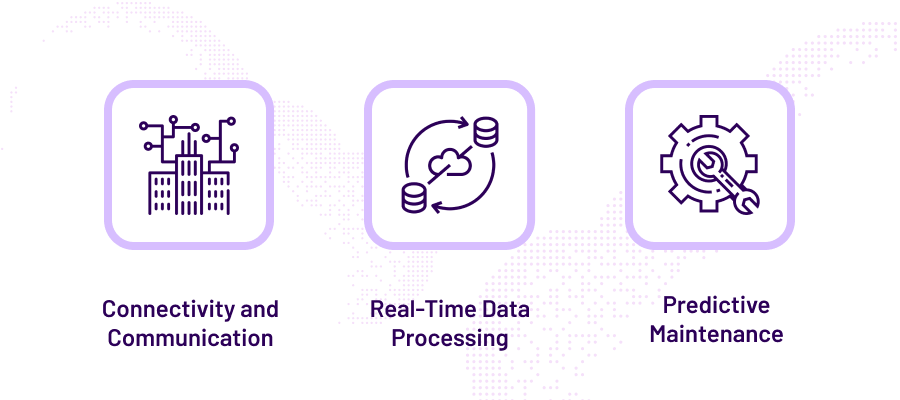
Now that we’ve gotten the definitions out of the way, it’s time to dive a little deeper. Thanks to the functionality of IIoT gateways, there are vast benefits to reap from the implementation of these tools. Hence, let’s take a closer look at the main capabilities of industrial IoT devices so that you get a better understanding of just how important they are in the modern day.
Connectivity and Communication
The very main function of IoT gateways is to facilitate connectivity and communication between company networks and remote devices. To ensure efficiency, the collected digital information is standardized for cloud consumption as well as analysis at the edge. Thus, naturally enabling interoperability among legacy systems, equipment, and various company-employed devices.
Real-Time Data Processing
You see, most often, data gathered from smart devices needs to travel to the cloud for in-depth analysis and subsequent decision-making. Naturally, depending on distance, this can take some time, which hinders the ability to respond swiftly to issues.
Discover an IoT Product With Real-Time Analytics Capabilities
In an industrial setting, fixing issues as soon as they come is imperative. Otherwise, the risk of production delays and negative financial consequences is significant. Thanks to the ability of IoT gateways to analyze digital information locally, this doesn’t have to be an issue any longer. Instead, data is processed at source, and any necessary steps can be taken almost instantly.
Monitoring and Predictive Maintenance
Finally, industrial IoT gateways are crucial in powering predictive maintenance and overall production monitoring. As we said, these solutions facilitate real-time data processing and that’s a must if you want to gain access to machine failure predictions in advance. After all, it’s important for you to have time to fix any problems before actual breakdown occurs.
Read up about an IIoT System for Monitoring Helical Pile Installation
In this way, IoT gateways significantly reduce or completely eliminate the costs that come from unexpected downtime, production delays, and the like. So, it’s no surprise that more and more business leaders are looking at edge computing and industrial IoT gateways to boost performance.
Top 7 Considerations When Choosing IIoT Gateways
Selecting optimal software and hardware for your business can be overwhelming regardless of which solutions you’re looking into. However, it is especially the case with industrial IoT gateways, as things can get quite technical very fast.
So, in order to ensure you are well-equipped for conversations with your IT team, we’ve rounded up some key points you should consider when looking at industrial IoT gateways. Let’s get into it.
1. End Goal

For instance, you might be looking to improve supply chain management by ensuring that products are transported at the required temperatures and in optimal conditions. This could be the overall end goal but don’t forget to get more specific.
Consider whether you’d like truck drivers to be notified of any issues or for condition control technologies to make automatic adjustments when, for example, temperature drops too low. What is it precisely that you’re trying to accomplish? That’s the important question to answer.
Read up on how we implemented a Cold Chain Monitoring IoT Solution
Having a clear idea about your purpose helps minimize issues and project delays and is crucial for the success of the initiative. So, don’t skip over this important step of the process.
2. Data Amount
So, try to figure out how much data the IoT gateway will likely have to deal with and choose a tool that will be able to store and process all of it. Plus, don’t forget that you may want to increase storage capacity as time goes by. Hence, an IIoT gateway that allows for expansion when needed might be ideal.
3. Pre-Processing Capabilities
Perhaps, fighting latency and acquiring immediate insights simply isn’t what you’re after and instead would just like for digital information to smoothly be transferred to the cloud. Whatever the situation may be, you’ve just got to think about it because the type of gateway you acquire will depend on it.
4. Security

Take a look at an Effective Blockchain-Based Security System
What data protection features does a gateway have? Are there any weak points within your IoT infrastructure? What encryption standards and authentication mechanisms are used? These are all the questions you should be asking when discussing the project with vendors and software development partners.
Some of the most popular encryption standards include DES, AES, RSA, Twofish Encryption Algorithm, but check with your IT partner to figure out which security measures might work best to protect an IoT gateway in your case.
5. Installation Site

Do they need to function in extremely low or high temperatures? Are you going to place a gateway in an area with a lot of shaking? Once you’ve answered these questions, it’ll be easier to determine which kind of a gateway is best.
6. Connectivity Options

Of course, the majority of modern gateways will support popular protocols. Nonetheless, these are the common ones you should be on the lookout for:
- Ethernet
- Bluetooth
- LoRaWan
- LTE
- GPRS
- GSM
- Modbus
- HTTPS
7. Integration Needs

So, don’t forget to flag this concern with your development partner and double-check that all platforms will work together seamlessly. Doing this upfront will save you a lot of time and money down the road.
Top Use Cases of Industrial IoT Gateways
Before wrapping up everything we’ve covered today, let’s briefly go over some examples of how the Internet of Things gateways are used for industrial automation in different sectors. With all the capabilities that this class of technology delivers, there are several use cases we can consider the most prominent.
Manufacturing
This area is the most obvious as gateways are extensively used in manufacturing environments to connect and monitor production equipment, robots, assembly lines, and other machinery. In essence, they enable real-time monitoring, predictive maintenance, process optimization, and data-driven decision-making.
Energy and Utilities
The next one is the energy sector. Here, IoT gateways also play an important role, helping connect and manage smart meters, power distribution systems, renewable energy sources, and grid infrastructures. By doing so, they facilitate various processes from energy monitoring and demand response to grid optimization and asset management.
Oil and Gas
Internet of Things gateways find applications in the oil and gas industry for remote monitoring and control of drilling operations, pipelines, storage facilities, and refineries. Like in other sectors, they help improve safety, optimize production, detect anomalies, and enhance asset management.
Agriculture
In agricultural technology, you will find that an IoT gateway can connect and monitor various sensors, irrigation systems, weather stations, and, for example, livestock tracking devices. They enable precision farming, crop monitoring, water management, and livestock optimization.
Transportation and Logistics
The transportation and logistics field leverages gateways to connect vehicles, tracking devices, warehouse systems, and supply chain networks. With this technology in use, companies can improve real-time tracking, optimize routes, enhance inventory management, and streamline fleet monitoring.
Mining and Construction
This is another sector we’d like to mention here as it also benefits from using industrial IoT gateways. By connecting and monitoring heavy machinery, sensors, and safety equipment, mining and construction businesses take their operations to the next level. Among them are remote monitoring, predictive maintenance, worker safety, and equipment utilization.
Implement the Right IIoT Gateway
As you can see, there is a lot to discuss in the topic of the industrial Internet of Things, gateways, intelligent hardware, and the like. Edge computing is gaining a lot of traction in manufacturing, logistics, construction, and similar business sectors. Naturally, the demand for IIoT gateways is rising with it.
If you’d like to capitalize on the rise of these technologies — don’t hesitate to contact Velvetech. We have significant expertise in implementing successful industrial IoT solutions and ensuring our clients acquire software that truly solves their unique business challenges.
So, fill out the form below, and we’ll get back to you shortly. Whether you’re interested in industrial IoT devices, edge computing, or are simply eager to figure out ways of boosting your company performance — we’ll be happy to help.