
The spread of smart devices both in the home and in the industrial setting has made developing Internet of Things hardware a profitable and highly competitive sphere. In this article, Velvetech experts provide a comprehensive guide to everything businesses need to consider before launching an IoT hardware product.
Key Highlights
- Reliability, scalability, and interoperability are the top three factors lying at the forefront of robust IoT hardware.
- Bespoke IoT hardware can be seamlessly customized to meet evolving business needs and stay competitive.
- By having full ownership and control over custom IoT hardware, businesses can establish the roadmap for updates, upgrades, and maintenance.
- Custom IoT platforms use high-quality, rugged components and tailored reliability testing to ensure consistent performance and minimize device failures.
What Is Internet of Things Hardware?
Internet of Things (IoT) hardware refers to the physical elements and components that are used to connect objects, devices, and systems to the Internet, enabling them to collect, send, and receive data. They typically include sensors, actuators, microcontrollers, communication modules, and other necessary components. Let’s take a closer look at them.
Sensors

Learn how to leverage your IoT Hardware for Sustainability
Selecting the relevant sensor for an IoT device may be a bit challenging. Below are the core factors to assist you along the way.
- Goals: As in any beginning, here as well, everything starts with clearly defining what the exact goal of employing sensors is.
- Environment: Consider the specific type of environment you are going to place sensors in. Is it very cold or very hot, or maybe it’s a pretty humid place? This factor will help in selecting appropriate sensors.
- Power: Define how often you need the sensor to transmit data and how long you expect its battery to last.
- Price: Ultimately, be aware of the approximate pricing of your desired sensors to ensure that it’s not going to cost you an arm and a leg.
Actuators

Microcontrollers and Processors

Modules

Data processing modules have similar functions to traditional computers and deal with data analysis and local storage. To implement them successfully, it’s important to have a clear image of the amount of information the device is expected to work with.
IoT devices need a way to connect to the internet to send and receive data. Communication modules such as Wi-Fi, Bluetooth, Zigbee, LoRa, Cellular (3G/4G/5G), and RFID facilitate this connectivity and ensure communication with the used cloud solutions. They could be wireless or include such ports as USB or CAN.
Wearables

Smart Home Devices

Industrial IoT (IIoT)

Read about the Development of an IIoT Solution for an Engineering Company
Vehicle IoT

Explore the project where Velvetech developed a New Generation of Smart Tires
Healthcare IoT

Learn more about Wearables in Healthcare
IoT Hardware Architecture
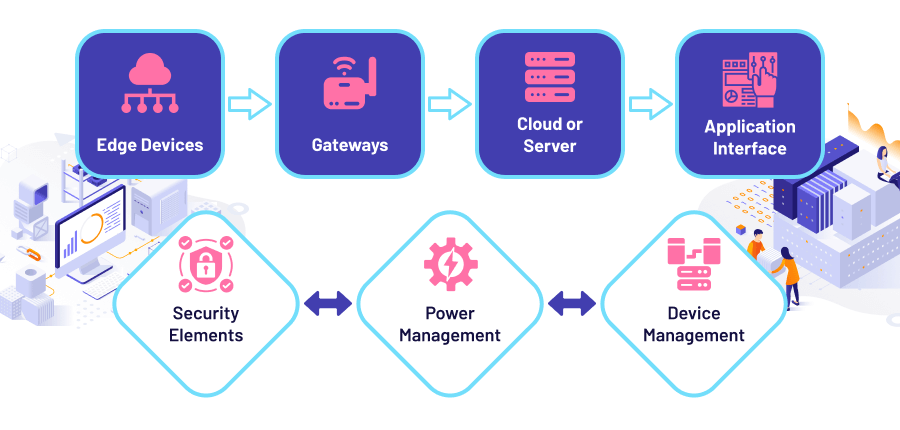
IoT hardware architecture refers to the way the physical components within an IoT system are arranged as a part of a defined structure.
Its design ensures that all the devices, sensors, communication modules, and other hardware parts are interconnected and organized to collect, process, transmit, and act on data.
The architecture can vary significantly depending on the specific use case, requirements, and scale of the IoT deployment. However, there are a number of components typically found in most IoT hardware architectures.
Edge devices are located at the fringe points of the IoT network, where they initially collect data from the physical world. They later transform it into digital form, before transferring it to gateway devices that serve as intermediaries between them and the central data processing systems.
These devices aggregate data from multiple edge sources, perform data preprocessing, and ensure secure communication. Correct gateway application in industrial IoT systems is vital due to high connectivity requirements.
Central data processing happens within a server or cloud infrastructure. Cloud platforms such as Amazon Web Services (AWS), Microsoft Azure, and Google Cloud Platform (GCP) are preferred industry options for many businesses.
Discover how to Optimize Your Cloud Costs
These platforms receive data from the gateway devices, store it securely, and enable advanced analytics, machine learning, and visualization.
As a more modern and performant alternative, edge computing on IoT devices may be used instead of traditional cloud computing. It ensures lower latency rates and quicker data offload with more access points managed in real time.
Security elements are another critical aspect of IoT hardware architecture to protect data, devices, and the overall system from cyber threats. Hardware-based security features such as Trusted Platform Modules (TPM) or Secure Elements also offer IoT systems enhanced protection.
For IoT devices, especially those in remote or battery-operated settings, efficient power management is equally vital for cost-efficiency and productivity. On a hardware level, architectures may include power-saving features, sleep modes, and the use of low-power components, as well as energy-collecting techniques, such as solar panels or kinetic energy harvesting.
IoT hardware architectures often incorporate systems for remote device management and monitoring. These solutions enable administrators to update firmware, configure devices, diagnose issues, and track device health.
Learn more about Embedded Systems in IoT
Finally, application interfaces exist to allow users to interact with IoT devices. Their design varies from mobile apps and web dashboards to interactive panels, which make up a crucial part of the architecture. These interfaces allow users to monitor data, control devices remotely, set up automation rules, and receive alerts or notifications.
What Makes Up Great IoT Hardware
A successful solution exhibits a range of features that contribute to its effective implementation in business and industrial processes. Here are the top characteristics that can make or break it.
Reliability

Scalability

Interoperability

Robust Security

Find out all about IoT Security Issues
Optimized Power Consumption

Data Processing Capabilities

Unveil the Role of Machine Learning in IoT
Ease of Deployment and Maintenance

Cost-Effectiveness

Long-term operational costs, including maintenance, upgrades, and energy consumption, are all important considerations. In some situations, they can be offset by design excellence, but in others, they may turn into an unmanageable burden on the system.
Adaptability

User-Friendly Interface

Key Steps in IoT Hardware Development
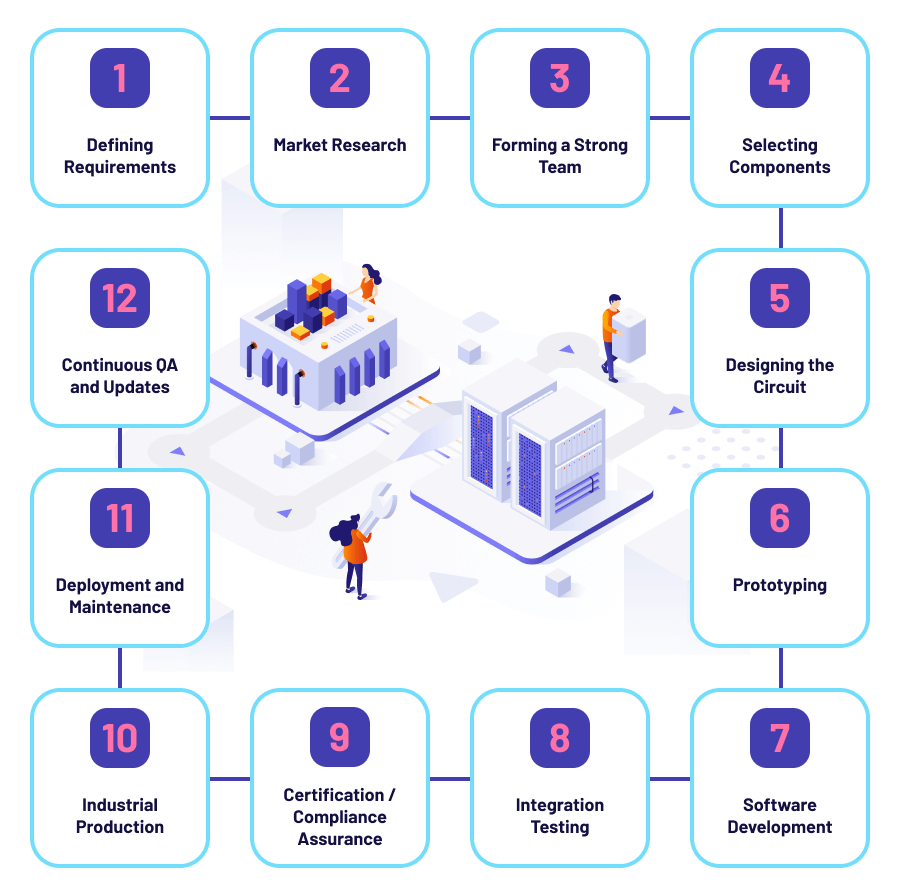
Process management is as important for IoT hardware development as its more technological aspects. By taking into account its main stages and building a structured roadmap, an enterprise can ensure a solid foundation for its product’s success. Let’s look at a brief overview of these essential steps.
Step 1: Defined Requirements
The first step is to clearly define the requirements of the IoT device. This includes understanding its intended use, the environment it will operate in, the data it needs to collect, the type of connectivity required (Wi-Fi, Bluetooth, cellular, etc.), and any specific constraints such as power consumption or size.
Step 2: In-Depth Market Research
Conducting market research is key to understanding the existing solutions, competitors, and potential customers. Evaluate the feasibility of your IoT hardware project, considering technical requirements, costs, regulatory constraints, and market demand for a smooth post-production sales process.
Step 3: A Strong Team
This is a demand applicable to any development project. However, it becomes paramount in IoT hardware development, as it requires a multidisciplinary team with expertise in hardware engineering, software development, data analytics, user experience design, and project management. To reach your business goals faster, ensure clear communication channels and collaboration among team members.

Expanding a Team
Step 4: Appropriate Components
Based on the requirements, developers choose the necessary components for the IoT device. This includes microcontrollers or microprocessors, sensors, actuators, communication modules, power sources, and other supporting hardware.
Step 5: Circuit Design
Engineers design the circuit board layout considering factors such as size constraints, power consumption, heat dissipation, and signal integrity. This involves using CAD (Computer-Aided Design) software to create the schematics and layout of the circuit board.
Step 6: Prototyping and Iteration
Once the circuit design is complete, a prototype of the IoT device is built. This involves soldering components onto a circuit board and assembling the device. The prototype allows developers to test the functionality of the device, identify any issues, and make necessary improvements in a step-by-step fashion.
Step 7: Software Development
Alongside hardware, software engineering plays a crucial role in IoT devices. This includes developing the firmware that runs on the device’s microcontroller or microprocessor. The firmware controls how the device interacts with sensors, processes data, communicates with other devices or servers, and manages power consumption.
Step 8: Integration Testing
Next, the company conducts extensive testing to ensure that the hardware and software work together as intended. A common practice is testing the device in different scenarios, checking its performance under various conditions, and verifying its ability to communicate with other devices or servers.
Step 9: Certification and Compliance Assurance
Depending on the intended market and application, IoT devices may need to comply with various industry standards and regulations. For example, there exist certifications for safety, electromagnetic compatibility (EMC), wireless communication standards, and data security. Additional costs for certification need to be taken into account while drafting your IoT project budget.
Step 10: Mass Production
Once the IoT device has passed all testing and certification requirements, it can move into mass production. This involves manufacturing the hardware components, assembling the devices, and ensuring consistent quality control throughout the production process.
Step 11: Deployment and Maintenance
The next step is deploying the IoT devices to their intended locations or users, so you may need to set up networks, configure devices, and provide user instructions. Additionally, ongoing maintenance and updates to the firmware may be necessary to ensure the device continues to function properly and remains secure.
Step 12: Continuous QA and Updates
Gathering feedback from users and monitoring the performance of the deployed solution may proceed via data analytics to derive insights and identify areas for improvement. At this stage, users expect regular software updates, bug fixes, and new features to enhance the functionality and security of your IoT hardware.
Discover 6 Types of Data Analysis for Better Decision-Making
Why Choose Internet of Things Hardware
There are many reasons to consider building IoT hardware for your business. In many cases, custom solutions provide an enterprise with better performance and integration than third-party offerings. Nevertheless, it pays to keep in mind the specific benefits that they have.
Benefits of Custom IoT Hardware
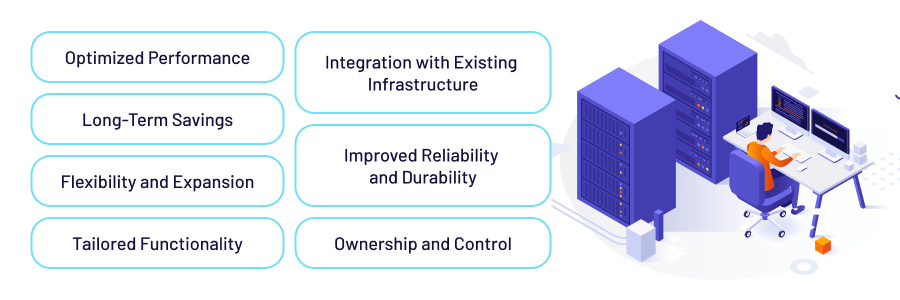
Custom IoT hardware offers several advantages over off-the-shelf solutions, especially when tailored to specific use cases, industries, or requirements.
These include:
Optimized Performance. Custom hardware can be designed with specific performance requirements in mind, tailored to the exact needs of the application. By selecting the right components, processors, sensors, and communication modules, developers can optimize the device’s performance for speed, accuracy, and efficiency.
Long-Term Savings. While the initial development cost of custom IoT hardware may be higher, it can lead to long-term cost savings. It allows for the elimination of unnecessary features and elements, reducing the overall bill of materials (BOM) cost.
Flexibility and Expansion. The flexibility of custom hardware enhances customization based on evolving business needs, industry requirements, or technological advancements. As the IoT infrastructure grows, the components can scale accordingly to prevent costs associated with total system overhauls due to outdated or low-capacity parts.
Tailored Functionality. It means that you have only the features needed for the application, no more, no less. Developers can incorporate specialized sensors, actuators, or communication protocols that are not available in off-the-shelf devices. Tailored functionality allows for the creation of unique, innovative IoT solutions that differentiate businesses in the market.
Integration with Existing Infrastructure. The hardware’s design aims at seamlessly integrating with existing systems, software, and networks within an organization. Compatibility with legacy systems or proprietary software can be ensured, minimizing disruptions and simplifying deployment. Integration with cloud platforms, data analytics tools, and enterprise software becomes more straightforward with custom hardware.
Improved Reliability and Durability. Custom IoT platforms can be built using high-quality components and rugged designs suitable for harsh environments or industrial settings. Reliability testing and quality assurance can be tailored to the specific requirements of the application, ensuring consistent performance. With longevity and durability prioritized, the risk of device failures and maintenance needs is minimized.
Ownership and Control. Organizations have full ownership and control over custom IoT hardware, allowing them to dictate the roadmap for updates, upgrades, and maintenance. Custom devices are not subject to the limitations or dependencies of third-party vendors, giving businesses greater autonomy. Intellectual property rights are retained, protecting proprietary technologies and innovations developed as part of the hardware design.
In short, custom IoT hardware allows organizations to create unique, differentiated products or services that stand out in the market. Tailoring devices to specific customer needs or niche markets can lead to a competitive edge and increased market share.
These advantages provide an attractive option for businesses looking to create tailored, efficient, and innovative IoT solutions that meet their specific needs and requirements.
At the same time, the very characteristics that make these so popular may cause damage if the enterprise encounters some of the elements of poor IoT hardware design.
The main difference between custom and off-the-shelf IoT hardware is cost and scalability. Custom IoT hardware requires higher upfront costs, but unlike off-the-shelf products, it meets exact and specific business needs.
Plus, as your business grows, you’ll more likely need to scale your product. But the truth is off-the-shelf products are not always easily customizable. Moreover, switching subscription plans or adding new features may cost more in the future than the initial investment in custom IoT hardware development.
IoT Hardware Design Pitfalls
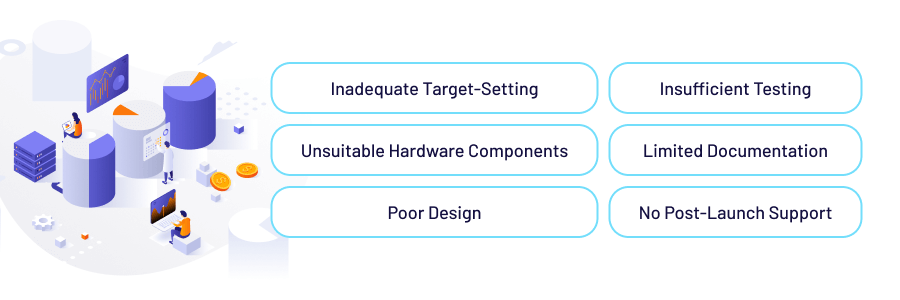
Inadequate Target-Setting. Unclear or changing requirements can lead to a misalignment between the developed hardware and the actual needs of users or stakeholders. If the use cases are not clearly defined, it can result in a lack of focus and direction for the development team. Insufficient understanding of the market, including customer needs, competition, and trends, can lead to developing a product that does not meet market demands.
Unsuitable Components. Selecting inappropriate or unreliable hardware pieces can result in performance issues, compatibility problems, or difficulties in production. It will also be likely to raise maintenance costs down the road and require more testing and iterations, which may overwhelm your budget.
Poor Design. Design flaws in the hardware architecture, layout, or connectivity can lead to inefficiencies, performance bottlenecks, or difficulties in assembly.
Insufficient Testing. Skipping or inadequately performing testing phases can result in undetected bugs, performance issues, or unreliable device behavior.
Limited Documentation. Poor documentation for users, developers, or production teams can bring about difficulties in setup, maintenance, or troubleshooting. As with building software, clear guidelines and documentation are essential at all development stages.
No Post-Launch Support. Neglecting post-launch support, updates, or maintenance can result in unresolved issues, missed opportunities for improvement, and lower user satisfaction. This, in turn, may decrease the market share of your product or even cause it to fail altogether.
To mitigate these risks and ensure successful project implementation, it’s crucial to plan ahead and continuously improve products throughout the development lifecycle.
According to Grand View Research, the IoT market size is expected to reach $181.17 billion by 2030. For comparison, in 2024 it was $70.3 billion. That huge jump probably leaves no room for doubt that IoT hardware development has a promising future. So, if you have a project idea in mind, now is the right time to approach it.
Embracing Hardware for Business
Virtually every industry can reap the benefits of introducing IoT hardware into their business processes due to the high adaptability, scalability, and efficiency of these solutions. The question is how to achieve that.
Here’s our Ultimate To-Do List to Launch a Successful IoT Project
We at Velvetech have been leveraging our expertise in IoT hardware engineering to offer services and competitive solutions that ensure our clients’ success. Get in touch to start the conversation right now.