
We all know this Hypocrite’s quote “The disease is easier to prevent than to cure”. Indeed, taking preventive measures can save many nerve cells, money, and above all – health. However, the given phrase can be applied not only to a single patient but also to the general population. It’s much more reasonable to prevent disease outbreaks than to deal with the aftermath, given the scale of the problem.
Predictions in healthcare are impossible without information and the right healthtech solution. Historical and real-time data have to be recorded and analyzed to be used for further forecasting. But what paths do they travel to become suitable for these purposes? What’s the cost of data processing failures and how do they affect prediction accuracy in the context of healthcare?
That’s the topic we’d like to touch upon in this blog post – predictive analytics in healthcare. How it helps the industry to move forward, consider some examples of predictive analytics in healthcare, and which pitfalls may occur on the way to accurate predictions.
What Is Predictive Analytics in Healthcare?
What is predictive analytics in general? If we turn to Deloitte, it defines predictive analytics as a subtype of data analytics for the creation of predictions about something unknown in the future. Put simply, the forecasts are built upon historical and real-time data.
In healthcare, predictive analytics allows us to anticipate future trends by leveraging diverse healthcare information from various sources, including Electronic Health Records (EHRs), patient registries, surveys, health insurance claims, and more. Also, it helps to maintain HIPAA compliance through medical and billing data analysis and detect potential fraud.
But how exactly can we use the tool, what are the pros and cons of predictive analytics in healthcare, and what issues can it help to address? Let’s explore some examples in the following section.
Use Cases of Predictive Analytics in Healthcare
Decision-Making & Resource Allocation

In addition, our task is to anticipate how big these substations should be – how many ambulances are to be procured and how many dispatchers should be hired. To make an informed decision and allocate our resources wisely, we should predict the number of possible calls to the emergency.
We’re not able to make a forecast out of thin air – we need a lot of different information. Statistics on emergency calls for the past period, including the difference between daytime and nighttime, the approximate average population of the similar residential area, patient waiting time, and so on. Only after gathering all this info and its thorough analysis will we be able to make most accurate predictions and plan and allocate our resources reasonably.
Sure thing, the example is relevant not only for large-scale resource planning. Healthcare predictive analytics can also be used for capacity and resource management within a particular medical facility, its staff workload planning, equipment maintenance planning, and many more.
Discover the Types of Data Analysis for Better Decision-Making
Disease Outbreaks Prevention

For example, BlueDot, a Canadian startup developing AI and predictive analytics solutions, gave a warning about the occurrence of unknown pneumonia on Dec 30, 2019, in Wuhan, while the WHO officially declared the emergence of the virus in 9 days only.
Explore more about the Role of AI in Healthcare
The given example showcases that using the power of predictive analytics we can foresee even novel viruses. But if we speak about well-researched diseases such as measles for example, the outbreaks can be foreseen well in advance.
Disease Progression Prevention

How can this be possible? Scientists used the health indicators of patients with Alzheimer’s disease and their medical tests before diagnosis and trained the model on them. Taking note of this example, just imagine how many other diseases, including even deadly ones, can be foreseen and even prevented with the help of historical and real-time data!
Read how we helped build an RPM Solution to Prevent Urinary Conditions
Treatment Optimization

Therefore, each patient requires a personalized treatment approach, and a doctor should take into account all patient specifics not only to cure but also to do no harm when making prescriptions. With the help of healthcare predictive analytics software, doctors can track patient health indicators and adjust treatments accordingly.
Predictive Modeling in Healthcare: Steps for Accurate Forecasting
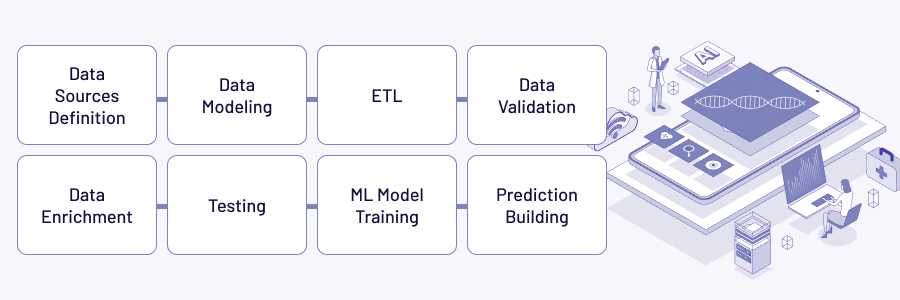
Now, let’s move on directly to the predictive modeling process. One does not simply make predictions without appropriate and thorough preparation, especially, if you work with big data. Data must be found, processed, and validated to be suitable for further usage.
Here’s a brief overview of the stages we go through before we leverage our healthcare data for forecasting.
Data Sources Definition
Depending on the goal we pursue when using predictive analytics in healthcare, we determine the necessary sources from which we’ll extract our data. For example, if we need to predict the level of flu cases for the next season, we may need a register containing information on the incidence of the population in past years. That contains general information on incidence, not just flu, EHRs, as well as metrics from medical equipment analyses.
Data Modeling
At this stage, we are finalizing the requirements for the ETL process and the prediction itself. In other words, we thoroughly work out the selected sources, choose the columns we’ll work with, and identify only the data that we need. In this particular case, we select only information on flu incidence and the results of examinations of people with this diagnosis.
It’s important to understand that modeling is an iterative process, and we can revisit it at any subsequent stage. This could be triggered by the emergence of new data or the discovery of inaccurately provided data.
Read about the Top Data Modeling Techniques
Extract, Transform, Load
During the ETL stage, we proceed directly to raw health data extraction from the required sources, processing and filtering, and loading into our chosen storage for subsequent prediction-building. The quality of the process and built data architecture will determine the system’s forecasting capabilities, that’s why this step is of paramount importance.
Data Validation
This stage involves verifying the data already loaded into the storage. We check the quality of the transformed data, its consistency, and whether it corresponds to the intervals of acceptable values.
Data Enrichment
At the enrichment stage, we have the opportunity to expand our dataset by adding extra columns. This becomes possible through the use of special tools, such as LLM (Large Language Model). For example, a doctor leaves notes after a patient’s visit. An LLM model is capable of analyzing handwritten text and providing the assessment of the patient’s condition in the range of 0-10, and this value can be used in the prediction itself.
Testing
The validation stage entails only checking the data format, whereas testing helps verify the entire flow. For example, we added new data to the ETL process and thereby slightly altered it. In such a case, tests that previously had worked successfully may have failed, which indicated that something went awry in the flow itself.
ML Model Training & Prediction Building
After we’ve prepared our healthcare data and made sure that they are clean, consistent, and suitable for further usage, we may start to select the machine learning model, train it on them, and build predictions. Below, there is a table on major steps for prediction building.
|
Step
|
Description
|
|---|---|
| ML Model Selection | Choose the right machine learning model based on the data type, desired outcome, and complexity. Options include Linear Regression for simple predictions, Decision Trees for non-linear data, and Neural Networks for complex patterns like image recognition. |
| Data Preprocessing | Prepare data by normalizing numeric inputs, imputing missing values, and encoding categorical data to ensure it is in a format suitable for modeling. |
| Training the ML Model | Adjust model parameters through cross-validation and regularization to prevent overfitting and ensure it performs well on new data. |
| Prediction Building | Generate predictions using the trained model on new data, apply appropriate thresholds for binary outcomes, and evaluate probabilistic outputs for decision-making under uncertainty. |
| Model Evaluation | Use accuracy, precision, recall, ROC-AUC, and F1 Score to evaluate the model’s performance and ensure its reliability for healthcare applications. |
| Continuous Learning and Model Updating | Incorporate new data through online learning or apply transfer learning to keep the model updated and relevant for current medical challenges. |
Forecast Precision in Danger: Main Risks of Predictive Analytics in Healthcare
As always, it’s easier said than done. All the steps of predictive analytics in healthcare mentioned above sound quite simple but it’s just in words. There are so many factors that may affect the accuracy of predictions, starting from the engineer’s ineptitude and ending up with business rules alterations. Below, let’s take a look at some of the most common problems with predictive analytics in healthcare that are worth considering.
Poor Raw Data Quality & Heterogeneity
Problem
Let’s explore the example of medical equipment for blood testing. A sensor that detects hemoglobin levels had malfunctioned, which was not immediately detected by the laboratory staff. Consequently, due to the faulty equipment, we receive incorrect results, which are then loaded into the database. Thus, since our source data are of low quality, it’s quite naive to expect accurate predictions on their basis.
Solution
If the equipment returns extreme values, for example, 0 or 1000, which is completely unacceptable when we are talking about hemoglobin levels, then we can easily detect such anomalies at the validation stage and conduct filtering immediately.
Of course, it’s a bit more complicated if the equipment returns results within the normal range. For example, over the past week, the hemoglobin levels of all patients were 139 and 140, which is in the normal range, but the equipment did not return any other values at all. In this case, we can use Artificial Intelligence to power an anomaly detector, which will help identify points that don’t fall into the statistical norm range for this sample.
Alterations in Initial Sources
Problem
Let’s continue discussing the hemoglobin indicator with the following example. Say, in the database containing equipment analysis results, the firmware was updated. As a result, the column that was previously called hemoglobin was transformed into Hemoglobin, meaning that the lowercase letter was changed to uppercase. The ETL, expecting the column name “hemoglobin”, cannot find the necessary column in the source and logically fails to process this data further.
Solution
To detect such discrepancies promptly, it’s necessary to set up alerts that will notify us if an error occurs. In our ETL pipeline, we will also need to change the column name so that the process continues smoothly and without a glitch.
ML for Predictive Analytics in Healthcare
As a rule, predictive analytics in healthcare can’t do without Machine Learning, however, it’s possible to use mathematical statistics formulas to create predictions. But if we speak about such a complex domain as healthcare, there are tasks that can’t be done with formulas only, and we need to leverage one of the ML models.
When is a formula enough? Say, we want to predict the amount of COVID patients for the next month in one particular hospital. We take figures for previous months and, with the help of special tools like Facebook Prophet, for instance, gain the result. Obviously, the prediction will not be as accurate as we could count on using ML, but if we need only a recommendation – that’ll do.
Higher Prediction Accuracy as ML’s Greatest Benefit
Relying only on formulas that predict trends, we can’t consider third-party factors that may affect the final result. For example, we need to predict the number of patients that must be vaccinated to decrease the measles case rate. We understand that there is a dependency of incidence on vaccinated patients. Therefore, we train our ML model on the vaccination data for previous years and make a prediction, and the level of accuracy will be quite high.
As always, there is a caveat we can’t fail to mention. Measles is well-studied and quite stable, which can’t be said about influenza or, moreover, COVID. New strains emerge from time to time, and making predictions considering these diseases is not an easy task to tackle.
ML Challenges Worth Mentioning
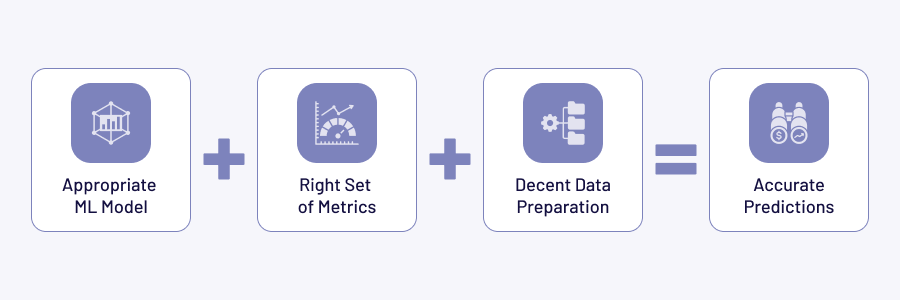
1. ML Model Selection
There are numerous ML models that can be used for predictive analytics in healthcare. However, it’s challenging to foresee how this or that model would work particularly in your case. Therefore, the most suitable ML model can be selected only through trial and error, no matter how sad it may be.
2. Picking the Right Metrics
Incorrect metrics selection, their excessive or insufficient number, and wrong definition of dependencies between them – all these factors affect prediction accuracy. This can be resolved with the help of specific tools, such as scatter plots and big data analysis.
Learn the key things about Data Analysis in Healthcare
3. Thorough Data Preparation
Sometimes, no matter how perfectly your ML model corresponds to your aims and how well it may have worked on your data. If something that we discussed above about preparation steps goes wrong – ML will be powerless. Therefore, to make everything run like clockwork, it’s necessary to pay due attention to the preparation phase, not only to ML algorithms.
To Wrap It Up
Predictive analytics, especially using big data, helps us expand opportunities and mitigate related risks in healthcare. With the right approach, we are empowered to manage population health, decrease the likelihood of irrational resource allocation, take preventive measures in case of high probability of disease outbreaks, and many more. But we should always keep in mind that the key phrase here is “the right approach”.
Find out why Having a Data Analytics Strategy Is a Must
Without thorough preparation, strategizing, and consideration of numerous intricacies of data manipulation, predictive analytics in healthcare may turn out to be not just a useless tool but also a quite dangerous one if your forecasts are far away from a decent level of accuracy.
Velvetech’s team has a vast experience in healthcare software development complemented by a proven proficiency in data analytics. Reach out to us, and we’ll assist you in extracting maximum value from your data for your healthcare project!
P.S. Our following blog post will also be dedicated to data. Next time, we’ll narrate about healthcare data visualization, its best practices, and most painful challenges, so stay tuned!