

RPA stands for Robotic Process Automation. It refers to the use of software robots or “bots” to automate repetitive and rule-based tasks that are usually performed by humans.
These bots are designed to mimic the actions of a human user interacting with digital systems and applications. They can navigate through software interfaces, input data, and extract information from documents, all that across multiple systems, often without the need for human intervention.
Organizations implement RPA software solutions to increase efficiency, reduce errors, save time, and cut costs associated with manual tasks. By automating routine processes, employees can focus on more strategic and value-added activities while RPA handles the repetitive work.
RPA technology is often used in various industries such as finance, manufacturing, insurance, customer service, and others. It has the potential to significantly transform how businesses operate by streamlining operations and improving productivity.
Among other industries, RPA services are especially important for healthcare, where growing patient numbers and labor shortages may easily disrupt service delivery. Recent years have seen this sphere embracing more and more healthtech solutions to offer better services to those who need them.
Read more about How RPA Enables Digital Transformation Industry-Wide
Robotic Process Automation in Healthcare Cycle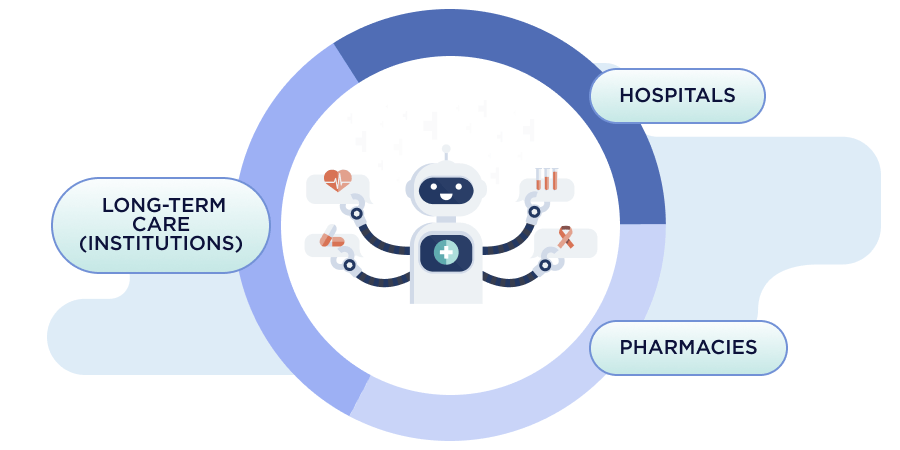
What is RPA in healthcare, and what does it mean for the main hubs of healthcare delivery?
With RPA, hospitals can automate a number of processes with varying complexity.
In terms of patient interactions, these are appointment scheduling and reminders to reduce the number of no-shows, patient registration, monitoring post-admission and after discharge, as well as billing.
Explore how we built an Appointment Scheduling System
On the administrative level, the processes that can be automated include insurance management, claim and invoice processing, together with revenue cycle monitoring and payroll organization.
Pharmacies can see the benefits of RPA in healthcare by integrating it into prescription ordering, processing and delivery, inventory management, forming medication reports, and more.
Long-term care institutions, such as retirement homes, have the opportunity to improve data management for their residents, optimize prescription ordering and distributing medication, and efficiently deal with sales, orders, and compliance.
Discover the project where we created a Long-Term Care Booking Platform
RPA is one of the most exciting and disruptive trends in the healthcare industry, with its 2022 market share being around 3.7 billion U.S. dollars, and a growth forecast of 36.6 percent by 2032. As you can see, there are tangible benefits to introducing automation on all levels, both for patients and service providers.
RPA in Healthcare: Scope & Use Cases
RPA for healthcare providers starts with simple administrative applications and goes on to cover much more complex activities.
Administrative Task Automation

Moreover, RPA systems automate the registration process for new patients, updating their information across all necessary systems for seamless record-keeping.
When it comes to billing and submitting insurance claims, RPA streamlines the process, ensuring accuracy and timely reimbursement.

GenAI for Business
Electronic Health Record Management

Bots also facilitate the transfer of patient information between different systems, so that healthcare providers have access to the most up-to-date and comprehensive data.
Based on this, RPA systems can automatically generate reports using patient data, such as test results, treatment plans, and outcomes, saving time and making sure there’s consistency in reporting.
Claims Processing

There are many RPA use cases in healthcare insurance. First, bots verify patient insurance information, checking eligibility and coverage details to streamline the claims process.
Then, automation through RPA enables healthcare organizations to quickly check the status of claims with insurance providers, reducing delays in reimbursement.
And finally, RPA systems promptly identify and address claim denials, allowing for swift resolution and improved revenue cycle efficiency.
Uncover the Role of RPA in Insurance
Patient Communication

Before appointments, RPA technology can send automated reminders via text messages, emails, or phone calls, reducing no-show rates and improving attendance.
Post-discharge, RPA systems just as easily automate follow-up communications, ensuring that patients receive timely reminders and instructions for post-care activities.
At the feedback stage, healthcare organizations use RPA bots to collect patient satisfaction surveys, providing valuable insights for improving services and patient experiences.
Compliance and Reporting

By leveraging RPA in healthcare, stakeholders have an easier time handling patient data in accordance with HIPAA regulations, for example, as it can be easily automated.
Find out what it takes to Build a HIPAA-Compliant Solution
Additionally, automation through RPA simplifies the generation of reports required for quality measures, regulatory submissions, and internal processes, ensuring accuracy and consistency across the whole organization.
Inventory Management

For instance, RPA technology automates the process of reordering medical supplies based on usage data and inventory levels. This helps healthcare facilities maintain an adequate supply at all times.
Simultaneously, inventory monitoring to check for medications that are nearing expiration and provide timely replacement reduces waste levels and improves sustainability.
Added Value of RPA in Healthcare
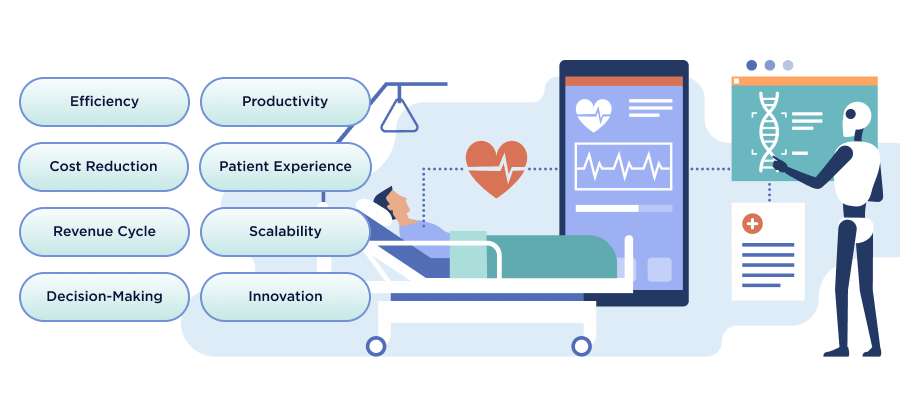
For healthcare, robotic process automation means not only better processing speed and management but a plethora of other tangible bonuses. Here are some examples of how RPA in healthcare adds value for patients and organizations.
Increased Efficiency and Productivity
The biggest boon of introducing RPA in the medical field, streamlined processes and optimized workflows are something every healthcare provider needs.
As automation eliminates or speeds up manual, repetitive tasks, it also allows healthcare professionals to focus on high-value activities. By automating tasks such as billing, claims processing, and patient record management, businesses can achieve smoother, error-free operations.
Reducing the burden that daily administrative grind places on employees is one more effective RPA solution. Automation reduces the need for manual labor in administrative tasks, leading to significant cost savings on salaries and benefits.
The risk of human error is equally minimized in data entry and billing, so nothing has to be spent on rectifying mistakes.
As a result, businesses can allocate resources more efficiently, focusing on areas that require human expertise while letting automation handle routine tasks.
Improved Patient Experience
We have previously talked about the ways RPA can enhance patient communication. This, together with higher personalization and faster service delivery, greatly improves patient experience overall.
Automation speeds up processes like appointment scheduling and prescription refills, leading to quicker service for patients. It eliminates such things as waiting in lines or trying to reach the provider by phone. And while scheduling, bots can analyze patient data to provide personalized treatment plans and recommendations, improving health outcomes.
Learn how to build Patient-Centric Healthcare
Accurate Data Management
Patient data management is very often a balancing act. Forward-thinking firms use RPA services for industry success by analyzing large volumes of patient data to gain a valuable perspective and act accordingly.
At the same time, automated systems ensure that patient records are accurate, up-to-date, and accessible when needed, not to mention compliant with healthcare regulations.
Read about Effective Data Management Strategy
Faster Revenue Cycle
Revenue cycle for healthcare includes several stages, such as appointment-making, billing, and payment processing.
Thanks to the presence of RPA in the healthcare market, companies can accelerate their billing processes, reducing the time between service delivery and payment receipt, as well as costly human-made mistakes. Thus, businesses that embrace RPA solutions maintain a steady cash flow in a much more efficient way.
Scalability
As the demand from the population grows, so should medical service offerings. RPA is instrumental in ensuring that this is the case. With automation handling less creative tasks, businesses can focus on expanding their services and entering new markets.
Like most modern software, automated systems are designed to scale efficiently, handling increased workloads without significant manual intervention. Even more so, scalability goes hand in hand with flexibility, allowing these systems to adapt to changes with impressive speed.
So, when companies adopt automation early, this gives them a competitive edge through future-proofing. This means that businesses investing in automation today position themselves for success in a rapidly evolving healthcare industry, staying ahead of the curve.
Enhanced Decision-Making
A step-up from effective patient data management, informed decision-making in healthcare is now easier due to RPA systems.
Automation generates actionable insights from patient data, enabling businesses to improve their treatment protocols, resource allocation, and strategic planning. It also powers predictive analytics to forecast patient needs, disease trends, and operational requirements.
Learn more about Data Analytics in Healthcare
Innovation and Research Advancements
With more trust in technology in the medical sphere, RPA has been tasked with managing clinical trial data, patient recruitment, and study protocols, thus accelerating the pace of medical advancement.
Summed up with routine task automation and removing the administrative burden from staff, RPA lets healthcare professionals dedicate more time to research, innovation, and development of new treatments and technologies.
Avoiding the Challenges of RPA
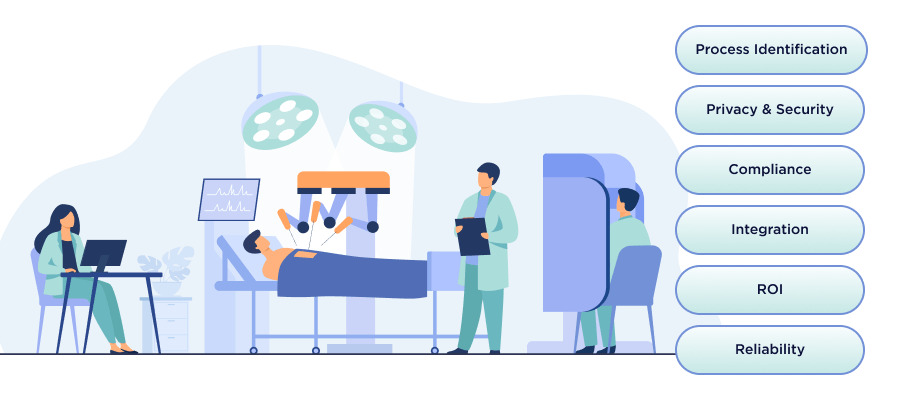
However profitable RPA integration may be in the medical sector, there are a number of challenges that businesses need to tackle first. Without a comprehensive strategy on how to address them, enterprises may feel a lasting negative impact or even see their investment fail.
However profitable RPA integration may be in the medical sector, there are a number of challenges that businesses need to tackle first. Without a comprehensive strategy on how to address them, enterprises may feel a lasting negative impact or even see their investment fail.
Process Identification
Robotic process automation works best with the so-called “single input – single output” processes, where both parts of the action are measurable and expected. As such, not all actions are suitable for automation.
Healthcare organizations need to carefully identify which tasks can benefit from RPA to maximize its impact. Moreover, implementing RPA often requires rethinking and redesigning existing workflows to fully leverage the technology’s capabilities.
In general, healthcare processes can be highly variable, with numerous exceptions and nuances. This variability can make it challenging to create standardized automation rules that apply universally.
Privacy and Security
While some aspects of automation promote data privacy in accordance with international regulations, they also introduce more points of access to patient information. This may increase the risk of data breaches if proper security measures are not in place.
Explore the Ways to Ensure Healthcare Data Security
Regulatory Compliance
Healthcare regulations are constantly evolving, requiring organizations to regularly update their RPA systems to remain compliant.
Automation implementations must maintain detailed audit trails to demonstrate compliance with regulatory requirements. Managing these logs can be a significant task.
Integration Problems
Robotic process automation relies heavily on interoperability and connectedness. Healthcare facilities often have legacy systems that may not easily integrate with modern RPA platforms.
This can require additional time and resources for customization. And considering the massive size of EHR databases, as well as the need for real-time updates, introducing RPA into these systems can be a complex process.
Moreover, if healthcare professionals and staff interact with RPA on a daily basis, they will require training to effectively use them. Providing adequate training and support is essential for successful implementation.
We know how to integrate things.
Need help with making systems work smoothly together? It’s never easy to ensure interoperability on all levels of production.
Return on Initial Investment
Many modernization initiatives fail not because of poor design, but because they are not cost-effective. Implementing RPA involves initial investments in software, hardware, training, and customization. Organizations need to assess these costs against expected returns.
After the initial investment, RPA systems require ongoing maintenance, updates, and monitoring to ensure they continue to function optimally. This can add to the IT workload and costs.
Bearing all this in mind, healthcare organizations must accurately measure the return on investment of RPA implementations, which can be challenging due to the complex nature of healthcare operations.
Reliability
As healthcare is among those vital industries where uninterrupted operations are essential, providers need to ensure that RPA bots operate reliably and consistently.
To achieve this, automated systems must be equipped to detect errors, such as data discrepancies or system failures, and respond appropriately to prevent disruptions. This demands not only further expenditures but also foresight.
RPA Implementation Outlooks for Healthcare
The future of RPA in healthcare looks bright, with analysts expecting it to claim an even bigger share of the market. Here, Velvetech’s experts share some of the most exciting developments expected in this sphere.
Advanced AI Integration

IPA will increasingly combine RPA with AI capabilities to handle more complex, unstructured data tasks, such as clinical documentation, diagnosis support, and predictive analytics.
Look at the Common Applications of GenAI in Healthcare
Telemedicine and Remote Care

This is already being achieved via remote patient health assessment. RPA can automate data collection from wearable devices and IoT sensors, enabling real-time monitoring of patient health indicators.
Read more about IoT Devices and Their Functionality
Predictive Analytics and Population Health

Robotic Assistants in Clinical Settings

Low-Code/No-Code Platforms

Discover more about the Low-Code Technology for Business
RPA as a Service

Since cloud-based RPA solutions offer scalability, flexibility, and ease of deployment, they will allow healthcare providers to quickly adapt to changing needs and demands.
By leveraging robotic process automation in the healthcare sector, businesses not only improve their operational efficiency and financial performance but also contribute to better patient care, healthcare outcomes, and overall industry advancement.
The key lies in strategic planning, selecting the right automation technologies, and effectively integrating them into existing healthcare workflows. Benefit from our expertise in providing custom healthtech solutions for all your automation needs.